
Editor's Note:
For the convenience of readers with limited memory, this on-line edition has been separated into two parts
"Little Men," Chapters I-XI and "Little Men," Chapters XII-XXI
CHAPTER XII
HUCKLEBERRIES
THERE was a great clashing of tin pails, much running to and fro, and frequent demands for something to eat, one August afternoon, for the boys were going huckleberrying, and made as much stir about it as if they were setting out to find the North West Passage.
"Now, my lads, get off as quietly as you can, for Rob is safely out of the way, and won't see you," said Mrs. Bhaer, as she tied Daisy's broad-brimmed hat, and settled the great blue pinafore in which she had enveloped Nan.
But the plan did not succeed, for Rob had heard the bustle, decided to go, and prepared himself, without a thought of disappointment. The troop was just getting under way when the little man came marching downstairs with his best hat on, a bright tin pail in his hand, and a face beaming with satisfaction.
"Oh, dear! now we shall have a scene," sighed Mrs. Bhaer, who found her eldest son very hard to manage at times.
"I'm all ready," said Rob, and took his place in the ranks with such perfect unconsciousness of his mistake, that it really was very hard to undeceive him.
"It's too far for you, my love; stay and take care of me, for I shall be all alone," began his mother.
"You've got Teddy. I'm a big boy, so I can go; you said I might when I was bigger, and I am now," persisted Rob, with a cloud beginning to dim the brightness of his happy face.
"We are going up to the great pasture, and it's ever so far; we don't want you tagging on," cried Jack, who did not admire the little boys.
"I won't tag, I'll run and keep up. O Mamma! let me go! I want to fill my new pail, and I'll bring 'em all to you. Please, please, I will be good!" prayed Robby, looking up at his mother, so grieved and disappointed that her heart began to fail her.
"But, my deary, you'll get so tired and hot you won't have a good time. Wait till I go, and then we will stay all day, and pick as many berries as you want."
"You never do go, you are so busy, and I'm tired of waiting. I'd rather go and get the berries for you all myself. I love to pick 'em, and I want to fill my new pail dreffly," sobbed Rob.
The pathetic sight of great tears tinkling into the dear new pail, and threatening to fill it with salt water instead of huckleberries, touched all the ladies present. His mother patted the weeper on his back; Daisy offered to stay home with him; and Nan said, in her decided way,–
"Let him come; I'll take care of him."
"If Franz was going I wouldn't mind, for he is very careful; but he is haying with the father, and I'm not sure about the rest of you," began Mrs. Bhaer.
"It's so far," put in Jack.
"I'd carry him if I was going–wish I was," said Dan, with a sigh.
"Thank you, dear, but you must take care of your foot. I wish I could go. Stop a minute, I think I can manage it after all;" and Mrs. Bhaer ran out to the steps, waving her apron wildly.
Silas was just driving away in the hay-cart, but turned back, and agreed at once, when Mrs. Jo proposed that he should take the whole party to the pasture, and go for them at five o'clock.
"It will delay your work a little, but never mind; we will pay you in huckleberry pies," said Mrs. Jo, knowing Silas's weak point.
His rough, brown face brightened up, and he said, with a cheery "Haw! haw!"–"Wal now, Mis' Bhaer, if you go to bribin' of me, I shall give in right away."
"Now, boys, I have arranged it so that you can all go," said Mrs. Bhaer, running back again, much relieved, for she loved to make them happy, and always felt miserable when she had disturbed the serenity of her little sons; for she believed that the small hopes and plans and pleasures of children should be tenderly respected by grown-up people, and never rudely thwarted or ridiculed.
"Can I go?" said Dan, delighted.
"I thought especially of you. Be careful, and never mind the berries, but sit about and enjoy the lovely things which you know how to find all about you," answered Mrs. Bhaer, who remembered his kind offer to her boy.
"Me too! me too!" sung Rob, dancing with joy, and clapping his precious pail and cover like castanets.
"Yes, and Daisy and Nan must take good care of you. Be at the bars at five o'clock, and Silas will come for you all."
Robby cast himself upon his mother in a burst of gratitude, promising to bring her every berry he picked, and not eat one. Then they were all packed into the hay-cart, and went rattling away, the brightest face among the dozen being that of Rob, as he sat between his two temporary little mothers, beaming upon the whole world, and waving his best hat; for his indulgent mamma had not the heart to bereave him of it, since this was a gala-day to him.
Such a happy afternoon as they had, in spite of the mishaps which usually occur on such expeditions! Of course Tommy came to grief, tumbled upon a hornet's nest and got stung; but being used to woe, he bore the smart manfully, till Dan suggested the application of damp earth, which much assuaged the pain. Daisy saw a snake, and flying from it lost half her berries; but Demi helped her to fill up again, and discussed reptiles most learnedly the while. Ned fell out of a tree, and split his jacket down the back, but suffered no other fracture. Emil and Jack established rival claims to a certain thick patch, and while they were squabbling about it, Stuffy quickly and quietly stripped the bushes and fled to the protection of Dan, who was enjoying himself immensely. The crutch was no longer necessary, and he was delighted to see how strong his foot felt as he roamed about the great pasture, full of interesting rocks and stumps, with familiar little creatures in the grass, and well-known insects dancing in the air.
But of all the adventures that happened on this afternoon that which befell Nan and Rob was the most exciting, and it long remained one of the favorite histories of the household. Having explored the country pretty generally, torn three rents in her frock, and scratched her face in a barberry-bush, Nan began to pick the berries that shone like big, black beads on the low, green bushes. Her nimble fingers flew, but still her basket did not fill up as rapidly as she desired, so she kept wandering here and there to search for better places, instead of picking contentedly and steadily as Daisy did. Rob followed Nan, for her energy suited him better than his cousin's patience, and he too was anxious to have the biggest and best berries for Marmar.
"I keep putting 'em in, but it don't fill up, and I'm so tired," said Rob, pausing a moment to rest his short legs, and beginning to think huckleberrying was not all his fancy painted it; for the sun blazed, Nan skipped hither and thither like a grasshopper, and the berries fell out of his pail almost as fast as he put them in, because, in his struggles with the bushes, it was often upside-down.
"Last time we came they were ever so much thicker over that wall–great bouncers; and there is a cave there where the boys made a fire. Let's go and fill our things quick, and then hide in the cave and let the others find us," proposed Nan, thirsting for adventures.
Rob consented, and away they went, scrambling over the wall and running down the sloping fields on the other side, till they were hidden among the rocks and underbrush. The berries were thick, and at last the pails were actually full. It was shady and cool down there, and a little spring gave the thirsty children a refreshing drink out of its mossy cup.
"Now we will go and rest in the cave, and eat our lunch," said Nan, well satisfied with her success so far.
"Do you know the way?" asked Rob.
"'Course I do; I've been once, and I always remember. Didn't I go and get my box all right?"
That convinced Rob, and he followed blindly as Nan led him over stock and stone, and brought him, after much meandering, to a small recess in the rock, where the blackened stones showed that fires had been made.
"Now, isn't it nice?" asked Nan, as she took out a bit of bread-and-butter, rather damaged by being mixed up with nails, fishhooks, stones and other foreign substances, in the young lady's pocket.
"Yes; do you think they will find us soon?" asked Rob, who found the shadowy glen rather dull, and began to long for more society.
"No, I don't; because if I hear them, I shall hide, and have fun making them find me."
"P'raps they won't come."
"Don't care; I can get home myself."
"Is it a great way?" asked Rob, looking at his little stubby boots, scratched and wet with his long wandering.
"It's six miles, I guess." Nan's ideas of distance were vague, and her faith in her own powers great.
"I think we better go now," suggested Rob, presently.
"I shan't till I have picked over my berries;" and Nan began what seemed to Rob an endless task.
"Oh, dear! you said you'd take good care of me," he sighed, as the sun seemed to drop behind the hill all of a sudden.
"Well I am taking good care of you as hard as I can. Don't be cross, child; I'll go in a minute," said Nan, who considered five-year-old Robby a mere infant compared to herself.
So little Rob sat looking anxiously about him, and waiting patiently, for, spite of some misgivings, he felt great confidence in Nan.
"I guess it's going to be night pretty soon," he observed, as if to himself, as a mosquito bit him, and the frogs in a neighboring marsh began to pipe up for the evening concert.
"My goodness me! so it is. Come right away this minute, or they will be gone," cried Nan, looking up from her work, and suddenly perceiving that the sun was down.
"I heard a horn about an hour ago; may be they were blowing for us," said Rob, trudging after his guide as she scrambled up the steep hill.
"Where was it?" asked Nan, stopping short.
"Over that way;" he pointed with a dirty little finger in an entirely wrong direction.
"Let's go that way and meet them;" and Nan wheeled about, and began to trot through the bushes, feeling a trifle anxious, for there were so many cow-paths all about she could not remember which way they came.
On they went over stock and stone again, pausing now and then to listen for the horn, which did not blow any more, for it was only the moo of a cow on her way home.
"I don't remember seeing that pile of stones–do you?" asked Nan, as she sat on a wall to rest a moment and take an observation.
"I don't remember any thing, but I want to go home," and Rob's voice had a little tremble in it that made Nan put her arms round him and lift him gently down, saying, in her most capable way,–
"I'm going just as fast as I can, dear. Don't cry, and when we come to the road, I'll carry you."
"Where is the road?" and Robby wiped his eyes to look for it.
"Over by that big tree. Don't you know that's the one Ned tumbled out of?"
"So it is. May be they waited for us; I'd like to ride home–wouldn't you?" and Robby brightened up as he plodded along toward the end of the great pasture.
"No, I'd rather walk," answered Nan, feeling quite sure that she would be obliged to do so, and preparing her mind for it.
Another long trudge through the fast-deepening twilight and another disappointment, for when they reached the tree, they found to their dismay that it was not the one Ned climbed, and no road anywhere appeared.
"Are we lost?" quavered Rob, clasping his pail in despair.
"Not much. I don't just see which way to go, and I guess we'd better call."
So they both shouted till they were hoarse, yet nothing answered but the frogs in full chorus.
"There is another tall tree over there, perhaps that's the one," said Nan, whose heart sunk within her, though she still spoke bravely.
"I don't think I can go any more; my boots are so heavy I can't pull 'em;" and Robby sat down on a stone quite worn out.
"Then we must stay here all night. I don't care much, if snakes don't come."
"I'm frightened of snakes. I can't stay all night. Oh, dear! I don't like to be lost," and Rob puckered up his face to cry, when suddenly a thought occurred to him, and he said, in a tone of perfect confidence,–
"Marmar will come and find me–she always does; I ain't afraid now."
"She won't know where we are."
"She didn't know I was shut up in the ice-house, but she found me. I know she'll come," returned Robby, so trustfully, that Nan felt relieved, and sat down by him, saying, with a remorseful sigh,–
"I wish we hadn't run away."
"You made me; but I don't mind much–Marmar will love me just the same," answered Rob, clinging to his sheet-anchor when all other hope was gone.
"I'm so hungry. Let's eat our berries," proposed Nan, after a pause, during which Rob began to nod.
"So am I, but I can't eat mine, 'cause I told Marmar I'd keep them all for her."
"You'll have to eat them if no one comes for us," said Nan, who felt like contradicting every thing just then. "If we stay here a great many days, we shall eat up all the berries in the field, and then we shall starve," she added grimly.
"I shall eat sassafras. I know a big tree of it, and Dan told me how squirrels dig up the roots and eat them, and I love to dig," returned Rob, undaunted by the prospect of starvation.
"Yes; and we can catch frogs, and cook them. My father ate some once, and he said they were nice," put in Nan, beginning to find a spice of romance even in being lost in a huckleberry pasture.
"How could we cook frogs? we haven't got any fire."
"I don't know; next time I'll have matches in my pocket," said Nan, rather depressed by this obstacle to the experiment in frog-cookery.
"Couldn't we light a fire with a fire-fly?" asked Rob, hopefully, as he watched them flitting to and fro like winged sparks.
"Let's try;" and several minutes were pleasantly spent in catching the flies, and trying to make them kindle a green twig or two. "It's a lie to call them fire -flies when there isn't a fire in them," Nan said, throwing one unhappy insect away with scorn, though it shone its best, and obligingly walked up and down the twigs to please the innocent little experimenters.
"Marmar's a good while coming," said Rob, after another pause, during which they watched the stars overhead, smelt the sweet fern crushed under foot, and listened to the crickets' serenade.
"I don't see why God made any night; day is so much pleasanter," said Nan, thoughtfully.
"It's to sleep in," answered Rob, with a yawn.
"Then do go to sleep," said Nan, pettishly.
"I want my own bed. Oh, I wish I could see Teddy!" cried Rob, painfully reminded of home by the soft chirp of birds safe in their little nests.
"I don't believe your mother will ever find us," said Nan, who was becoming desperate, for she hated patient waiting of any sort. "It's so dark she won't see us."
"It was all black in the ice-house, and I was so scared I didn't call her, but she saw me; and she will see me now, no matter how dark it is," returned confiding Rob, standing up to peer into the gloom for the help which never failed him.
"I see her! I see her!" he cried, and ran as fast as his tired legs would take him toward a dark figure slowly approaching. Suddenly he stopped, then turned about, and came stumbling back, screaming in a great panic,–
"No, it's a bear, a big black one!" and hid his face in Nan's skirts.
For a moment Nan quailed; ever her courage gave out at the thought of a real bear, and she was about to turn and flee in great disorder, when a mild "Moo!" changed her fear to merriment, as she said, laughing,–
"It's a cow, Robby! the nice, black cow we saw this afternoon."
The cow seemed to feel that it was not just the thing to meet two little people in her pasture after dark, and the amiable beast paused to inquire into the case. She let them stroke her, and stood regarding them with her soft eyes so mildly, that Nan, who feared no animal but a bear, was fired with a desire to milk her.
"Silas taught me how; and berries and milk would be so nice," she said, emptying the contents of her pail into her hat, and boldly beginning her new task, while Rob stood by and repeated, at her command, the poem from Mother Goose:–
"Cushy cow, bonny, let down your milk, |
But the immortal rhyme had little effect, for the benevolent cow had already been milked, and had only half a gill to give the thirsty children.
"Shoo! get away! you are an old cross patch," cried Nan, ungratefully, as she gave up the attempt in despair; and poor Molly walked on with a gentle gurgle of surprise and reproof.
"Each can have a sip, and then we must take a walk. We shall go to sleep if we don't; and lost people mustn't sleep. Don't you know how Hannah Lee in the pretty story slept under the snow and died?"
"But there isn't any snow now, and it's nice and warm," said Rob, who was not blessed with as lively a fancy as Nan.
"No matter, we will poke about a little, and call some more; and then, if nobody comes, we will hide under the bushes, like Hop-'o-my-thumb and his brothers."
It was a very short walk, however, for Rob was so sleepy he could not get on, and tumbled down so often that Nan entirely lost patience, being half distracted by the responsibility she had taken upon herself.
"If you tumble down again, I'll shake you," she said, lifting the poor little man up very kindly as she spoke, for Nan's bark was much worse than her bite.
"Please don't. It's my boots–they keep slipping so;" and Rob manfully checked the sob just ready to break out, adding, with a plaintive patience that touched Nan's heart, "If the skeeters didn't bite me so, I could go to sleep till Marmar comes."
"Put your head on my lap, and I'll cover you up with my apron; I'm not afraid of the night," said Nan, sitting down and trying to persuade herself that she did not mind the shadow nor the mysterious rustlings all about her.
"Wake me up when she comes," said rob, and was fast asleep in five minutes with his head in Nan's lap under the pinafore.
The little girl sat for some fifteen minutes, staring about her with anxious eyes, and feeling as if each second was an hour. Then a pale light began to glimmer over the hill-top and she said to herself–
"I guess the night is over and morning is coming. I'd like to see the sun rise, so I'll watch, and when it comes up we can find our way right home."
But before the moon's round face peeped above the hill to destroy her hope, Nan had fallen asleep, leaning back in a little bower of tall ferns, and was deep in a mid-summer night's dream of fire-flies and blue aprons, mountains of huckleberries, and Robby wiping away the tears of a black cow, who sobbed, "I want to go home! I want to go home!"
While the children were sleeping, peacefully lulled by the drowsy hum of many neighborly mosquitoes, the family at home were in a great state of agitation. The hay-cart came at five, and all but Jack, Emil, Nan, and Rob were at the bars ready for it. Franz drove instead of Silas, and when the boys told him that the others were going home through the wood, he said, looking ill-pleased, "They ought to have left Rob to ride, he will be tired out by the long walk."
"It's shorter that way, and they will carry him," said Stuffy, who was in a hurry for his supper.
"You are sure Nan and Rob went with them?"
"Of course they did; I saw them getting over the wall, and sung out that it was most five, and Jack called back that they were going the other way," explained Tommy.
"Very well, pile in then," and away rattled the hay-cart with the tired children and the full pails.
Mrs. Jo looked sober when she heard of the division of the party, and sent Franz back with Toby to find and bring the little ones home. Supper was over, and the family sitting about in the cool hall as usual, when Franz came trotting back, hot, dusty, and anxious.
"Have they come?" he called out when half-way up the avenue.
"No!" and Mrs. Jo flew out of her chair looking so alarmed that every one jumped up and gathered round Franz.
"I can't find them anywhere," he began; but the words were hardly spoken when a loud "Hullo!" startled them all, and the next minute Jack and Emil came round the house.
"Where are Nan and Rob?" cried Mrs. Jo, clutching Emil in a way that caused him to think his aunt had suddenly lost her wits.
"I don't know. They came home with the others, didn't they?" he answered, quickly.
"No; George and Tommy said they went with you."
"Well, they didn't. Haven't seen them. We took a swim in the pond, and came by the wood," said Jack, looking alarmed, as well he might.
"Call Mr. Bhaer, get the lanterns, and tell Silas I want him."
That was all Mrs. Jo said, but they knew what she meant, and flew to obey her orders. In ten minutes, Mr. Bhaer and Silas were off to the wood, and Franz tearing down the road on old Andy to search the great pasture. Mrs. Jo caught up some food from the table, a little bottle of brandy from the medicine-closet, took a lantern, and bidding Jack and Emil come with her, and the rest not stir, she trotted away on Toby, never stopping for hat or shawl. She heard some one running after her, but said not a word till, as she paused to call and listen, the light of her lantern shone on Dan's face.
"You here! I told Jack to come," she said, half-inclined to send him back, much as she needed help.
"I wouldn't let him; he and Emil hadn't had any supper, and I wanted to come more than they did," he said, taking the lantern from her and smiling up in her face with the steady look in his eyes that made her feel as if, boy though he was, she had some one to depend on.
Off she jumped, and ordered him on to Toby, in spite of his pleading to walk; then they went on again along the dusty, solitary road, stopping every now and then to call and hearken breathlessly for little voices to reply.
When they came to the great pasture, other lights were already flitting to and fro like will-o'-the-wisps, and Mr. Bhaer's voice was heard shouting, "Nan! Rob! Rob! Nan!" in every part of the field. Silas whistled and roared, Dan plunged here and there on Toby, who seemed to understand the case, and went over the roughest places with unusual docility. Often Mrs. Jo hushed them all, saying, with a sob in her throat, "The noise may frighten them, let me call; Robby will know my voice;" and then she would cry out the beloved little name in every tone of tenderness, till the very echoes whispered it softly, and the winds seemed to waft it willingly; but still no answer came.
The sky was overcast now, and only brief glimpses of the moon were seen, heat-lightening darted out of the dark clouds now and then, and a faint far-off rumble as of thunder told that a summer-storm was brewing.
"O my Robby! my Robby!" mourned poor Mrs. Jo, wandering up and down like a pale ghost, while Dan kept beside her like a faithful fire-fly. "What shall I say to Nan's father if she comes to harm? Why did I ever trust my darling so far away? Fritz, do you hear any thing?" and when a mournful, "No" came back, she wrung her hands so despairingly that Dan sprung down from Toby's back, tied the bridle to the bars, and said, in his decided way,–
"They may have gone down the spring–I'm going to look."
He was over the wall and away so fast that she could hardly follow him; but when she reached the spot, he lowered the lantern and showed her with joy the marks of little feet in the soft ground about the spring. She fell down on her knees to examine the tracks, and then sprung up, saying eagerly,–
"Yes; that is the mark of my Robby's little boots! Come this way, they must have gone on."
Such a weary search! But now some inexplicable instinct seemed to lead the anxious mother, for presently Dan uttered a cry, and caught up a little shining object lying in the path. It was the cover of the new tin pail, dropped in the first alarm of being lost. Mrs. Jo hugged and kissed it as if it were a living thing; and when Dan was about to utter a glad shout to bring the others to the spot, she stopped him, saying, as she hurried on, "No, let me find them; I let Rob go, and I want to give him back to his father all myself."
A little farther on Nan's hat appeared, and after passing the place more than once, they came at last upon the babes in the wood, both sound asleep. Dan never forgot the little picture on which the light of his lantern shone that night. He thought Mrs. Jo would cry out, but she only whispered, "Hush!" as she softly lifted away the apron, and saw the little ruddy face below. The berry-stained lips were half-open as the breath came and went, the yellow hair lay damp on the hot forehead, and both the chubby hands held fast the little pail still full.
The sight of the childish harvest, treasured through all the troubles of that night for her, seemed to touch Mrs. Jo to the heart, for suddenly she gathered up her boy, and began to cry over him, so tenderly, yet so heartily, that he woke up, and at first seemed bewildered. Then he remembered, and hugged her close, saying with a laugh of triumph,–
"I knew you'd come! O Marmar! I did want you so!" For a moment they kissed and clung to one another, quite forgetting all the world; for no matter how lost and soiled and worn-out wandering sons may be, mothers can forgive and forget every thing as they fold them in their fostering arms. Happy the son whose faith in his mother remains unchanged, and who, through all his wanderings, has kept some filial token to repay her brave and tender love.
Dan meantime picked Nan out of her bush, and, with a gentleness none but Teddy ever saw in him before, he soothed her first alarm at the sudden waking, and wiped away her tears; for Nan also began to cry for joy, it was so good to see a kind face and feel a strong arm round her after what seemed to her ages of loneliness and fear.
"My poor little girl, don't cry! You are all safe now, and no one shall say a word of blame to-night," said Mrs. Jo, taking Nan into her capacious embrace, and cuddling both children as a hen might gather her lost chickens under her motherly wings.
"It was my fault; but I am sorry. I tried to take care of him, and I covered him up and let him sleep, and didn't touch his berries, though I was so hungry; and I never will do it again–truly, never, never," sobbed Nan, quite lost in a sea of penitence and thankfulness.
"Call them now, and let us get home," said Mrs. Jo; and Dan, getting upon the wall, sent a joyful word "Found!" ringing over the field.
How the wandering lights came dancing from all sides, and gathered round the little group among the sweet fern bushes! Such a hugging, and kissing, and talking, and crying, as went on must have amazed the glowworms, and evidently delighted the mosquitoes, for they hummed frantically, while the little moths came in flocks to the party, and the frogs croaked as if they could not express their satisfaction loudly enough.
Then they set out for home,–a queer party, for Franz rode on to tell the news; Dan and Toby led the way; then came Nan in the strong arms of Silas, who considered her "the smartest little baggage he ever saw," and teased her all the way home about her pranks. Mrs. Bhaer would let no one carry Rob but himself, and the little fellow, refreshed by sleep, sat up, and chattered gayly, feeling himself a hero, while his mother went beside him holding on to any pat of his precious little body that came handy, and never tired of hearing him say, "I knew Marmar would come," or seeing him lean down to kiss her, and put a plump berry into her mouth, "'Cause he picked 'em all for her."
The moon shone out just as they reached the avenue, and all the boys came shouting to meet them, so the lost lambs were borne in triumph and safety, and landed in the dining-room, where the unromantic little things demanded supper instead of preferring kisses and caresses. They were set down to bread and milk, while the entire household stood round to gaze upon them. Nan soon recovered her spirits, and recounted her perils with a relish now that they were all over. Rob seemed absorbed in his food, but put down his spoon all of a sudden, and set up a doleful roar.
"My precious, why do you cry?" asked his mother, who still hung over him.
"I'm crying 'cause I was lost," bawled Rob, trying to squeeze out a tear, and failing entirely.
"But you are found now. Nan says you didn't cry out in the field, and I was glad you were such a brave boy."
"I was so busy being frightened I didn't have any time then. But I want to cry now, 'cause I don't like to be lost," explained Rob, struggling with sleep, emotion, and a mouthful of bread and milk.
The boys set up such a laugh at this funny way of making up for lost time, that Rob stopped to look at them, and the merriment was so infectious, that after a surprised stare he burst out into a merry, "Ha, ha!" and beat his spoon upon the table as if he enjoyed the joke immensely.
"It is ten o'clock; into bed, every man of you," said Mr. Bhaer, looking at his watch.
"And, thank Heaven! there will be no empty ones to-night," added Mrs. Bhaer, watching, with full eyes, Robby going up in his father's arms, and Nan escorted by Daisy and Demi, who considered her the most interesting heroine of their collection.
"Poor Aunt Jo is so tired she ought to be carried up herself," said gentle Franz, putting his arm round her as she paused at the stair-foot, looking quite exhausted by her fright and long walk.
"Let's make an arm-chair," proposed Tommy.
"No, thank you, my lads; but somebody may lend me a shoulder to lean on," answered Mrs. Jo.
"Me! me!" and half-a-dozen jostled one another, all eager to be chosen, for there was something in the pale motherly face that touched the warm hearts under the round jackets.
Seeing that they considered it an honor, Mrs. Jo gave it to the one who had earned it, and nobody grumbled when she put her arm on Dan's broad shoulder, saying, with a look that made him color up with pride and pleasure,–
"He found the children; so I think he must help me up."
Dan felt richly rewarded for his evening's work, not only that he was chosen from all the rest to go proudly up bearing the lamp, but because Mrs. Jo said heartily, "Good-night, my boy! God bless you!" as he left her at her door.
"I wish I was your boy," said Dan, who felt as if danger and trouble had somehow brought him nearer than ever to her.
"You shall be my oldest son," and she sealed her promise with a kiss that made Dan hers entirely.
Little Rob was all right next day, but Nan had a headache, and lay on Mother Bhaer's sofa with cold-cream upon her scratched face. Her remorse was quite gone, and she evidently thought being lost rather a fine amusement. Mrs. Jo was not pleased with this state of things, and had no desire to have her children led from the paths of virtue, or her pupils lying round loose in huckleberry fields. So she talked soberly to Nan, and tried to impress upon her mind the difference between liberty and license, telling several tales to enforce her lecture. She had not decided how to punish Nan, but one of these stories suggested a way, and as Mrs. Jo liked odd penalties, she tried it.
"All children run away," pleaded Nan, as if it was as natural and necessary a thing as measles or hooping cough.
"Not all, and some who do run away don't get found again," answered Mrs. Jo.
"Didn't you do it yourself?" asked Nan, whose keen little eyes saw some traces of a kindred spirit in the serious lady who was sewing so morally before her.
Mrs. Jo laughed, and owned that she did.
"Tell about it," demanded Nan, feeling that she was getting the upper hand in the discussion.
Mrs. Jo saw that, and sobered down at once, saying, with a remorseful shake of the head,–
"I did it a good many times, and led my poor mother rather a hard life with my pranks, till she cured me."
"How?" and Nan sat up with a face full of interest.
"I had a new pair of shoes once, and wanted to show them; so, though I was told not to leave the garden, I ran away and was wandering about all day. It was in the city, and why I wasn't killed I don't know. Such a time as I had. I frolicked in the park with dogs, sailed boats in the Back Bay with strange boys, dined with a little Irish beggar-girl on salt fish and potatoes, and was found at last fast asleep on a door-step with my arms round a great dog. It was late in the evening, and I was a dirty as a little pig, and the new shoes were worn out–I had travelled so far."
"How nice!" cried Nan, looking all ready to go and do it herself.
"It was not nice next day;" and Mrs. Jo tried to keep her eyes from betraying how much she enjoyed the memory of her early capers.
"Did your mother whip you?" asked Nan, curiously.
"She never whipped me but once, and then she begged my pardon, or I don't think I ever should have forgiven her, it hurt my feelings so much."
"Why did she beg your pardon?–my father don't."
"Because, when she had done it, I turned round and said, 'Well, you are mad yourself, and ought to be whipped as much as me.' She looked at me a minute, then her anger all died out, and she said, as if ashamed, 'You are right, Jo, I am angry; and why should I punish you for being in a passion when I set you such a bad example? Forgive me, dear, and let us try to help one another in a better way.' I never forgot it, and it did me more good than a dozen rods."
Nan sat thoughtfully turning the little cold-cream jar for a minute, and Mrs. Jo said nothing, but let that idea get well into the busy little mind that was so quick to see and feel what went on about her.
"I like that," said Nan, presently, and her face looked less elfish, with its sharp eyes, inquisitive nose, and mischievous mouth. "What did your mother do to you when you ran away that time?"
"She tied me to the bed-post with a long string, so that I could not go out of the room, and there I stayed all day with the little worn-out shoes hanging up before me to remind me of my fault."
"I should think that would cure anybody," cried Nan, who loved her liberty above all things.
"It did cure me, and I think it will you, so I am going to try it," said Mrs. Jo, suddenly taking a ball of strong twine out of a drawer in her work-table.
Nan looked as if she was decidedly getting the worst of the argument now, and sat feeling much crestfallen while Mrs. Jo tied one end round her waist and the other to the arm of the sofa, saying, as she finished,–
"I don't like to tie you up like a naughty little dog, but if you don't remember any better than a dog, I must treat you like one."
"I'd just as lief be tied up as not–I like to play dog;" and Nan put on a don't-care face, and began to growl and grovel on the floor.
Mrs. Jo took no notice, but leaving a book or two and a handkerchief to hem, she went away, and left Miss Nan to her own devices. This was not agreeable, and after sitting a moment she tried to untie the cord. But it was fastened in the belt of her apron behind, so she began on the knot at the other end. It soon came loose, and, gathering it up, Nan was about to get out of the window, when she heard Mrs. Jo say to somebody as she passed through the hall,–
"No, I don't think she will run away now; she is an honorable little girl, and knows that I do it to help her."
In a minute, Nan whisked back, tied herself up, and began to sew violently. Rob came in a moment after, and was so charmed with the new punishment, that he got a jump-rope and tethered himself to the other arm of the sofa in the most social manner.
"I got lost too, so I ought to be tied up as much as Nan," he explained to his mother when she saw the new captive.
"I'm not sure that you don't deserve a little punishment, for you knew it was wrong to go far away from the rest."
"Nan took me," began Rob, willing to enjoy the novel penalty, but not willing to take the blame.
"You needn't have gone. You have got a conscience, though you are a little boy, and you must learn to mind it."
"Well, my conscience didn't prick me a bit when she said 'Let's get over the wall,' " answered Rob, quoting one of Demi's expressions.
"Did you stop to see if it did?"
"No."
"Then you cannot tell."
"I guess it's such a little conscience that it don't prick hard enough for me to feel it," added Rob, after thinking the matter over for a minute.
"We must sharpen it up. It's bad to have a dull conscience; so you may stay here till dinner-time, and talk about it with Nan. I trust you both not to untie yourselves till I say the word."
"No, we won't," said both, feeling a certain sense of virtue in helping to punish themselves.
For an hour they were very good, then they grew tired of one room, and longed to get out. Never had the hall seemed so inviting; even the little bedroom acquired a sudden interest, and they would gladly have gone in and played tent with the curtains of the best bed. The open windows drove them wild because they could not reach them; and the outer world seemed so beautiful, they wondered how they ever found the heart to say it was dull. Nan pined for a race round the lawn, and Rob remembered with dismay that he had not fed his dog that morning, and wondered what poor Pollux would do. They watched the clock, and Nan did some nice calculations in minutes and seconds, while Rob learned to tell all the hours between eight and one so well that he never forgot them. It was maddening to smell the dinner, to know that there was to be succotash and huckleberry pudding, and to feel that they would not be on the spot to secure good helps of both. When Mary Ann began to set the table, they nearly cut themselves in two trying to see what meat there was to be; and Nan offered to help her make the beds, if she would only see that she had "lots of sauce on her pudding."
When the boys came bursting out of school, they found the children tugging at their halters like a pair of restive little colts, and were much edified, as well as amused, by the sequel to the exciting adventures of the night.
"Untie me now, Marmar; my conscience will prick like a pin next time, I know it will," said Rob, as the bell rang, and Teddy came to look at him with sorrowful surprise.
"We shall see," answered his mother, setting him free. He took a good run down the hall, back through the dining-room, and brought up beside Nan, quite beaming with virtuous satisfaction.
"I'll bring her dinner to her, may I?" he asked, pitying his fellow-captive.
"That's my kind little son! Yes, pull out the table, and get a chair;" and Mrs. Jo hurried away to quell the ardor of the others, who were always in a raging state of hunger at noon.
Nan ate alone, and spent a long afternoon attached to the sofa. Mrs. Bhaer lengthened her bonds so that she could look out of the window; and there she stood watching the boys play, and all the little summer creatures enjoying their liberty. Daisy had a picnic for the dolls on the lawn, so that Nan might see the fun if she could not join in it. Tommy turned his best somersaults to console her; Demi sat on the steps reading aloud to himself, which amused Nan a good deal; and Dan brought a little tree-toad to show her as the most delicate attention in his power.
But nothing atoned for the loss of freedom; and a few hours of confinement taught Nan how precious it was. A good many thoughts went through the little head that lay on the window-sill during the last quiet hour when all the children went to the brook to see Emil's new ship launched. She was to have christened it, and had depended on smashing a tiny bottle of currant-wine over the prow as it was named Josephine in honor of Mrs. Bhaer. Now she had lost her chance, and Daisy wouldn't do it half so well. Tears rose to her eyes as she remembered that it was all her own fault; and she said aloud, addressing a fat bee who was rolling about in the yellow heart of a rose just under the window,–
"If you have run away, you'd better go right home, and tell your mother you are sorry, and never do so any more."
"I am glad to hear you give him such good advice, and I think he has taken it," said Mrs. Jo, smiling, as the bee spread his dusty wings and flew away.
Nan brushed off a bright drop or two that shone on the window-sill, and nestled against her friend as she took her on her knee, adding kindly–for she had seen the little drops, and knew what they meant–
"Do you think my mother's cure for running away a good one?"
"Yes, ma'am," answered Nan, quite subdued by her quiet day.
"I hope I shall not have to try it again."
"I guess not;" and Nan looked up with such an earnest little face that Mrs. Jo felt satisfied, and said no more, for she liked to have her penalties do their own work, and did not spoil the effect by too much moralizing.
Here Rob appeared, bearing with infinite care what Asia called a "sarcer pie," meaning one baked in a saucer.
"It's made out of some of my berries, and I'm going to give you half at supper-time," he announced with a flourish.
"What makes you, when I'm so naughty?" asked Nan, meekly.
"Because we got lost together. You ain't going to be naughty again, are you?"
"Never," said Nan, with great decision.
"Oh, goody! now let's go and get Mary Ann to cut this for us all ready to eat; it's 'most tea time;" and Rob beckoned with the delicious little pie.
Nan started to follow, then stopped, and said,–
"I forgot, I can't go."
"Try and see," said Mrs. Bhaer, who had quietly untied the cord sash while she had been talking.
Nan saw that she was free, and with one tempestuous kiss to Mrs. Jo, she was off like a humming-bird, followed by Robby, dribbling huckleberry juice as he ran.
CHAPTER XIII
GOLDILOCKS
AFTER the last excitement peace descended upon Plumfield and reigned unbroken for several weeks, for the elder boys felt that the loss of Nan and Rob lay at their door, and all became so paternal in their care that they were rather wearying; while the little ones listened to Nan's recital of her perils so many times, that they regarded being lost as the greatest ill humanity was heir to, and hardly dared to put their little noses outside the great gate lest night should suddenly descend upon them, and ghostly black cows come looming through the dusk.
"It is too good to last," said Mrs. Jo; for years of boy-culture had taught her that such lulls were usually followed by outbreaks of some sort, and when less wise women would have thought that the boys had become confirmed saints, she prepared herself for a sudden eruption of the domestic volcano.
One cause of this welcome calm was a visit from little Bess, whose parents lent her for a week while they were away with Grandpa Laurence, who was poorly. The boys regarded Goldilocks as a mixture of child, angel, and fairy, for she was a lovely little creature, and the golden hair which she inherited from her blonde mamma enveloped her like a shining veil, behind which she smiled upon her worshippers when gracious, and hid herself when offended. Her father would not have it cut and it hung below her waist, so soft and fine and bright, that Demi insisted that it was silk spun from a cocoon. Every one praised the little Princess, but it did not seem to do her harm, only to teach her that her presence brought sunshine, her smiles made answering smiles on other faces, and her baby griefs filled every heart with tenderest sympathy.
Unconsciously, she did her young subjects more good than many a real sovereign, for her rule was very gentle and her power was felt rather than seen. Her natural refinement made her dainty in all things, and had a good effect upon the careless lads about her. She would let no one touch her roughly or with unclean hands, and more soap was used during her visits than at any other time, because the boys considered it the highest honor to be allowed to carry her highness, and the deepest disgrace to be repulsed with the disdainful command, "Do away, dirty boy!"
Lour voices displeased her and quarrelling frightened her; so gentler tones came into the boyish voices as they addressed her, and squabbles were promptly suppressed in her presence by lookers-on if the principles could not restrain themselves. She liked to be waited on, and the biggest boys did her little errands without a murmur, while the small lads were her devoted slaves in all things. They begged to be allowed to draw her carriage, bear her berry-basket, or pass her plate at table. No service was too humble, and Tommy and Ned came to blows before they could decide which should have the honor of blacking her little boots.
Nan was especially benefited by a week in the society of a well-bred lady, though such a very small one; for Bess would look at her with a mixture of wonder and alarm in her great blue eyes when the hoyden screamed and romped; and she shrunk from her as if she thought her a sort of wild animal. Warm-hearted Nan felt this very much. She said at first, "Pooh! I don't care!" But she did care, and was so hurt when Bess said, "I love my tuzzin best, tause she is twiet," that she shook poor Daisy till her teeth chattered in her head, and then fled to the barn to cry dismally. In that general refuge for perturbed spirits she found comfort and good counsel from some source or other. Perhaps the swallows from their mud-built nests overhead twittered her a little lecture on the beauty of gentleness. However that might have been, she came out quite subdued, and carefully searched the orchard for a certain kind of early apple that Bess liked because it was sweet and small and rosy. Armed with this peace-offering, she approached the little Princess, and humbly presented it. To her great joy it was graciously accepted, and when Daisy gave Nan a forgiving kiss, Bess did likewise, as if she felt that she had been too severe, and desired to apologize. After this they played pleasantly together, and Nan enjoyed the royal favor for days. To be sure she felt a little like a wild bird in a pretty cage at first, and occasionally had to slip out to stretch her wings in a long flight, or to sing at the top of her voice, where neither would disturb the plump turtle-dove Daisy, nor the dainty golden canary Bess. But it did her good; for, seeing how every one loved the little Princess for her small graces and virtues, she began to imitate her, because Nan wanted much love, and tried hard to win it.
Not a boy in the house but felt the pretty child's influence, and was improved by it without exactly knowing how or why, for babies can work miracles in the hearts that love them. Poor Billy found infinite satisfaction in staring at her, and though she did not like it she permitted without a frown, after she had been made to understand that he was not quite like the others, and on that account must be more kindly treated. Dick and Dolly overwhelmed her with willow whistles, the only thing they knew how to make, and she accepted but never used them. Rob served her like a little lover, and Teddy followed her like a pet dog. Jack she did not like, because he was afflicted with warts and had a harsh voice. Stuffy displeased her because he did not eat tidily, and George tried hard not to gobble, that he might not disgust the dainty little lady opposite. Ned was banished from court in utter disgrace when he was discovered tormenting some unhappy field-mice. Goldilocks could never forget the sad spectacle, and retired behind her veil when he approached, waving him away with an imperious little hand, and crying, in a tone of mingled grief and anger,–
"No, I tarn't love him; he tut the poor mouses' little tails off, and they queeked!"
Daisy promptly abdicated when Bess came, and took the humble post of chief cook, while Nan was first maid of honor; Emil was chancellor of the exchequer, and spent the public monies lavishly in getting up spectacles that cost whole ninepences. Franz was prime minister, and directed her affairs of state, planned royal progresses through the kingdom, and kept foreign powers in order. Demi was her philosopher, and fared much better than such gentlemen usually do among crowned heads. Dan was her standing army, and defended her territories gallantly; Tommy was court fool, and Nat a tuneful Rizzio to this innocent little Mary.
Uncle Fritz and Aunt Jo enjoyed this peaceful episode, and looked on at the pretty play in which the young folk unconsciously imitated their elders, without adding the tragedy that is so apt to spoil the dramas acted on the larger stage.
"They teach us quite as much as we teach them," said Mr. Bhaer.
"Bless the dears! they never guess how many hints they give us as to the best way of managing them," answered Mrs. Jo.
"I think you were right about the good effect of having girls among the boys. Nan has stirred up Daisy, and Bess is teaching the little bears how to behave better than we can. If this reformation goes on as it has begun, I shall soon feel like Dr. Blimber with his model young gentlemen," said Professor, laughing, as he saw Tommy not only remove his own hat, but knock off Ned's also, as they entered the hall where the Princess was taking a ride on the rocking-horse, attended by Rob and Teddy astride of chairs, and playing gallant knights to the best of their ability.
"You will never be a Blimber, Fritz, you couldn't do it if you tried; and our boys will never submit to the forcing process of that famous hot-bed. No fear that they will be too elegant: American boys like liberty too well. But good manners they cannot fail to have, if we give them the kindly spirit that shines through the simplest demeanor, making it courteous and cordial, like yours, my dear old boy."
"Tut! tut! we will not compliment; for if I begin you will run away, and I have a wish to enjoy this happy half hour to the end;" yet Mr. Bhaer looked pleased with the compliment, for it was true, and Mrs. Jo felt that she had received the best her husband could give her, by saying that he found his truest rest and happiness in her society.
"To return to the children: I have just had another proof of Goldilocks' good influence," said Mrs. Jo, drawing her chair nearer the sofa, where the Professor lay resting after a long day's work in his various gardens. "Nan hates sewing, but for love of Bess has been toiling half the afternoon over a remarkable bag in which to present a dozen of our love-apples to her idol when she goes. I praised her for it, and she said, in her quick way, 'I like to sew for other people; it is stupid sewing for myself.' I took the hint, and shall give her some little shirts and aprons for Mrs. Carney's children. She is so generous, she will sew her fingers sore for them, and I shall not have to make a task of it."
"But needlework is not a fashionable accomplishment, my dear."
"Sorry for it. My girls shall learn all I can teach them about it, even if they give up the Latin, Algebra, and half-a-dozen ologies it is considered necessary for girls to muddle their poor brains over now-a-days. Amy means to make Bess an accomplished woman, but the dear's mite of a forefinger has little pricks on it already, and her mother has several specimens of needlework which she values more than the clay bird without a bill, that filled Laurie with such pride when Bess made it."
"I also have proof of the Princess's power," said Mrs. Bhaer, after he had watched Mrs. Jo sew on a button with an air of scorn for the whole system of fashionable education. "Jack is so unwilling to be classed with Stuffy and Ned, as distasteful to Bess, that he came to me a little while ago, and asked me to touch his warts with caustic. I have often proposed it, and he never would consent; but now he bore the smart manfully, and consoles his present discomfort by hopes of future favor, when he can show her fastidious ladyship a smooth hand."
Mrs. Bhaer laughed at the story, and just then Stuffy came in to ask if he might give Goldilocks some of the bonbons his mother had sent him.
"She is not allowed to eat sweeties; but if you like to give her the pretty box with the pink sugar-rose in it, she would like it very much," said Mrs. Jo, unwilling to spoil this unusual piece of self-denial, for the "fat boy" seldom offered to share his sugar-plums.
"Won't she eat it? I shouldn't like to make her sick," said Stuffy, eyeing the delicate sweetmeat lovingly, yet putting it into the box.
"Oh, no, she won't touch it, if I tell her it is to look at, not to eat. She will keep it for weeks, and never think of tasting it. Can you do as much?"
"I should hope so! I'm ever so much older than she is," cried Stuffy, indignantly.
"Well, suppose we try. Here, put your bonbons in this bag, and see how long you can keep them. Let me count–two hearts, four red fishes, three barley-sugar horses, nine almonds, and a dozen chocolate drops. Do you agree to that?" asked sly Mrs. Jo, popping the sweeties into her little spool-bag.
"Yes," said Stuffy, with a sigh; and pocketing the forbidden fruit, he went away to give Bess the present, that won a smile from her, and permission to escort her round the garden.
"Poor Stuffy's heart has really got the better of his stomach at last, and his efforts will be much encouraged by the rewards Bess gives him," said Mrs. Jo.
"Happy is the man who can put temptation in his pocket and learn self-denial from so sweet a little teacher!" added Mr. Bhaer, as the children passed the window, Stuffy's fat face full of placid satisfaction, and Goldilocks surveying her sugar-rose with polite interest, though she would have preferred a real flower with a "pitty smell."
When her father came to take her home, a universal wail arose, and the parting gifts showered upon her increased her luggage to such an extent that Mr. Laurie proposed having out the big wagon to take it into town. Every one had given her something; and it was found difficult to pack white mice, cake, a parcel of shells, apples, a rabbit kicking violently in a bag, a large cabbage for his refreshment, a bottle of minnows, and a mammoth bouquet. The farewell scene was moving, for the Princess sat upon the hall-table, surrounded by her subjects. She kissed her cousins, and held out her hand to the other boys, who shook it gently with various soft speeches, for they were taught not to be ashamed of showing their emotions.
"Come again soon, little dear," whispered Dan, fastening his best green-and-gold beetle in her hat.
"Don't forget me, Princess, whatever you do," said the engaging Tommy, taking a last stroke of the pretty hair.
"I am coming to your house next week, and then I shall see you, Bess," added Nat, as if he found consolation in the thought.
"Do shake hands now," cried Jack, offering a smooth paw.
"Here are two nice new ones to remember us by," said Dick and Dolly, presenting fresh whistles, quite unconscious that seven old ones had been privately deposited in the kitchen-stove.
"My little precious! I shall work you a book-mark right away, and you must keep it always," said Nan, with a warm embrace.
But of all the farewells, poor Billy's was the most pathetic, for the thought that she was really going became so unbearable that he cast himself down before her, hugging her little blue boots and blubbering despairingly, "Don't go away! oh, don't!" Goldilocks was so touched by this burst of feeling, that she leaned over and lifting the poor lad's head, said, in her soft, little voice,–
"Don't cry, poor Billy! I will tiss you and tum adain soon."
This promise consoled Billy, and he fell back beaming with pride at the unusual honor conferred upon him.
"Me too! me too!" clamored Dick and Dolly, feeling that their devotion deserved some return. The others looked as if they would like to join in the cry; and something in the kind, merry faces about her moved the Princess to stretch out her arms and say, with reckless condescension,–
"I will tiss evvybody!"
Like a swarm of bees about a very sweet flower, the affectionate lads surrounded their pretty playmate, and kissed her till she looked like a little rose, not roughly, but so enthusiastically that nothing but the crown of her hat was visible for a moment. Then her father rescued her, and she drove away still smiling and waving her hands, while the boys sat on the fence screaming like a flock of guinea-fowls, "Come back! come back!" till she was out of sight.
They all missed her, and each dimly felt that he was better for having known a creature so lovely, delicate, and sweet; for little Bess appealed to the chivalrous instinct in them as something to love, admire, and protect with a tender sort of reverence. Many a man remembers some pretty child who has made a place in his heart and kept her memory alive by the simple magic of her innocence; these little men were just learning to feel this power, and to love it for its gentle influence, not ashamed to let the small hand lead them, nor to own their loyalty to womankind, even in the bud.
CHAPTER XIV
DAMON AND PYTHIAS
MRS. BHAER was right; peace was only a temporary lull, a storm was brewing, and two days after Bess left, a moral earthquake shook Plumfield to its centre.
Tommy's hens were at the bottom of the trouble, for if they had not persisted in laying so many eggs, he could not have sold them and made such sums. Money is the root of all evil, and yet it is such a useful root that we cannot get on without it any more than we can without potatoes. Tommy certainly could not, for he spent his income so recklessly, that Mr. Bhaer was obliged to insist on a savings-bank, and presented him with a private one–an imposing tin edifice, with the name over the door, and a tall chimney, down which the pennies were to go, there to rattle temptingly till leave was given to open a sort of trap-door in the floor.
The house increased in weight so rapidly, that Tommy soon became satisfied with his investment, and planned to buy unheard-of treasures with his capital. He kept account of the sums deposited, and was promised that he might break the bank as soon as he had five dollars, on condition that he spent the money wisely. Only one dollar was needed, and the day Mrs. Jo paid him for four dozen eggs, he was so delighted, that he raced off to the barn to display the bright quarters to Nat, who was also laying by money for the long-desired violin.
"I wish I had 'em to put with my three dollars, then I'd soon get enough to buy my fiddle," he said, looking wistfully at the money.
"P'raps I'll lend you some. I haven't decided yet what I'll do with mine," said Tommy, tossing up his quarters and catching them as they fell.
"Hi! boys! come down to the brook and see what a jolly great snake Dan's got!" called a voice from behind the barn.
"Come on," said Tommy; and, laying his money inside the old winnowing machine, away he ran, followed by Nat.
The snake was very interesting, and then a long chase after a lame crow, and its capture, so absorbed Tommy's mind and time, that he never thought of his money till he was safely in bed that night.
"Never mind, no one but Nat knows where it is," said the easy-going lad, and fell asleep untroubled by any anxiety about his property.
Next morning, just as the boys assembled for school, Tommy rushed into the room breathlessly, demanding,–
"I say, who has got my dollar?"
"What are you talking about?" asked Franz.
Tommy explained, and Nat corroborated his statement.
Every one else declared they knew nothing about it, and began to look suspiciously at Nat, who got more and more alarmed and confused with each denial.
"Somebody must have taken it," said Franz, as Tommy shook his fist at the whole party, and wrathfully declared that–
"By thunder turtles! if I get hold of the thief, I'll give him what he won't forget in a hurry."
"Keep cool, Tom; we shall find him out; thieves always come to grief," said Dan, as one who knew something of the matter.
"May be some tramp slept in the barn and took it," suggested Ned.
"No, Silas don't allow that; besides, a tramp wouldn't go looking in that old machine for money," said Emil, with scorn.
"Wasn't it Silas himself?" said Jack.
"Well, I like that! Old Si is as honest as daylight. You wouldn't catch him touching a penny of ours," said Tommy, handsomely defending his chief admirer from suspicion.
"Whoever it was had better tell, and not wait to be found out," said Demi, looking as if an awful misfortune had befallen the family.
"I know you think it's me," broke out Nat, red and excited.
"You are the only one who knew where it was," said Franz.
"I can't help it–I didn't take it. I tell you I didn't–I didn't!" cried Nat, in a desperate sort of way.
"Gently, gently, my son! What is all this noise about?" and Mr. Bhaer walked in among them.
Tommy repeated the story of his loss, and, as he listened, Mr. Bhaer's face grew graver and graver; for, with all their faults and follies, the lads till now had been honest.
"Take your seats," he said; and, when all were in their places, he added slowly, as his eye went from face to face with a grieved look, that was harder to bear than a storm of words,–
"Now, boys, I shall ask each one of you a single question, and I want an honest answer. I am not going to try to frighten, bribe, or surprise the truth out of you, for every one of you have got a conscience, and know what it is for. Now is the time to undo the wrong done to Tommy, and set yourselves right before us all. I can forgive the yielding to sudden temptation much easier than I can deceit. Don't add a lie to the theft, but confess frankly, and we will all try to help you make us forget and forgive."
He paused a moment, and one might have heard a pin drop, the room was so still; then slowly and impressively he put the question to each one, receiving the same answer in varying tones from all. Every face was flushed and excited, so that Mr. Bhaer could not take color as a witness, and some of the little boys were so frightened that they stammered over the two short words as if guilty, though it was evident that they could not be. When he came to Nat, his voice softened, for the poor lad looked so wretched, Mr. Bhaer felt for him. He believed him to be the culprit, and hoped to save the boy from another lie, by winning him to tell the truth without fear.
"Now, my son, give me an honest answer. Did you take the money?"
"No, sir!" and Nat looked up at him imploringly.
As the words fell from his trembling lips, somebody hissed.
"Stop that!" cried Mr. Bhaer, with a sharp rap on his desk, as he looked sternly toward the corner whence the sound came.
Ned, Jack, and Emil sat there, and the first two looked ashamed of themselves, but Emil called out,–
"It wasn't me, uncle! I'd be ashamed to hit a fellow when he is down."
"Good for you!" cried Tommy, who was in a sad state of affliction at the trouble his unlucky dollar had made.
"Silence!" commanded Mr. Bhaer; and when it came, he said soberly,–
"I am very sorry, Nat, but evidences are against you, and your old fault makes us more ready to doubt you than we should be if we could trust you as we do some of the boys, who never fib. But mind, my child, I do not charge you with this theft; I shall not punish you for it till I am perfectly sure, nor ask any thing more about it. I shall leave it for you to settle with your own conscience. If you are guilty, come to me at any hour of the day or night and confess it, and I will forgive and help you to amend. If you are innocent, the truth will appear sooner or later, and the instant it does, I will be the first to beg your pardon for doubting you, and will so gladly do my best to clear your character before us all."
"I didn't! I didn't!" sobbed Nat, with his head down upon his arms, for he could not bear the look of distrust and dislike which he read in the many eyes fixed on him.
"I hope not." Mr. Bhaer paused a minute, as if to give the culprit, whoever he might be, one more chance. Nobody spoke, however, and only sniffs of sympathy from some of the little fellows broke the silence. Mr. Bhaer shook his head, and added, regretfully,–
"There is nothing more to be done, then, and I have but one thing to say: I shall not speak of this again, and I wish you all to follow my example. I cannot expect you to feel as kindly toward any one whom you suspect as before this happened, but I do expect and desire that you will not torment the suspected person in any way,–he will have a hard enough time without that. Now go to your lessons."
"Father Bhaer let Nat off too easy," muttered Ned to Emil, as they got out their books.
"Hold your tongue," growled Emil, who felt that this event was a blot upon the family honor.
Many of the boys agreed with Ned, but Mr. Bhaer was right, nevertheless; and Nat would have been wiser to confess on the spot and have the trouble over, for even the hardest whipping he ever received from his father was far easier to bear than the cold looks, the avoidance, and general suspicion that met him on all sides. If ever a boy was sent to Coventry and kept there, it was poor Nat; and he suffered a week of slow torture, though not a hand was raised against him, and hardly a word said.
That was the worst of it; if they would only have talked it out, or even have thrashed him all round, he could have stood it better than the silent distrust that made very face so terrible to meet. Even Mrs. Bhaer's showed traces of it, though her manner was nearly as kind as ever; but the sorrowful anxious look in Father Bhaer's eyes cut Nat to the heart, for he loved his teacher dearly, and knew that he had disappointed all his hopes by this double sin.
Only one person in the house entirely believed in him, and stood up for him stoutly against all the rest. This was Daisy. She could not explain why she trusted him against all appearances, she only felt that she could not doubt him, and her warm sympathy made her strong to take his part. She would not hear a word against him from any one, and actually slapped her beloved Demi when he tried to convince her that it must have been Nat, because no one else knew where the money was.
"Maybe the hens ate it; they are greedy old things," she said; and when Demi laughed, she lost her temper, slapped the amazed boy, and then burst out crying and ran away, still declaring, "He didn't! he didn't! he didn't!"
Neither aunt nor uncle tried to shake the child's faith in her friend, but only hoped her innocent instinct might prove sure, and loved her all the better for it. Nat often said, after it was over, that he couldn't have stood it, if it had not been for Daisy. When the others shunned him, she clung to him closer than ever, and turned her back on the rest. She did not sit on the stairs now when he solaced himself with the old fiddle, but went in and sat beside him, listening with a face so full of confidence and affection, that Nat forgot disgrace for a time, and was happy. She asked him to help her with her lessons, she cooked him marvelous messes in her kitchen, which he ate manfully, no matter what they were, for gratitude gave a sweet flavor to the most distasteful. She proposed impossible games of cricket and ball, when she found that he shrank from joining the other boys. She put little nosegays from her garden on his desk, and tried in every way to show that she was not a fair-weather friend, but faithful through evil as well as good repute. Nan soon followed her example, in kindness at least; curbed her sharp tongue, and kept her scornful little nose from any demonstration of doubt or dislike, which was good of Madame Giddy-gaddy, for she firmly believed that Nat took the money.
Most of the boys let him severely alone, but Dan, though he said he despised him for being a coward, watched over him with a grim sort of protection, and promptly cuffed any lad who dared to molest his mate or make him afraid. His idea of friendship was as high as Daisy's, and, in his own rough way, he lived up to it as loyally.
Sitting by the brook one afternoon, absorbed in the study of the domestic habits of water-spiders, he overheard a bit of conversation on the other side of the wall. Ned, who was intensely inquisitive, had been on tenterhooks to know certainly who was the culprit; for of late one or two of the boys had begun to think that they were wrong, Nat was so steadfast in his denials, and so meek in his endurance of their neglect. This doubt had teased Ned past bearing, and he had several times privately beset Nat with questions, regardless of Mr. Bhaer's express command. Finding Nat reading alone on the shady side of the wall, Ned could not resist stopping for a nibble at the forbidden subject. He had worried Nat for some ten minutes before Dan arrived, and the first words the spider-student heard were these, in Nat's patient, pleading voice,–
"Don't, Ned! oh, don't! I can't tell you because I don't know, and it's mean of you to keep nagging at me on the sly, when Father Bhaer told you not to plague me. You wouldn't dare to if Dan was round."
"I ain't afraid of Dan; he's nothing but an old bully. Don't believe but what he took Tom's money, and you know it, and won't tell. Come, now!"
"He didn't, but, if he did, I would stand up for him, he has always been so good to me," said Nat, so earnestly that Dan forgot his spiders, and rose quickly to thank him, but Ned's next words arrested him.
"I know Dan did it, and gave the money to you. Shouldn't wonder if he got his living picking pockets before he came here, for nobody knows any thing about him but you," said Ned, not believing his own words, but hoping to get the truth out of Nat by making him angry.
He succeeded in a part of his ungenerous wish, for Nat cried out, fiercely,–
"If you say that again I'll go and tell Mr. Bhaer all about it. I don't want to tell tales, but, by George! I will, if you don't let Dan alone."
"Then you'll be a sneak, as well as a liar and a thief," began Ned, with a jeer, for Nat had borne insult to himself so meekly, the other did not believe he would dare to face the master just to stand up for Dan.
What he might have added I cannot tell, for the words were hardly out of his mouth when a long arm from behind took him by the collar, and, jerking him over the wall in a most promiscuous way, landed him with a splash in the middle of the brook.
"Say that again and I'll duck you till you can't see!" cried Dan, looking like a modern Colossus of Rhodes as he stood, with a foot on either side of the narrow stream, glaring down at the discomfited youth in the water.
"I was only in fun," said Ned.
"You are a sneak yourself to badger Nat round the corner. Let me catch you at it again, and I'll souse you in the river next time. Get up, and clear out!" thundered Dan, in a rage.
Ned fled, dripping, and his impromptu sitz-bath evidently did him good, for he was very respectful to both the boys after that, and seemed to have left his curiosity in the brook. As he vanished Dan jumped over the wall, and found Nat lying, as if quite worn out and bowed down with his troubles.
"He won't pester you again, I guess. If he does, just tell me, and I'll see to him," said Dan, trying to cool down.
"I don't mind what he says about me so much, I've got used to it," answered Nat sadly; "but I hate to have him pitch into you."
"How do you know he isn't right?" asked Dan, turning his face away.
"What, about the money?" cried Nat, looking up with a startled air.
"Yes."
"But I don't believe it! You don't care for money; all you want is your old bugs and things," and Nat laughed, incredulously.
"I want a butterfly net as much as you want a fiddle; why shouldn't I steal the money for it as much as you?" said Dan, still turning away, and busily punching holes in the turf with his stick.
"I don't think you would. You like to fight and knock folks round sometimes, but you don't lie, and I don't believe you'd steal," and Nat shook his head decidedly.
"I've done both. I used to fib like fury; it's too much trouble now; and I stole things to eat out of gardens when I ran away from Page, so you see I am a bad lot," said Dan, speaking in the rough, reckless way which he had been learning to drop lately.
"O Dan! don't say it's you! I'd rather have it any of the other boys," cried Nat, in such a distressed tone that Dan looked pleased, and showed that he did, by turning round with a queer expression in his face, though he only answered,–
"I won't say any thing about it. But don't you fret, and we'll pull through somehow, see if we don't."
Something in his face and manner gave Nat a new idea; and he said, pressing his hands together, in the eagerness of his appeal,–
"I think you know who did it. If you do, beg him to tell, Dan. It's so hard to have 'em all hate me for nothing. I don't think I can bear it much longer. If I had any place to go to, I'd run away, though I love Plumfield dearly; but I'm not brave and big like you, so I must stay and wait till some one shows them that I haven't lied."
As he spoke, Nat looked so broken and despairing, that Dan could not bear it, and, muttered huskily,–
"You won't wait long," and he walked rapidly away, and was seen no more for hours.
"What is the matter with Dan?" asked the boys of one another several times during the Sunday that followed a week which seemed as if it would never end. Dan was often moody, but that day he was so sober and silent that no one could get any thing out of him. When they walked he strayed away from the rest, and came home late. He took no part in the evening conversation, but sat in the shadow, so busy with his own thoughts that he scarcely seemed to hear what was going on. When Mrs. Jo showed him an unusually good report in the Conscience Book, he looked at it without a smile, and said, wistfully,–
"You think I am getting on, don't you?"
"Excellently, Dan! and I am so pleased, because I always thought you only needed a little help to make you a boy to be proud of."
He looked up at her with a strange expression in his black eyes–an expression of mingled pride and love and sorrow which she could not understand then–but remembered afterward.
"I'm afraid you'll be disappointed, but I do try," he said, shutting the book with no sign of pleasure in the page that he usually liked so much to read over and talk about.
"Are you sick, dear?" asked Mrs. Jo, with her hand on his shoulder.
"My foot aches a little; I guess I'll go to bed. Good-night, mother," he added, and held the hand against his cheek a minute, then went away looking as if he had said good-bye to something dear.
"Poor Dan! he takes Nat's disgrace to heart sadly. He is a strange boy; I wonder if I ever shall understand him thoroughly?" said Mrs. Jo to herself, as she thought over Dan's late improvement with real satisfaction, yet felt that there was more in the lad than she had at first suspected.
One of things which cut Nat most deeply was an act of Tommy's, for after his loss Tommy had said to him, kindly, but firmly,–
"I don't wish to hurt you, Nat, but you see I can't afford to lose my money, so I guess we won't be partners any longer;" and with that Tommy rubbed out the sign, "T. Bangs & Co."
Nat had been very proud of the "Co.," and had hunted eggs industriously, kept his accounts all straight, and had added a good sum to his income from the sale of his share of stock in trade.
"O Tom! must you?" he said, feeling that his good name was gone for ever in the business world if this was done.
"I must," returned Tommy, firmly. "Emil says that when one man 'bezzles (believe that's the word–it means to take money and cut away with it) the property of a firm, the other one sues him, or pitches into him somehow, and won't have any thing more to do with him. Now you have 'bezzled my property; I shan't sue you, and I shan't pitch into you, but I must dissolve the partnership, because I can't trust you, and I don't wish to fail."
"I can't make you believe me, and you won't take my money, though I'd be thankful to give all my dollars if you'd only say you don't think I took your money. Do let me hunt for you, I won't ask any wages, but do it for nothing. I know all the places, and I like it," pleaded Nat.
But Tommy shook his head, and his jolly round face looked suspicious and hard as he said, shortly, "Can't do it; wish you didn't know the places. Mind you don't go hunting on the sly, and speculate in my eggs."
Poor Nat was so hurt that he could not get over it. He felt that he had lost not only his partner and patron, but that he was bankrupt in honor, and an outlaw from the business community. No one trusted his word, written or spoken, in spite of his efforts to redeem the past falsehood; the sign was down, the firm broken up, and he a ruined man. The barn, which was the boys' Wall Street, knew him no more. Cockletop and her sisters cackled for him in vain, and really seemed to take his misfortune to heart, for eggs were fewer, and some of the biddies retired in disgust to new nests, which Tommy could not find.
"They trust me," said Nat, when he heard of it; and though the boys shouted at the idea, Nat found comfort in it, for when one is down in the world, the confidence of even a speckled hen is most consoling.
Tommy took no new partner, however, for distrust had entered in, and poisoned the peace of his once confiding soul. Ned offered to join him, but he declined, saying, with a sense of justice that did him honor,–
"It might turn out that Nat didn't take my money, and then we could be partners again. I don't think it will happen, but I will give him a chance, and keep the place open a little longer."
Billy was the only person whom Bangs felt he could trust in his shop, and Billy was trained to hunt eggs, and hand them over unbroken, being quite satisfied with an apple or a sugar-plum for wages. The morning after Dan's gloomy Sunday, Billy said to his employer, as he displayed the results of a long hunt,–
"Only two."
"It gets worse and worse; I never saw such provoking old hens," growled Tommy, thinking of the days when he often had six to rejoice over. "Well, put 'em in my hat and give me a new bit of chalk; I must mark 'em up, any way."
Billy mounted a peck-measure, and looked into the top of the machine, where Tommy kept his writing materials.
"There's lots of money in here," said Billy.
"No, there isn't. Catch me leaving my cash round again," returned Tommy.
"I see 'em–one, four, eight, two dollars," persisted Billy, who had not yet mastered the figures correctly.
"What a jack you are!" and Tommy hopped up to get the chalk for himself, but nearly tumbled down again, for there actually were four bright quarters in a row, with a bit of paper on them directed to "Tom Bangs," that there might be no mistake.
"Thunder turtles!" cried Tommy, and seizing them he dashed into the house, bawling wildly, "It's all right! Got my money! Where's Nat?"
He was soon found, and his surprise and pleasure were so genuine that few doubted his word when he now denied all knowledge of the money.
"How could I put it back when I didn't take it? Do believe me now, and be good to me again," he said, so imploringly, that Emil slapped him on the back, and declared he would for one.
"So will I, and I'm jolly glad it's not you. But who the dickens is it?" said Tommy, after shaking hands heartily with Nat.
"Never mind, as long as it's found," said Dan with his eyes fixed on Nat's happy face.
"Well, I like that! I'm not going to have my things hooked, and then brought back like the juggling man's tricks," cried Tommy, looking at his money as if he suspected witchcraft.
"We'll find him out somehow, though he was sly enough to print this so his writing wouldn't be known," said Franz, examining the paper.
"Demi prints tip-top," put in Rob, who had not a very clear idea what the fuss was all about.
"You can't make me believe it's him, not if you talk till you are blue," said Tommy, and the others hooted at the mere idea; for the little deacon, as they called him, was above suspicion.
Nat felt the difference in the way they spoke of Demi and himself, and would have given all he had or ever hoped to have to be so trusted; for he had learned how easy it is to lose the confidence of others, how very, very hard to win it back, and truth became to him a precious thing since he had suffered from neglecting it.
Mr. Bhaer was very glad one step had been taken in the right direction, and waited hopefully for yet further revelations. They came sooner than he expected, and in a way that surprised and grieved him very much. As they sat at supper that night, a square parcel was handed to Mrs. Bhaer from Mrs. Bates, a neighbor. A note accompanied the parcel, and, while Mr. Bhaer read it, Demi pulled off the wrapper, exclaiming, as he saw its contents,–
"Why, it's the book Uncle Teddy gave Dan!"
"The devil!" broke from Dan, for he had not yet quite cured himself of swearing, though he tried very hard.
Mr. Bhaer looked up quickly at the sound. Dan tried to meet his eyes, but could not; his own fell, and he sat biting his lips, getting redder and redder till he was the picture of shame.
"What is it?" asked Mrs. Bhaer, anxiously.
"I should have preferred to talk about this in private, but Demi has spoilt that plan, so I may as well have it out now," said Mr. Bhaer, looking a little stern, as he always did when any meanness or deceit came up for judgment.
"The note is from Mrs. Bates, and she says that her boy Jimmy told her he bought this book of Dan last Saturday. She saw that it was worth much more than a dollar, and thinking there was some mistake, has sent it to me. Did you sell it, Dan?"
"Yes, sir," was the slow answer.
"Why?"
"Wanted money."
"For what?"
"To pay somebody."
"To whom did you owe it?"
"Tommy."
"Never borrowed a cent of me in his life," cried Tommy, looked scared, for he guessed what was coming now, and felt that on the whole he would have preferred witchcraft, for he admired Dan immensely.
"Perhaps he took it," cried Ned, who owed Dan a grudge for the ducking, and, being a mortal boy, liked to pay it off.
"O Dan!" cried Nat, clasping his hands, regardless of the bread and butter in them.
"It is a hard thing to do, but I must have this settled, for I cannot have you watching each other like detectives, and the whole school disturbed in this way. did you put that dollar in the barn this morning?" asked Mr. Bhaer.
Dan looked him straight in the face, and answered steadily, "Yes, I did."
A murmur went round the table, Tommy dropped his mug with a crash; Daisy cried out, "I knew it wasn't Nat;" Nan began to cry, and Mrs. Jo left the room, looking so disappointed, sorry, and ashamed that Dan could not bear it. He hid his face in his hands a moment, then threw up his head, squared his shoulders as if settling some load upon them, and said, with the dogged look, and half-resolute, half-reckless tone he had used when he first came–
"I did it; now you may do what you like to me, but I won't say another word about it."
"Not even that you are sorry?" asked Mr. Bhaer, troubled by the change in him.
"I ain't sorry."
"I'll forgive him without asking," said Tommy, feeling that it was harder somehow to see brave Dan disgraced than timid Nat.
"Don't want to be forgiven," returned Dan, gruffly.
"Perhaps you will when you have thought about it quietly by yourself, I won't tell you now how surprised and disappointed I am, but by and by I will come up and talk to you in your room."
"Won't make any difference," said Dan, trying to speak defiantly, but failing as he looked at Mr. Bhaer's sorrowful face; and, taking his words for a dismissal, Dan left the room as if he found it impossible to stay.
It would have done him good if he had stayed; for the boys talked the matter over with such sincere regret, and pity, and wonder, it might have touched and won him to ask pardon. No one was glad to find that it was he, not even Nat; for, spite of all his faults, and they were many, every one liked Dan now, because under his rough exterior lay some of the manly virtues which we most admire and love. Mrs. Jo had been the chief prop, as well as cultivator, of Dan; and she took it sadly to heart that her last and most interesting boy had turned out so ill. The theft was bad, but the lying about it, and allowing another to suffer so much from an unjust suspicion was worse; and most discouraging of all was the attempt to restore the money in an underhand way, for it showed not only a want of courage, but a power of deceit that boded ill for the future. Still more trying was his steady refusal to talk of the matter, to ask pardon, or express any remorse. Days passed; and he went about his lessons and his work, silent, grim, and unrepentant. As if taking warning by their treatment of Nat, he asked no sympathy of any one, rejected the advances of the boys, and spent his leisure hours roaming about the fields and woods, trying to find playmates in the birds and beasts, and succeeding better than most boys would have done, because he knew and loved them so well.
"If this goes on much longer, I'm afraid he will run away again, for he is too young to stand a life like this," said Mr. Bhaer, quite dejected at the failure of all his efforts.
"A little while ago I should have been quite sure that nothing would tempt him away, but now I am ready of any thing, he is so changed," answered poor Mrs. Jo, who mourned over her boy and could not be comforted, because he shunned her more than any one else, and only looked at her with the half-fierce, half-imploring eyes of a wild animal caught in a trap, when she tried to talk to him alone.
Nat followed him about like a shadow, and Dan did not repulse him as rudely as he did others, but said, in his blunt way, "You are all right; don't worry about me. I can stand it better than you did."
"But I don't like to have you all alone," Nat would say, sorrowfully.
"I like it;" and Dan would tramp away, stifling a sigh sometimes, for he was lonely.
Passing through the birch grove one day, he came up on several of the boys, who were amusing themselves by climbing up the trees and swinging down again, as they slender elastic stems bent till their tops touched the ground. Dan paused a minute to watch the fun, without offering to join in it, and as he stood there Jack took his turn. He had unfortunately chosen too large a tree; for when he swung off, it only bent a little way, and left him hanging at a dangerous height.
"Go back; you can't do it!" called Ned from below.
Jack tried, but the twigs slipped from his hands, and he could not get his legs round the trunk. He kicked, and squirmed, and clutched in vain, then gave it up, and hung breathless, saying helplessly,–
"Catch me! help me! I must drop!"
"You'll be killed if you do," cried Ned, frightened out of his wits.
"Hold on!" shouted Dan; and up the tree he went, crashing his way along till he nearly reached Jack, whose face looked up at him, full of fear and hope.
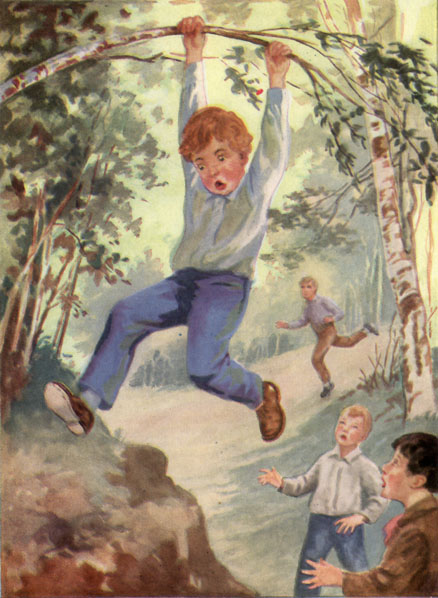
"HOLD ON!" SHOUTED DAN, AND RAN TO THE TREE
"You'll both come down," said Ned, dancing with excitement on the slope underneath, while Nat held out his arms, in the wild hope of breaking the fall.
"That's what I want; stand from under," answered Dan, coolly; and, as he spoke, his added weight bent the tree many feet nearer the earth.
Jack dropped safely; but the birch, lightened of half its load, flew up again so suddenly, that Dan, in the act of swinging round to drop feet foremost, lost his hold and fell heavily.
"I'm not hurt, all right in a minute," he said, sitting up, a little pale and dizzy, as the boys gathered round him, full of admiration and alarm.
"You're a trump, Dan, and I'm ever so much obliged to you," cried Jack, gratefully.
"It wasn't any thing," muttered Dan, rising slowly.
"I say it was, and I'll shake hands with you, though you are–," Ned checked the unlucky word on his tongue, and held out his hand, feeling that it was a handsome thing on his part.
"But I won't shake hands with a sneak;" and Dan turned his back with a look of scorn, that caused Ned to remember the brook, and retire with undignified haste.
"Come home, old chap; I'll give you a lift;" and Nat walked away with him leaving the others to talk over the feat together, to wonder when Dan would "come round," and to wish one and all that Tommy's "confounded money had been in Jericho before it made such a fuss."
When Mr. Bhaer came into school next morning, he looked so happy, that the boys wondered what had happened to him, and really thought he had lost his mind when they saw him go straight to Dan, and, taking him by both hands, say all in one breath, as he shook them heartily,–
"I know all about it, and I beg your pardon. It was like you to do it, and I love you for it, though it's never right to tell lies, even for a friend."
"What is it?" cried Nat, for Dan said not a word, only lifted up his head, as if a weight of some sort had fallen off his back.
"Dan did not take Tommy's money;" and Mr. Bhaer quite shouted it, he was so glad.
"Who did?" cried the boys in a chorus.
Mr. Bhaer pointed to one empty seat, and every eye followed his finger, yet no one spoke for a minute, they were so surprised.
"Jack went home early this morning, but he left this behind him;" and in the silence Mr. Bhaer read the note which he had found tied to his door-handle when he rose.
"I took Tommy's dollar. I was peeking in through a crack and saw him put it there. I was afraid to tell before, though I wanted to. I didn't care so much about Nat, but Dan is a trump, and I can't stand it any longer. I never spent the money; it's under the carpet in my room, right behind the washstand. I'm awful sorry. I am going home, and don't think I shall ever come back, so Dan may have my things.
"JACK"
It was not an elegant confession, being badly written, much blotted, and very short; but it was a precious paper to Dan; and, when Mr. Bhaer paused, the boy went to him, saying, in a rather broken voice, but with clear eyes, and the frank, respectful manner they had tried to teach him,–
"I'll say I'm sorry now, and ask you to forgive me, sir."
"It was a kind lie, Dan, and I can't help forgiving it; but you see it did no good," said Mr. Bhaer, with a hand on either shoulder, and a face full of relief and affection.
"It kept the boys from plaguing Nat. That's what I did it for. It made him right down miserable. I didn't care so much," explained Dan, as if glad to speak out after his hard silence.
"How could you do it? You are always so kind to me," faltered Nat, feeling a strong desire to hug his friend and cry. Two girlish performances, which would have scandalized Dan to the last degree.
"It's all right now, old fellow, so don't be a fool," he said, swallowing the lump in his throat, and laughing out as he had not done for weeks. "Does Mrs. Bhaer know?" he asked, eagerly.
"Yes; and she is so happy I don't know what she will do to you," began Mr. Bhaer, but got no farther, for here the boys came crowding about Dan in a tumult of pleasure and curiosity; but before he had answered more than a dozen questions, a voice cried out,–
"Three cheers for Dan!" and there was Mrs. Jo in the doorway waving her dish-towel, and looking as if she wanted to dance a jig for joy, as she used to do when a girl.
"Now then," cried Mr. Bhaer, and led off a rousing hurrah, which startled Asia in the kitchen, and made old Mr. Roberts shake his head as he drove by, saying,–
"Schools are not what they were when I was young!"
Dan stood it pretty well for a minute, but the sight of Mrs. Jo's delight upset him, and he suddenly bolted across the hall into the parlor, whither she instantly followed, and neither were seen for half an hour.
Mr. Bhaer found it very difficult to calm his excited flock; and, seeing that lessons were an impossibility for a time, he caught their attention by telling them the fine old story of the friends whose fidelity to one another has made their names immortal. The lads listened and remembered, for just then their hearts were touched by the loyalty of a humbler pair of friends. The lie was wrong, but the love that prompted it and the courage that bore in silence the disgrace which belonged to another, made Dan a hero in their eyes. Honesty and honor had a new meaning now; a good name was more precious than gold; for once lost money could not buy it back; and faith in one another made life smooth and happy as nothing else could do.
Tommy proudly restored the name of the firm; Nat was devoted to Dan; and all the boys tried to atone to both for former suspicion and neglect. Mrs. Jo rejoiced over her flock, and Mr. Bhaer was never tired of telling the story of his young Damon and Pythias.
CHAPTER XV
IN THE WILLOW
THE old tree saw and heard a good many little scenes and confidences that summer, because it became the favorite retreat of all the children, and the willow seemed to enjoy it, for a pleasant welcome always met them, and the quiet hours spent in its arms did them all good. It had a great deal of company one Saturday afternoon, and some little bird reported what went on there.
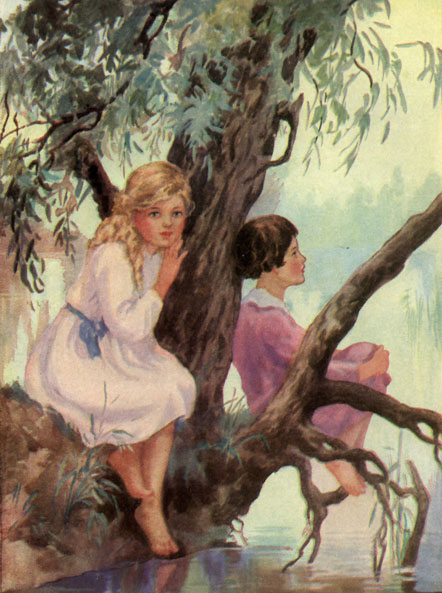
DAISY AND NAN IN THE WILLOW
First came Nan and Daisy with their small tubs and bits of soap, for now and then they were seized with a tidy fit, and washed up all their dolls' clothes in the brook. Asia would not have them "slopping round" in her kitchen, and the bath-room was forbidden since Nan forgot to turn off the water till it overflowed and came gently dripping down through the ceiling. Daisy went systematically to work, washing first the white and then the colored things, rinsing them nicely, and hanging them to dry on a cord fastened from one barberry-bush to another, and pinning them up with a set of tiny clothes-pins Ned had turned for her. But Nan put all her little things to soak in the same tub, and then forgot them while she collected thistledown to stuff a pillow for Semiramis, Queen of Babylon, as one doll was named. This took some time, and when Mrs. Giddy-gaddy came to take out her clothes, deep green stains appeared on every thing, for she had forgotten the green silk lining of a certain cape, and its color had soaked nicely into the pink and blue gowns, the little chemises, and even the best ruffled petticoat.
"Oh me! what a mess!" sighed Nan.
"Lay them on the grass to bleach," said Daisy, with an air of experience.
"So I will, and we can sit up in the nest and watch that they don't blow away."
The Queen of Babylon's wardrobe was spread forth upon the bank, and, turning up their tubs to dry, the little washerwomen climbed into the nest, and fell to talking, as ladies are apt to do in the pauses of domestic labor.
"I'm going to have a feather-bed to go with my new pillow," said Mrs. Giddy-gaddy, as she transferred the thistledown from her pocket to her handkerchief, losing about half in the process.
"I wouldn't; Aunt Jo says feather-beds aren't healthy. I never let my children sleep on any thing but a mattress," returned Mrs. Shakespeare Smith, decidedly.
"I don't care; my children are so strong they often sleep on the floor, and don't mind it," (which was quite true). "I can't afford nine mattresses, and I like to make beds myself."
"Won't Tommy charge for the feathers?"
"May be he will, but I shan't pay him, and he won't care," returned Mrs. G., taking a base advantage of the well-known good nature of T. Bangs.
"I think the pink will fade out of that dress sooner than the green mark will," observed Mrs. S., looking down from her perch, and changing the subject, for she and her gossip differed on many points, and Mrs. Smith was a discreet lady.
"Never mind; I'm tired of dolls, and I guess I shall put them all away and attend to my farm; I like it rather better than playing house," said Mrs. G., unconsciously expressing the desire of many older ladies, who cannot dispose of their families so easily however.
"But you mustn't leave them; they will die without their mother," cried the tender Mrs. Smith.
"Let 'em die then; I'm tired of fussing over babies, and I'm going to play with the boys; they need me to see to 'em," returned the strong-minded lady.
Daisy knew nothing about women's rights; she quietly took all she wanted, and no one denied her claim, because she did not undertake what she could not carry out, but unconsciously used the all-powerful right of her own influence to win from others any privilege for which she had proved her fitness. Nan attempted all sorts of things, undaunted by direful failures, and clamored fiercely to be allowed to do every thing that the boys did. They laughed at her, hustled her out of the way, and protested against her meddling with their affairs. But she would not be quenched and she would be heard, for her will was strong, and she had the spirit of a rampant reformer. Mrs. Bhaer sympathized with her, but tired to curb her frantic desire for entire liberty, showing her that she must wait a little, learn self-control, and be ready to use her freedom before she asked for it. Nan had meek moments when she agreed to this, and the influences at work upon her were gradually taking effect. She no longer declared that she would be engine-driver or a blacksmith, but turned her mind to farming, and found in it a vent for the energy bottled up in her active little body. It did not quite satisfy her, however; for her sage and sweet marjoram were dumb things, and could not thank her for her care. She wanted something human to love, work for, and protect, and was never happier than when the little boys brought their cut fingers, bumped heads, or bruised joints for her to "mend-up." Seeing this, Mrs. Jo proposed that she should learn how to do it nicely, and Nursey had an apt pupil in bandaging, plastering, and fomenting. The boys began to call her "Dr. Giddy-gaddy," and she liked it so well that Mrs. Jo one day said to the Professor–
"Fritz, I see what we can do for that child. She wants something to live for even now, and will be one of the sharp, strong, discontented women if she does not have it. Don't let us snub her restless little nature, but do our best to give her the work she likes, and by and by persuade her father to let her study medicine. She will make a capital doctor, for she has courage, strong nerves, a tender heart, and an intense love and pity for the weak and suffering."
Mr. Bhaer smiled at first, but agreed to try, and gave Nan an herb-garden, teaching her the various healing properties of the plants she tended, and letting her try their virtues on the children in the little illnesses they had from time to time. She learned fast, remembered well, and showed a sense and interest most encouraging to her Professor, who did not shut his door in her face because she was a little woman.
She was thinking of this, as she sat in the willow that day, and when Daisy said in her gentle way–
"I love to keep house, and mean to have a nice one for Demi when we grow up and live together."
Nan replied with decision–
"Well, I haven't got any brother, and I don't want any house to fuss over. I shall have an office, with lots of bottles and drawers and pestle things in it, and I shall drive round in a horse and chaise and cure sick people. That will be such fun."
"Ugh! how can you bear the bad-smelling stuff and the nasty little powders and castor-oil and senna and hive syrup?" cried Daisy, with a shudder.
"I shan't have to take any, so I don't care. Besides, they make people well, and I like to cure folks. Didn't my sage-tea make Mother Bhaer's headache go away, and my hops stop Ned's toothache in five hours? So now!"
"Shall you put leeches on people, and cut off legs and pull out teeth?" asked Daisy, quaking at the thought.
"Yes, I shall do every thing; I don't care if the people are all smashed up, I shall mend them. My grandpa was a doctor, and I saw him sew a great cut in a man's cheek, and I held the sponge, and wasn't frightened a bit, and Grandpa said I was a brave girl."
"How could you? I'm sorry for sick people, and I like to nurse them, but it makes my legs shake so I have to run away. I'm not a brave girl," sighed Daisy.
"Well, you can be my nurse, and cuddle my patients when I have given them the physic and cut off their legs," said Nan, whose practice was evidently to be of the heroic kind.
"Ship ahoy! Where are you, Nan?" called a voice from below.
"Here we are."
"Ay, ay!" said the voice, and Emil appeared holding one hand in the other, with his face puckered up as if in pain.
"Oh, what's the matter?" cried Daisy, anxiously.
"A confounded splinter in my thumb. Can't get it out. Take a pick at it, will you, Nanny?"
"It's in very deep, and I haven't any needle," said Nan, examining a tarry thumb with interest.
"Take a pin," said Emil, in a hurry.
"No, it's too big and hasn't got a sharp point."
Here Daisy, who had dived into her pocket, presented a neat little housewife with four needles in it.
"You are the Posy who always has what we want," said Emil; and Nan resolved to have a needle-book in her own pocket henceforth, for just such cases as this were always occurring in her practice.
Daisy covered her eyes, but Nan probed and picked with a steady hand, while Emil gave directions not down in any medical work or record.
"Starboard now! Steady, boys, steady! Try another tack. Heave ho! there she is!"
"Suck it," ordered the Doctor, surveying the splinter with an experienced eye.
"Too dirty," responded the patient, shaking his bleeding hand.
"Wait; I'll tie it up if you have got a handkerchief."
"Haven't; take one of those rags down there."
"Gracious! no, indeed; they are doll's clothes," cried Daisy, indignantly.
"Take one of mine; I'd like to have you," said Nan; and swinging himself down, Emil caught up the first "rag" he saw. It happened to be the frilled skirt; but Nan tore it up without a murmur; and when the royal petticoat was turned into a neat little bandage, she dismissed her patient with the command–
"Keep it wet, and let it alone; then it will heal right up, and not be sore."
"What do you charge?" asked the Commodore, laughing.
"Nothing; I keep a 'spensary; that is a place where poor people are doctored free gratis for nothing," explained Nan, with an air.
"Thank you, Doctor Giddy-gaddy. I'll always call you in when I come to grief;" and Emil departed, but looked back to say–for one good turn deserves another–"Your duds are blowing away, Doctor."
Forgiving the disrespectful word, "duds," the ladies hastily descended, and, gathering up their wash, retired to the house to fire up the little stove, and go to ironing.
A passing breath of air shook the old willow, as if it laughed softly at the childish chatter which went on in the nest, and it had hardly composed itself when another pair of birds alighted for a confidential twitter.
"Now, I'll tell you the secret," began Tommy, who was "swellin' wisibly" with the importance of his news.
"Tell away," answered Nat, wishing he had brought his fiddle, it was so shady and quiet here.
"Well, we fellows were talking over the late interesting case of circumstantial evidence," said Tommy, quoting at random from a speech Franz had made at the club, "and I proposed giving Dan something to make up for our suspecting him, to show our respect, and so on, you know–something handsome and useful, that he could keep always and be proud of. What do you think we chose?"
"A butterfly-net; he wants one ever so much," said Nat, looking a little disappointed, for he meant to get it himself.
"No, sir; it's to be a microscope, a real swell one, that we see what-do-you-call-'ems in water with, and stars, and ant-eggs, and all sorts of games, you know. Won't it be a jolly good present?" said Tommy, rather confusing microscopes and telescopes in his remarks.
"Tip-top! I'm so glad! Won't it cost a heap, though?" cried Nat, feeling that his friend was beginning to be appreciated.
"Of course it will; but we are all going to give something. I headed the paper with my five dollars; for if it is done at all, it must be done handsome."
"What! all of it? I never did see such a generous chap as you are;" and Nat beamed upon him with sincere admiration.
"Well, you see, I've been so bothered with my property, that I'm tired of it, and don't mean to save up any more, but give it away as I go along, and then nobody will envy me, or want to steal it, and I shan't be suspecting folks and worrying about my old cash," replied Tommy, on whom the cares and anxieties of a millionaire weighed heavily.
"Will Mr. Bhaer let you do it?"
"He thought it was a first-rate plan, and said that some of the best men he knew preferred to do good with their money instead of laying it up to be squabbled over when they died."
"Your father is rich; does he do that way?"
"I'm not sure; he gives me all I want; I know that much. I'm going to talk to him about it when I go home. Anyhow, I shall set him a good example;" and Tommy was so serious, that Nat did not dare to laugh, but said, respectfully–
"You will be able to do ever so much with your money, won't you?"
"So Mr. Bhaer said, and he promised to advise me about useful ways of spending it. I'm going to begin with Dan; and next time I get a dollar or so, I shall do something for Dick, he's such a good little chap, and only has a cent a week for pocket-money. He can't earn much, you know; so I'm going to kind of see to him;" and good-hearted Tommy quite longed to begin.
"I think that's a beautiful plan, and I'm not going to try to buy a fiddle any more; I'm going to get Dan his net all myself, and if there is any money left, I'll do something to please poor Billy. He's fond of me, and though he isn't poor, he'd like some little thing from me, because I can make out what he wants better than the rest of you." And Nat fell to wondering how much happiness could be got out of his precious three dollars.
"So I would. Now come and ask Mr. Bhaer if you can't go in town with me on Monday afternoon, so you can get the net, while I get the microscope. Franz and Emil are going too, and we'll have a jolly time larking round among the shops."
The lads walked away arm-in-arm, discussing the new plans with droll importance, yet beginning already to feel the sweet satisfaction which comes to those who try, no matter how humbly, to be earthly providences to the poor and helpless, and gild their mite with the gold of charity before it is laid up where thieves cannot break through and steal.
"Come up and rest while we sort the leaves; it's so cool and pleasant here," said Demi, as he and Dan came sauntering home from a long walk in the woods.
"All right!" answered Dan, who was a boy of few words, and up they went.
"What makes birch leaves shake so much more than the others?" asked inquiring Demi, who was always sure of an answer from Dan.
"They are hung differently. Don't you see the stem where it joins the leaf is sort of pinched one way, and where it joins the twig, it is pinched another. This makes it waggle with the least bit of wind, but the elm leaves hang straight, and keep stiller."
"How curious! will this do so?" and Demi held up a sprig of acacia, which he had broken from a little tree on the lawn, because it was so pretty.
"No; that belongs to the sort that shuts up when you touch it. Draw your finger down the middle of the stem, and see if the leaves don't curl up," said Dan, who was examining a bit of mica.
Demi tried it, and presently the little leaves did fold together, till the spray showed a single instead of a double line of leaves.
"I like that; tell me about the others. What do these do?" asked Demi, taking up a new branch.
"Feed silk-worms; they live on mulberry leaves, till they begin to spin themselves up. I was in a silk-factory once, and there were rooms full of shelves all covered with leaves, and worms eating them so fast that it made a rustle. Sometimes they eat so much they die. Tell that to Stuffy," and Dan laughed, as he took up another bit of rock with a lichen on it.
"I know one thing about this mullein leaf: the fairies use them for blankets," said Demi, who had not quite given up his faith in the existence of the little folk in green.
"If I had a microscope, I'd show you something prettier than fairies," said Dan, wondering if he should ever own that coveted treasure. "I knew an old woman who used mullein leaves for a night-cap because she had face-ache. She sewed them together, and wore it all the time."
"How funny! was she your grandmother?"
"Never had any. She was a queer old woman, and lived alone in a little tumble-down house with nineteen cats. Folks called her a witch, but she wasn't, though she looked like an old rag-bag. She was real kind to me when I lived in that place, and used to let me get warm at her fire when the folks at the poorhouse were hard on me."
"Did you live in a poorhouse?"
"A little while. Never mind that–I didn't mean to speak of it;" and Dan stopped short in his unusual fit of communicativeness.
"Tell about the cats, please," said Demi, feeling that he had asked an unpleasant question, and sorry for it.
"Nothing to tell; only she had a lot of 'em, and kept 'em in a barrel nights; and I used to go and tip over the barrel sometimes, and let 'em out all over the house, and then she'd scold, and chase 'em and put 'em in again, spitting and yowling like fury."
"Was she good to them?" asked Demi, with a hearty child's laugh, pleasant to hear.
"Guess she was. Poor old soul! she took in all the lost and sick cats in the town; and when anybody wanted one they went to Marm Webber, and she let 'em pick any kind and color they wanted, and only asked ninepence,–she was glad to have her pussies get a good home."
"I should like to see Marm Webber. Could I, if I went to that place?"
"She's dead. All my folks are," said Dan, briefly.
"I'm sorry;" and Demi sat silent a minute, wondering what subject would be safe to try next. He felt delicate about speaking of the departed lady, but was very curious about the cats, and could not resist asking softly–
"Did she cure the sick ones?"
"Sometimes. One had a broken leg, and she tied it up to a stick, and it got well; and another had fits, and she doctored it with yarbs till it was cured. But some of 'em died, and she buried 'em; and when they couldn't get well, she killed 'em easy."
"How?" asked Demi, feeling that there was a peculiar charm about this old woman, and some sort of joke about the cats, because Dan was smiling to himself.
"A kind lady, who was fond of cats, told her how, and gave her some stuff, and sent all her own pussies to be killed that way. Marm used to put a sponge wet with ether, in the bottom of an old boot, then poke puss in head downwards. The ether put her to sleep in a jiffy, and she was drowned in warm water before she woke up."
"I hope the cats didn't feel it. I shall tell Daisy about that. You have known a great many interesting things, haven't you?" asked Demi, and fell to meditating on the vast experience of a boy who had run away more than once, and taken care of himself in a big city.
"Wish I hadn't sometimes."
"Why? Don't remembering them feel good?"
"No."
"It's very singular how hard it is to manage your mind," said Demi, clasping his hands round his knees, and looking up at the sky as if for information upon his favorite topic.
"Devilish hard–no, I don't mean that;" and Dan bit his lips, for the forbidden word slipped out in spite of him, and he wanted to be more careful with Demi than with any of the other boys.
"I'll play I didn't hear it," said Demi; "and you won't do it again, I'm sure."
"Not if I can help it. That's one of the things I don't want to remember. I keep pegging away, but it don't seem to do much good;" and Dan looked discouraged.
"Yes, it does. You don't say half so many bad words as you used to; and Aunt Jo is pleased, because she said it was a hard habit to break up."
"Did she?" and Dan cheered up a bit.
"You must put swearing away in your fault-drawer, and lock it up; that's the way I do with my badness."
"What do you mean?" asked Dan, looking as if he found Demi almost as amusing as a new sort of cockchafer or beetle.
"Well, it's one of my private plays, and I'll tell you, but I think you'll laugh at it," began Demi, glad to hold forth on this congenial subject. "I play that my mind is a round room, and my soul is a little sort of creature with wings that lives in it. The walls are full of shelves and drawers, and in them I keep my thoughts, and my goodness and badness, and all sorts of things. The goods I keep where I can see them, and the bads I lock up tight, but they get out, and I have to keep putting them in and squeezing them down, they are so strong. The thoughts I play with when I am alone or in bed, and I make up and do what I like with them. Every Sunday I put my room in order, and talk with the little spirit that lives there, and tell him what to do. He is very bad sometimes, and won't mind me, and I have to scold him, and take him to Grandpa. He always makes him behave, and be sorry for his faults, because Grandpa likes this play, and gives me nice things to put in the drawers, and tells me how to shut up the naughties. Hadn't you better try that way? It's a very good one;" and Demi looked so earnest and full of faith, that Dan did not laugh at his quaint fancy, but said, soberly,–
"I don't think there is a lock strong enough to keep my badness shut up. Any way my room is in such a clutter I don't know how to clear it up."
"You keep your drawers in the cabinet all spandy nice; why can't you do the others?"
"I ain't used to it. Will you show me how?" and Dan looked as if inclined to try Demi's childish way of keeping a soul in order.
"I'd love to, but I don't know how, except to talk as Grandpa does. I can't do it good like him, but I'll try."
"Don't tell any one; only now and then we'll come here and talk things over, and I'll pay you for it by telling all I know about my sort of things. Will that do?" and Dan held out his big, rough hand.
Demi gave his smooth, little hand readily, and the league was made; for in the happy, peaceful world where the younger boy lived, lions and lambs played together, and little children innocently taught their elders.
"Hush!" said Dan, pointing toward the house, as Demi was about to indulge in another discourse on the best way of getting badness down, and keeping it down; and peeping from their perch, they saw Mrs. Jo strolling slowly along, reading as she went, while Teddy trotted behind her, dragging a little cart upside down.
"Wait till they see us," whispered Demi, and both sat still as the pair came nearer, Mrs. Jo so absorbed in her book that she would have walked into the brook if Teddy had not stopped her by saying–
"Marmar, I wanter fis."
Mrs. Jo put down the charming book which she had been trying to read for a week, and looked about her for a fishing-pole, being used to making toys out of nothing. Before she had broken one from the hedge, a slender willow bough fell at her feet; and, looking up, she saw the boys laughing in the nest.
"Up! up!" cried Teddy, stretching his arms and flapping his skirts as if about to fly.
"I'll come down and you come up. I must go to Daisy now;" and Demi departed to rehearse the tale of the nineteen cats, with the exciting boot-and-barrel episodes.
Teddy was speedily whisked up; and then Dan said, laughing, "Come, too; there's plenty of room. I'll lend you a hand."
Mrs. Jo glanced over her shoulder, but no one was in sight; and rather liking the joke of the thing, she laughed back, saying, "Well, if you won't mention it, I think I will;" and with two nimble steps was in the willow.
"I haven't climbed a tree since I was married. I used to be very fond of it when I was a girl," she said, looking well-pleased with her shady perch.
"Now, you read if you want to, and I'll take care of Teddy," proposed Dan, beginning to make a fishing-rod for impatient Baby.
"I don't think I care about it now. What were you and Demi at up here?" asked Mrs. Jo, thinking, from the sober look on Dan's face, that he had something on his mind.
"Oh! we were talking. I'd been telling him about leaves and things, and he was telling me some of his queer plays. Now, then, Major, fish away;" and Dan finished off his work by putting a big blue fly on the bent pin which hung at the end of the cord he had tied to the willow-rod.
Teddy leaned down from the tree, and was soon wrapt up in watching for the fish which he felt sure would come. Dan held him by his little petticoats, lest he should take a "header" into the brook, and Mrs. Jo soon won him to talk by doing so herself.
"I am so glad you told Demi about 'leaves and things;' it is just what he needs; and I wish you would teach him, and take him to walk with you."
"I'd like to, he is so bright; but–"
"But what?"
"I didn't think you'd trust me."
"Why not?"
"Well, Demi is so kind of precious, and so good, and I'm such a bad lot, I thought you'd keep him away from me."
"But you are not a 'bad lot,' as you say; and I do trust you, Dan, entirely, because you honestly try to improve, and do better and better every week."
"Really?" and Dan looked up at her with the cloud of despondency lifting from his face.
"Yes; don't you feel it?"
"I hoped so, but I didn't know."
"I have been waiting and watching quietly, for I thought I'd give you a good trial first; and if you stood it, I would give you the best reward I had. You have stood it well; and now I'm going to trust not only Demi, but my own boy, to you, because you can teach them some things better than any of us."
"Can I?" and Dan looked amazed at the idea.
"Demi has lived among older people so much that he needs just what you have–knowledge of common things, strength, and courage. He thinks you are the bravest boy he ever saw, and admires your strong way of doing things. Then you know a great deal about natural objects, and can tell him more wonderful tales of birds, and bees, and leaves, and animals, than his story-books give him; and, being true, these stories will teach and do him good. Don't you see now how much you can help him, and why I like to have him with you?"
"But I swear sometimes, and might tell him something wrong. I wouldn't mean to, but it might slip out, just as 'devil' did a few minutes ago," said Dan, anxious to do his duty, and let her know his shortcomings.
"I know you try not to say or do any thing to harm the little fellow, and here is where I think Demi will help you, because he is so innocent and wise in his small way, and has what I am trying to give you, dear,–good principles. It is never too early to try and plant them in a child, and never too late to cultivate them in the most neglected person. You are only boys yet; you can teach one another. Demi will unconsciously strengthen your moral sense, you will strengthen his common sense, and I shall feel as if I had helped you both."
Words could not express how pleased and touched Dan was by this confidence and praise. No one had ever trusted him before, no one had cared to find out and foster the good in him, and no one had suspected how much there was hidden away in the breast of the neglected boy, going fast to ruin, yet quick to feel and value sympathy and help. No honor that he might earn hereafter would ever be half so precious as the right to teach his few virtues and small store of learning to the child whom he most respected; and no more powerful restraint could have been imposed upon him than the innocent companion confided to his care. He found courage now to tell Mrs. Jo of the plan already made with Demi, and she was glad that the first step had been so naturally taken. Every thing seemed to be working well for Dan, and she rejoiced over him, because it had seemed a hard task, yet, working on with a firm belief in the possibility of reformation in far older and worse subjects than he, there had come this quick and hopeful change to encourage her. He felt that he had friends now and a place in the world, something to live and work for, and, though he said little, all that was best and bravest in a character made old by a hard experience responded to the love and faith bestowed on him, and Dan's salvation was assured.
Their quiet talk was interrupted by a shout of delight from Teddy, who, to the surprise of every one, did actually catch a trout where no trout had been seen for years. He was so enchanted with his splendid success that he insisted on showing his prize to the family before Asia cooked it for supper; so the three descended and went happily away together, all satisfied with the work of that half hour.
Ned was the next visitor to the tree, but he only made a short stay, sitting there at his ease while Dick and Dolly caught a pailful of grasshoppers and crickets for him. He wanted to play a joke on Tommy, and intended to tuck up a few dozen of the lively creatures in his bed, so that when Bangs got in he would speedily tumble out again, and pass a portion of the night in chasing "hopper-grasses" round the room. The hunt was soon over, and having paid the hunters with a few peppermints apiece Ned retired to make Tommy's bed.
For an hour the old willow sighed and sung to itself, talked with the brook, and watched the lengthening shadows as the sun went down. The first rosy color was touching its graceful branches when a boy came stealing up the avenue, across the lawn, and, spying Billy by the brook-side, went to him, saying, in a mysterious tone,–
"Go and tell Mr. Bhaer I want to see him down here, please. Don't let any one hear."
Billy nodded and ran off, while the boy swung himself up into the tree, and sat there looking anxious, yet evidently feeling the charm of the place and hour. In five minutes, Mr. Bhaer appeared, and, stepping up on the fence, leaned into the nest, saying, kindly,–
"I am glad to see you, Jack; but why not come in and meet us all at once?"
"I wanted to see you first, please, sir. Uncle made me come back. I know I don't deserve any thing, but I hope the fellows won't be hard upon me."
Poor Jack did not get on very well, but it was evident that he was sorry and ashamed, and wanted to be received as easily as possible; for his Uncle had thrashed him well and scolded him soundly for following the example he himself set. Jack had begged not to be sent back, but the school was cheap, and Mr. Ford insisted, so the boy returned as quietly as possible, and took refuge behind Mr. Bhaer.
"I hope not, but I can't answer for them, though I will see that they are not unjust. I think, as Dan and Nat have suffered so much, being innocent, you should suffer something, being guilty. Don't you?" asked Mr. Bhaer, pitying Jack, yet feeling he deserved punishment for a fault which had so little excuse.
"I suppose so, but I sent Tommy's money back, and I said I was sorry, isn't that enough?" said Jack, rather sullenly; for the boy who could do so mean a thing was not brave enough to bear the consequences well.
"No; I think you should ask pardon of all three boys, openly and honestly. You cannot expect them to respect and trust you for a time, but you can live down this disgrace if you try, and I will help you. Stealing and lying are detestable sins, and I hope this will be a lesson to you. I am glad you are ashamed, it is a good sign; bear it patiently, and do your best to earn a better reputation."
"I'll have an auction, and sell off all my goods dirt cheap," said Jack, showing his repentance in the most characteristic way.
"I think it would be better to give them away, and begin on a new foundation. Take 'Honesty is the best policy' for your motto, and live up to it in act, and word, and thought, and though you don't make a cent of money this summer, you will be a rich boy in the autumn," said Mr. Bhaer, earnestly.
It was hard, but Jack consented, for he really felt that cheating didn't pay, and wanted to win back the friendship of the boys. His heart clung to his possessions, and he groaned inwardly at the thought of actually giving away certain precious things. Asking pardon publicly was easy compared to this; but then he began to discover that certain other things, invisible, but most valuable, were better property than knives, fish-hooks, or even money itself. So he decided to buy up a little integrity, even at a high price, and secure the respect of his playmates, though it was not a salable article.
"Well, I'll do it," he said, with a sudden air of resolution, which pleased Mr. Bhaer.
"Good! and I'll stand by you. Now come and begin at once."
And Father Bhaer led the bankrupt boy back into the little world, which received him coldly at first, but slowly warmed to him, when he showed that he had profited by the lesson, and was sincerely anxious to go into a better business with a new stock-in-trade.
CHAPTER XVI
TAMING THE COLT
"WHAT in the world is that boy doing?" said Mrs. Jo to herself, as she watched Dan running round the half-mile triangle as if for a wager. He was all alone, and seemed possessed by some strange desire to run himself into a fever, or break his neck; for, after several rounds, he tried leaping walls, and turning somersaults up the avenue, and finally dropped down on the grass before the door as if exhausted.
"Are you training for a race, Dan?" asked Mrs. Jo, from the window where she sat.
He looked up quickly, and stopped panting to answer, with a laugh,–
"No; I'm only working off my steam."
"Can't you find a cooler way of doing it? You will be ill if you tear about so in such warm weather," said Mrs. Jo, laughing also, as she threw him out a great palm-leaf fan.
"Can't help it. I must run somewhere," answered Dan, with such an odd expression in his restless eyes, that Mrs. Jo was troubled, and asked, quickly,–
"Is Plumfield getting too narrow for you?"
"I wouldn't mind if it was a little bigger. I like it though; only the fact is the devil gets into me sometimes, and then I do want to bolt."
The words seemed to come against his will, for he looked sorry the minute they were spoken, and seemed to think he deserved a reproof for his ingratitude. But Mrs. Jo understood the feeling, and though sorry to see it, she could not blame the boy for confessing it. She looked at him anxiously, seeing how tall and strong he had grown, how full of energy his face was, with its eager eyes and resolute mouth; and remembering the utter freedom he had known for years before, she felt how even the gentle restraint of this home would weigh upon him at times when the old lawless spirit stirred in him. "Yes," she said to herself, "my wild hawk needs a larger cage; and yet, if I let him go, I am afraid he will be lost. I must try and find some lure strong enough to keep him safe."
"I know all about it," she added, aloud. "It is not 'the devil,' as you call it, but the very natural desire of all young people for liberty. I used to feel just so, and once, I really did think for a minute that I would bolt."
"Why didn't you?" said Dan, coming to lean on the low window-ledge, with an evident desire to continue the subject.
"I knew it was foolish, and love for my mother kept me at home."
"I haven't got any mother," began Dan.
"I thought you had now," said Mrs. Jo, gently stroking the rough hair off his hot forehead.
"You are no end good to me, and I can't ever thank you enough, but it just isn't the same, is it?" and Dan looked up at her with a wistful, hungry look that went to her heart.
"No, dear, it is not the same, and never can be. I think an own mother would have been a great deal to you. But as that cannot be, you must try to let me fill her place. I fear I have not done all I ought, or you would not want to leave me," she added, sorrowfully.
"Yes, you have!" cried Dan, eagerly. "I don't want to go, and I won't go, if I can help it; but every now and then I feel as if I must burst out somehow. I want to run straight ahead somewhere, to smash something, or pitch into somebody. Don't know why, but I do, and that's all about it."
Dan laughed as he spoke, but he meant what he said, for he knit his black brows, and brought down his fist on the ledge with such force, that Mrs. Jo's thimble flew off into the grass. He brought it back, and as she took it she held the big, brown hand a minute, saying, with a look that showed the words cost her something–
"Well, Dan, run if you must, but don't run very far; and come back to me soon, for I want you very much."
He was rather taken aback by this unexpected permission to play truant, and somehow it seemed to lessen his desire to go. He did not understand why, but Mrs. Jo did, and, knowing the natural perversity of the human mind, counted on it to help her now. She felt instinctively that the more the boy was restrained the more he would fret against it; but leave him free, and the mere sense of liberty would content him, joined to the knowledge that his presence was dear to those whom he loved best. It was a little experiment, but it succeeded, for Dan stood silent a moment, unconsciously picking the fan to pieces and turning the matter over in his mind. He felt that she appealed to his heart and his honor, and owned that he understood it by saying presently, with a mixture of regret and resolution in his face,–
"I won't go yet awhile, and I'll give you fair warning before I bolt. That's fair, isn't it?"
"Yes, we will let it stand so. Now, I want to see if I can't find some way for you to work off your steam better than running about the place like a mad dog, spoiling my fans, or fighting with the boys. What can we invent?" and while Dan tried to repair the mischief he had done, Mrs. Jo racked her brain for some new device to keep her truant safe until he had learned to love his lessons better.
"How would you like to be my express-man?" she said, as a sudden thought popped into her head.
"Go into town, and do the errands?" asked Dan, looking interested at once.
"Yes; Franz is tired of it, Silas cannot be spared just now, and Mr. Bhaer has no time. Old Andy is a safe horse, you are a good driver, and know your way about the city as well as a postman. Suppose you try it, and see if it won't do most as well to drive away two or three times a week as to run away once a month."
"I'd like it ever so much, only I must go alone and do it all myself. I don't want any of the other fellows bothering round," said Dan, taking to the new idea so kindly that he began to put on business airs already.
"If Mr. Bhaer does not object you shall have it all your own way. I suppose Emil will growl, but he cannot be trusted with horses, and you can. By the way, to-morrow is market-day, and I must make out my list. You had better see that the wagon is in order, and tell Silas to have the fruit and vegetables ready for mother. You will have to be up early and get back in time for school, can you do that?"
"I'm always an early bird, so I don't mind," and Dan slung on his jacket with despatch.
"The early bird got the worm this time, I'm sure," said Mrs. Jo, merrily.
"And a jolly good worm it is," answered Dan, as he went laughing away to put a new lash to the whip, wash the wagon, and order Silas about with all the importance of a young express-man.
"Before he is tired of this I will find something else and have it ready when the next restless fit comes on," said Mrs. Jo to herself, as she wrote her list with a deep sense of gratitude that all her boys were not Dans.
Mr. Bhaer did not entirely approve of the new plan, but agreed to give it a trial, which put Dan on his mettle, and caused him to give up certain wild plans of his own, in which the new lash and the long hill were to have borne a part. He was up and away very early the next morning, heroically resisting the temptation to race with the milkmen going into town. Once there, he did his errands carefully, to Mr. Bhaer's surprise and Mrs. Jo's great satisfaction. The Commodore did growl at Dan's promotion, but was pacified by a superior padlock to his new boat-house, and the thought that seamen were meant for higher honors than driving market-wagons and doing family errands. So Dan filled his new office well and contentedly for weeks, and said no more about bolting. But one day Mr. Bhaer found him pummelling Jack, who was roaring for mercy under his knee.
"Why, Dan, I thought you had given up fighting," he said, as he went to the rescue.
"We ain't fighting, we are only wrestling," answered Dan, leaving off reluctantly.
"It looks very much like it, and feels like it, hey, Jack?" said Mr. Bhaer, as the defeated gentleman got upon his legs with difficulty.
"Catch me wrestling with him again. He's most knocked my head off," snarled Jack, holding on to that portion of his frame as if it really was loose upon his shoulders.
"The fact is, we began in fun, but when I got him down I couldn't help pounding him. Sorry I hurt you, old fellow," explained Dan, looking rather ashamed of himself.
"I understand. The longing to pitch into somebody was so strong you couldn't resist. You are a sort of Berserker, Dan, and something to tussle with is as necessary to you as music is to Nat," said Mr. Bhaer, who knew all about the conversation between the boy and Mrs. Jo.
"Can't help it. So if you don't want to be pounded you'd better keep out of the way," answered Dan, with a warning look in his black eyes that made Jack sheer off in haste.
"If you want something to wrestle with, I will give you a tougher specimen than Jack," said Mr. Bhaer; and, leading the way to the wood-yard, he pointed out certain roots of trees that had been grubbed up in the spring, and had been lying there waiting to be split.
"There, when you feel inclined to maltreat the boys, just come and work off your energies here, and I'll thank you for it."
"So I will;" and, seizing the axe that lay near Dan hauled out a tough root, and went at it so vigorously, that the chips flew far and wide, and Mr. Bhaer fled for his life.
To his great amusement, Dan took him at his word, and was often seen wrestling with the ungainly knots, hat and jacket off, red face, and wrathful eyes; for he got into royal rages over some of his adversaries, and swore at them under his breath till he had conquered them, when he exulted, and marched off to the shed with an armful of gnarled oak-wood in triumph. He blistered his hands, tired his back, and dulled the axe, but it did him good, and he got more comfort out of the ugly roots than any one dreamed, for with each blow he worked off some of the pent-up power that would otherwise have been expended in some less harmless way.
"When this is gone I really don't know what I shall do," said Mrs. Jo to herself, for no inspiration came, and she was at the end of her resources.
But Dan found a new occupation for himself, and enjoyed it some time before any one discovered the cause of his contentment. A fine young horse of Mr. Laurie's was kept at Plumfield that summer, running loose in a large pasture across the brook. The boys were all interested in the handsome, spirited creature, and for a time were fond of watching him gallop and frisk with his plumey tail flying, and his handsome head in the air. But they soon got tired of it, and left Prince Charlie to himself. All but Dan, he never tired of looking at the horse, and seldom failed to visit him each day with a lump of sugar, a bit of bread, or an apple to make him welcome. Charlie was grateful, accepted his friendship, and the two loved one another as if they felt some tie between them, inexplicable but strong. In whatever part of the wide field he might be, Charlie always came at full speed when Dan whistled at the bars, and the boy was never happier than when the beautiful, fleet creature put its head on his shoulder, looking up at him with fine eyes full of intelligent affection.
"We understand one another without any palaver, don't we, old fellow?" Dan would say, proud of the horse's confidence, and, so jealous of his regard, that he told no one how well the friendship prospered, and never asked anybody but Teddy to accompany him on these daily visits.
Mr. Laurie came now and then to see how Charlie got on, and spoke of having him broken to harness in the autumn.
"He won't need much taming, he is such a gentle, fine-tempered brute. I shall come out and try him with a saddle myself some day," he said, on one of these visits.
"He lets me put a halter on him, but I don't believe he will bear a saddle even if you put it on," answered Dan, who never failed to be present when Charlie and his master met.
"I shall coax him to bear it, and not mind a few tumbles at first. He has never been harshly treated, so, though he will be surprised at the new performance, I think he won't be frightened, and his antics will do no harm."
"I wonder what he would do," said Dan to himself, as Mr. Laurie went away with the Professor, and Charlie returned to the bars, from which he had retired when the gentlemen came up.
A daring fancy to try the experiment took possession of the boy as he sat on the topmost rail with the glossy back temptingly near him. Never thinking of danger, he obeyed the impulse, and while Charlie unsuspectingly nibbled at the apple he held, Dan quickly and quietly took his seat. He did not keep it long, however, for with an astonished snort, Charlie reared straight up, and deposited Dan on the ground. The fall did not hurt him, for the turf was soft, and he jumped up, saying, with a laugh,–
"I did it anyway! Come here, you rascal, and I'll try it again."
But Charlie declined to approach, and Dan left him resolving to succeed in the end; for a struggle like this suited him exactly. Next time he took a halter, and having got it on, he played with the horse for a while, leading him to and fro, and putting him through various antics till he was a little tired; then Dan sat on the wall and gave him bread, but watched his chance, and getting a good grip of the halter, slipped on to his back. Charlie tried the old trick, but Dan held on, having had practice with Toby, who occasionally had an obstinate fit, and tried to shake off his rider. Charlie was both amazed and indignant; and after prancing for a minute, set off at a gallop, and away went Dan heels over head. If he had not belonged to the class of boys who go through all sorts of dangers unscathed, he would have broken his neck; as it was, he got a heavy fall, and lay still collecting his wits, while Charlie tore round the field tossing his head with every sign of satisfaction at the discomfiture of his rider. Presently it seemed to occur to him that something was wrong with Dan, and, being of a magnanimous nature, he went to see what the matter was. Dan let him sniff about and perplex himself for a few minutes; then he looked up at him, saying, as decidedly as if the horse could understand,–
"You think you have beaten, but you are mistaken, old boy; and I'll ride you yet–see if I don't."
He tried no more that day, but soon after attempted a new method of introducing Charlie to a burden. He strapped a folded blanket on his back, and then let him race, and rear, and roll, and fume as much as he liked. After a few fits of rebellion Charlie submitted, and in a few days permitted Dan to mount him, often stopped short to look round, as if he said, half patiently, half reproachfully, "I don't understand it, but I suppose you mean no harm, so I permit the liberty."
Dan patted and praised him, and took a short turn every day, getting frequent falls, but persisting in spite of them, and longing to try a saddle and bridle, but not daring to confess what he had done. He had his wish, however, for there had been a witness of his pranks who said a good word for him.
"Do you know what that chap has ben doin' lately?" asked Silas of his master, one evening, as he received his orders for the next day.
"Which boy?" said Mr. Bhaer, with an air of resignation, expecting some sad revelation.
"Dan, he's ben a breaking the colt, sir, and I wish I may die if he ain't done it," answered Silas, chuckling.
"How do you know?"
"Wal, I kinder keep an eye on the little fellers, and most gen'lly know what they're up to; so when Dan kep going off to the paster, and coming home black and blue, I mistrusted that suthing was goin' on. I didn't say nothin', but I crep up into the barn chamber, and from there I see him goin' through all manner of games with Charlie. Blest if he warn't throwed time and agin, and knocked round like a bag o' meal. But the pluck of that boy did beat all, and he 'peared to like it, and kep on as ef bound to beat."
"But, Silas, you should have stopped it–the boy might have been killed," said Mr. Bhaer, wondering what freak his irrepressibles would take into their heads next.
"S'pose I oughter; but there warn't no real danger, for Charlie ain't no tricks, and is as pretty a tempered horse as ever I see. Fact was, I couldn't bear to spile sport, for ef there's any thing I do admire it's grit, and Dan is chock full on 't. But now I know he's hankerin' after a saddle, and yet won't take even the old one on the sly; so I just thought I'd up and tell, and may be you'd let him try what he can do. Mr. Laurie won't mind, and Charlie's all the better for 't."
"We shall see;" and off went Mr. Bhaer to inquire into the matter.
Dan owned up at once, and proudly proved that Silas was right by showing off his power over Charlie; for by dint of much coaxing, many carrots, and infinite perseverance, he really had succeeded in riding the colt with a halter and blanket. Mr. Laurie was much amused, and well pleased with Dan's courage and skill, and let him have a hand in all future performances; for he set about Charlie's education at once, saying that he was not going to be outdone by a slip of a boy. Thanks to Dan, Charlie took kindly to the saddle and bridle when he had once reconciled himself to the indignity of the bit; and after Mr. Laurie had trained him a little, Dan was permitted to ride him, to the great envy and admiration of the other boys.
"Isn't he handsome? and don't he mind me like a lamb?" said Dan one day as he dismounted and stood with his arm round Charlie's neck.
"Yes, and isn't he a much more useful and agreeable animal than the wild colt who spent his days racing about the field, jumping fences, and running away now and then?" asked Mrs. Bhaer from the steps where she always appeared when Dan performed with Charlie.
"Of course he is. See he won't run away now, even if I don't hold him, and he comes to me the minute I whistle; I have tamed him well, haven't I?" and Dan looked both proud and pleased, as well he might, for, in spite of their struggles together, Charlie loved him better than his master.
"I am taming a colt too, and I think I shall succeed as well as you if I am as patient and persevering," said Mrs. Jo, smiling so significantly at him, that Dan understood and answered, laughing, yet in earnest,–
"We won't jump over the fence and run away, but stay and let them make a handsome, useful span of us, hey, Charlie?"
CHAPTER XVII
COMPOSITION DAY
"HURRY up, boys, it's three o'clock, and Uncle Fritz likes us to be punctual, you know," said Franz one Wednesday afternoon as a bell rang, and a stream of literary-looking young gentlemen with books and paper in their hands were seen going toward the museum.
Tommy was in the school-room, bending over his desk, much bedaubed with ink, flushed with the ardor of inspiration, and in a great hurry as usual, for easy-going Bangs never was ready till the very last minute. As Franz passed the door looking up laggards, Tommy gave one last blot and flourish, and departed out the window, waving his paper to dry as he went. Nan followed, looking very important, with a large roll in her hand, and Demi escorted Daisy, both evidently brimful of some delightful secret.
The museum was all in order, and the sunshine among the hop-vines made pretty shadows on the floor as it peeped through the great window. On one side sat Mr. and Mrs. Bhaer, on the other was a little table on which the compositions were laid as soon as read, and in a large semicircle sat the children on camp-stools which occasionally shut up and let the sitter down, thus preventing any stiffness in the assembly. As it took too much time to have all read, they took turns, and on this Wednesday the younger pupils were the chief performers, while the elder ones listened with condescension and criticised freely.
"Ladies first; so Nan may begin," said Mr. Bhaer, when the settling of stools and rustling of papers had subsided.
Nan took her place beside the little table, and, with a preliminary giggle, read the following interesting essay on
"THE SPONGE
"The sponge, my friends, is a most useful and interesting plant. It grows on rocks under the water, and is a kind of sea-weed, I believe. People go and pick it and dry it and wash it, because little fish and insects live in the holes of the sponge; I found shells in my new one, and sand. Some are very fine and soft; babies are washed with them. The sponge has many uses. I will relate some of them, and I hope my friends will remember what I say. One use is to wash the face; I don't like it myself, but I do it because I wish to be clean. Some people don't, and they are dirty." Here the eye of the reader rested sternly upon Dick and Dolly, who quailed under it, and instantly resolved to scrub themselves virtuously on all occasions. "Another use is to wake people up; I allude to boys par-tic -u-lar-ly." Another pause after the long word to enjoy the smothered laugh that went round the room. "Some boys do not get up when called, and Mary Ann squeezes the water out of a wet sponge on their faces, and it makes them so mad they wake up." Here the laugh broke out, and Emil said, as if he had been hit,–
"Seems to me you are wandering from the subject."
"No, I ain't; we are to write about vegetables or animals, and I'm doing both: for boys are animals, aren't they?" cried Nan; and, undaunted by the indignant "No!" shouted at her, she calmly proceeded,–
"One more interesting thing is done with sponges, and this is when doctors put ether on it, and hold it to people's noses when they have teeth out. I shall do this when I am bigger, and give ether to the sick, so they will go to sleep and not feel me cut off their legs and arms."
"I know somebody who killed cats with it," called out Demi, but was promptly crushed by Dan, who upset his camp-stool and put a hat over his face.
"I will not be interruckted," said Nan, frowning upon the unseemly scrimmagers. Order was instantly restored, and the young lady closed her remarks as follows:–
"My composition has three morals, my friends." Somebody groaned, but no notice was taken of the insult. "First, is keep your faces clean–second, get up early–third, when the ether sponge is put over your nose, breathe hard and don't kick, and your teeth will come out easy. I have no more to say." And Miss Nan sat down amid tumultuous applause.
"That is a very remarkable composition; its tone is high, and there is a good deal of humor in it. Very well done, Nan. Now, Daisy," and Mr. Bhaer smiled at one young lady as he beckoned the other.
Daisy colored prettily as she took her place, and said, in her modest little voice,–
"I'm afraid you won't like mine; it isn't nice and funny like Nan's. But I couldn't do any better."
"We always like yours, Posy," said Uncle Fritz, and a gentle murmur from the boys seemed to confirm the remark. Thus encouraged, Daisy read her little paper, which was listened to with respectful attention.
"THE CAT
"The cat is a sweet animal. I love them very much. They are clean and pretty, and catch rats and mice, and let you pet them, and are fond of you if you are kind. They are very wise, and can find their way anywhere. Little cats are called kittens, and are dear things. I have two, named Huz and Buz, and their mother is Topaz, because she has yellow eyes. Uncle told me a pretty story about a man named Ma-ho-met. He had a nice cat, and when she was asleep on his sleeve, and he wanted to go away, he cut off the sleeve so as not to wake her up. I think he was a kind man. Some cats catch fish."
"So do I!" cried Teddy, jumping up eager to tell about his trout.
"Hush!" said his mother, setting him down again as quickly as possible, for orderly Daisy hated to be "interruckted," as Nan expressed it.
"I read about one who used to do it very slyly. I tried to make Topaz, but she did not like the water, and scratched me. She does like tea, and when I play in my kitchen she pats the teapot with her paw, till I give her some. She is a fine cat, she eats apple-pudding and molasses. Most cats do not."
"That's a first-rater," called out Nat, and Daisy retired, pleased with the praise of her friend.
"Demi looks so impatient we must have him up at once or he won't hold out," said Uncle Fritz, and Demi skipped up with alacrity.
"Mine is a poem!" he announced in a tone of triumph, and read his first effort in a loud and solemn voice:–
"I write about the butterfly,
It is a pretty thing;
And flies about like the birds,
But it does not sing.
"First it is a little grub,
And then it is a nice yellow cocoon,
And then the butterfly
Eats its way out soon.
"They live on dew and honey,
They do not have any hive,
They do not sting like wasps, and bees, and hornets,
And to be as good as they are we should strive.
"I should like to be a beautiful butterfly,
All yellow, and blue, and green, and red;
But I should not like
To have Dan put camphor on my poor little head."
This unusual burst of genius brought down the house, and Demi was obliged to read it again, a somewhat difficult task, as there was no punctuation whatever, and the little poet's breath gave out before he got to the end of some of the long lines.
"He will be a Shakespeare yet," said Aunt Jo, laughing as if she would die, for this poetic gem reminded her of one of her own, written at the age of ten, and beginning gloomily,–
"I wish I had a quiet tomb,
Beside a little rill;
Where birds, and bees, and butterflies,
Would sing upon the hill."
"Come on, Tommy. If there is as much ink inside your paper as there is outside, it will be a long composition," said Mr. Bhaer, when Demi had been induced to tear himself from his poem and sit down.
"It isn't a composition, it's a letter. You see, I forgot all about its being my turn till after school, and then I didn't know what to have, and there wasn't time to read up; so I thought you wouldn't mind my taking a letter that I wrote to my Grandma. It's got something about birds in it, so I thought it would do."
With this long excuse, Tommy plunged into a sea of ink and floundered through, pausing now and then to decipher one of his own flourishes.
"MY DEAR GRANDMA,–I hope you are well. Uncle James sent me a pocket rifle. It is a beautiful little instrument of killing, shaped like this–[Here Tommy displayed a remarkable sketch of what looked like an intricate pump, or the inside of a small steam-engine]–44 are the sights; 6 is a false stock that fits in at A; 3 is the trigger, and 2 is the cock. It loads at the breech, and fires with great force and straightness. I am going out shooting squirrels soon. I shot several fine birds for the museum. They had speckled breasts, and Dan liked them very much. He stuffed them tip-top, and they sit on the tree quite natural, only one looks a little tipsy. We had a Frenchman working here the other day, and Asia called his name so funnily that I will tell you about it. His name was Germain: first she called him Jerry, but we laughed at her, and she changed it to Jeremiah; but ridicule was the result, so it became Mr. Germany; but ridicule having been again resumed, it became Garrymon, which it has remained ever since. I do not write often, I am so busy; but I think of you often, and sympathize with you, and sincerely hope you get on as well as can be expected without me.–Your affectionate grandson,
"THOMAS BUCKMINSTER BANGS.
"P.S. ? If you come across any postage-stamps, remember me.
"N.B.–Love to all, and a great deal to Aunt Almira. Does she make any nice plum-cakes now?
"P.S. ? Mrs. Bhaer sends her respects.
"P.S. ? And so would Mr. B, if he knew I was in act to write.
"N.B.–Father is going to give me a watch on my birthday. I am glad as at present I have no means of telling time, and am often late at school.
"P.S. ? I hope to see you soon. Don't you wish to send for me?
T. B. B."
As each postscript was received with a fresh laugh from the boys, by the time he came to the sixth and last, Tommy was so exhausted that he was glad to sit down and wipe his ruddy face.
"I hope the dear old lady will live through it," said Mr. Bhaer, under cover of the noise.
"We won't take any notice of the broad hint given in that last P.S. The letter will be quite as much as she can bear without a visit from Tommy," answered Mrs. Jo, remembering that the old lady usually took to her bed after a visitation from her irrepressible grandson.
"Now, me," said Teddy, who had learned a bit of poetry, and was so eager to say it that he had been bobbing up and down during the reading, and could no longer be restrained.
"I'm afraid he will forget it if he waits; and I have had a deal of trouble teaching him," said his mother.
Teddy trotted to the rostrum, dropped a curtsey and nodded his head at the same time, as if anxious to suit every one; then, in his baby voice, and putting the emphasis on the wrong words, he said his verse all in one breath:–
"Little drops of water,
Little drains of sand,
Mate a might okum (ocean),
And a peasant land.
"Little words of kindness,
Pokin evvy day,
Make a home a hebbin,
And hep us on a way."
Clapping his hands at the end, he made another double salutation, and then ran to hide his head in his mother's lap, quite overcome by the success of his "piece," for the applause was tremendous.
Dick and Dolly did not write, but were encouraged to observe the habits of animals and insects, and report what they saw. Dick liked this, and always had a great deal to say; so, when his name was called, he marched up, and, looking at the audience with his bright confiding eyes, told his little story so earnestly that no one smiled at his crooked body, because the "straight soul" shone through it beautifully.
"I've been watching dragonflies, and I read about them in Dan's book, and I'll try and tell you what I remember. There's lots of them flying round on the pond, all blue, with big eyes, and sort of lace wings, very pretty. I caught one, and looked at him, and I think he was the handsomest insect I ever saw. They catch littler creatures than they are to eat, and have a queer kind of hook thing that folds up when they ain't hunting. It likes the sunshine, and dances round all day. Let me see! what else was there to tell about? Oh, I know! The eggs are laid in the water, and go down to the bottom, and are hatched in the mud. Little ugly things come out of 'em; I can't say the name, but they are brown, and keep having new skins, and getting bigger and bigger. Only think! it takes them two years to be a dragonfly! Now this is the curiousest part of it, so you listen tight, for I don't believe you know it. When it is ready it knows somehow, and the ugly, grubby thing climbs up out of the water on a flag or a bulrush, and bursts open its back."
"Come, I don't believe that," said Tommy, who was not an observant boy, and really thought Dick was "making up."
"It does burst open its back, don't it?" and Dick appealed to Mr. Bhaer, who nodded a very decided affirmative, to the little speaker's great satisfaction.
"Well, out comes the dragonfly, all whole, and he sits in the sun–sort of coming alive, you know; and he gets strong, and then he spreads his pretty wings, and flies away up in the air, and never is a grub any more. That's all I know; but I shall watch and try to see him do it, for I think it's splendid to turn into a beautiful dragonfly, don't you?"
Dick had told his story well, and, when he described the flight of the new-born insect, had waved his hands, and looked up as if he saw, and wanted to follow it. Something in his face suggested to the minds of the elder listeners the thought that some day little Dick would have his wish, and after years of helplessness and pain would climb up into the sun some happy day, and, leaving his poor little body behind him, find a new lovely shape in a fairer world than this. Mrs. Jo drew him to her side, and said, with a kiss on his thin cheek,–
"That is a sweet little story, dear, and you remembered it wonderfully well. I shall write and tell your mother all about it;" and Dick sat on her knee, contentedly smiling at the praise, and resolving to watch well, and catch the dragonfly in the act of leaving its old body for the new, and see how he did it. Dolly had a few remarks to make upon the "Duck," and made them in a sing-song tone, for he had learned it by heart, and thought it a great plague to do it at all.
"Wild ducks are hard to kill; men hide and shoot at them, and have tame ducks to quack and make the wild ones come where the men can fire at them. They have wooden ducks made too, and they sail round, and the wild ones come to see them; they are stupid, I think. Our ducks are very tame. They eat a great deal, and go poking round in the mud and water. They don't take good care of their eggs, but them spoil, and–"
"Mine don't!" cried Tommy.
"Well, some people's do; Silas said so. Hens take good care of little ducks, only they don't like to have them go in the water, and make a great fuss. But the little ones don't care a bit. I like to eat ducks with stuffing in them and lots of apple-sauce."
"I have something to say about owls," began Nat, who had carefully prepared a paper upon this subject with some help from Dan.
"Owls have big heads, round eyes, hooked bills, and strong claws. Some are gray, some white, some black and yellowish. Their feathers are very soft, and stick out a great deal. They fly very quietly, and hunt bats, mice, little birds, and such things. They build nests in barns, hollow trees, and some take the nests of other birds. The great horned owl has two eggs bigger than a hen's and reddish brown. The tawny owl has five eggs, white and smooth; and this is the kind that hoots at night. Another kind sounds like a child crying. They eat mice and bats whole, and the parts that they cannot digest they make into little balls and spit out."
"My gracious! how funny!" Nan was heard to observe.
"They cannot see by day; and if they get out into the light, they go flapping round half blind, and the other birds chase and peck at them, as if they were making fun. The horned owl is very big, 'most as big as the eagle. It eats rabbits, rats, snakes, and birds; and lives in rocks and old tumble-down houses. They have a good many cries, and scream like a person being choked, and say, 'Waugh O! waugh O!' and it scares people at night in the woods. The white owl lives by the sea, and in cold places, and looks something like a hawk. There is a kind of owl that makes holes to live in like moles. It is called the burrowing owl, and is very small. The barn-owl is the commonest kind; and I have watched one sitting in a hole in a tree, looking like a little gray cat, with one eye shut and the other open. He comes out at dusk, and sits round waiting for the bats. I caught one, and here he is."
With that Nat suddenly produced from inside his jacket a little downy bird, who blinked and ruffled his feathers, looking very plump and sleepy and scared.
"Don't touch him! He is going to show off," said Nat, displaying his new pet with great pride. First he put a cocked hat on the bird's head, and the boys laughed at the funny effect; then he added a pair of paper spectacles, and that gave the owl such a wise look that they shouted with merriment. The performance closed with making the bird angry, and seeing him cling to a handkerchief upside down, pecking and "clucking," as Rob called it. He was allowed to fly after that, and settled himself on the bunch of pine-cones over the door, where he sat staring down at the company with an air of sleepy dignity that amused them very much.
"Have you anything for us, George?" asked Mr. Bhaer, when the room was still again.
"Well, I read and learned ever so much about moles, but I declare I've forgotten every bit of it, except that they dig holes to live in, that you catch them by pouring water down, and that they can't possibly live without eating very often;" and Stuffy sat down, wishing he had not been too lazy to write out his valuable observations, for a general smile went round when he mentioned the last of the three facts which lingered in his memory.
"Then we are done for to-day," began Mr. Bhaer, but Tommy called out in a great hurry,–
"No we ain't. Don't you know? We must give the thing;" and he winked violently as he made an eye-glass of his fingers.
"Bless my heart, I forgot! Now is your time, Tom;" and Mr. Bhaer dropped into his seat again, while all the boys but Dan looked mightily tickled at something.
Nat, Tommy, and Demi left the room, and speedily returned with a little red morocco box set forth in state on Mrs. Jo's best silver salver. Tommy bore it, and, still escorted by Nat and Demi, marched up to unsuspecting Dan, who stared at them as if he thought they were going to make fun of him. Tommy had prepared an elegant and impressive speech for the occasion, but when the minute came, it all went out of his head, and he just said, straight from his kindly boyish heart,–
"Here, old fellow, we all wanted to give you something to kind of pay for what happened awhile ago, and to show how much we liked you for being such a trump. Please take it, and have a jolly good time with it."
Dan was so surprised he could only get as red as the little box, and mutter, "Thanky, boys!" as he fumbled to open it. But when he saw what was inside, his face lighted up, and he seized the long desired treasure, saying so enthusiastically that every one was satisfied, though is language was anything but polished,–
"What a stunner! I say, you fellows are regular bricks to give me this; it's just what I wanted. Give us your paw, Tommy."
Many paws were given, and heartily shaken, for the boys were charmed with Dan's pleasure, and crowded round him to shake hands and expatiate on the beauties of their gift. In the midst of this pleasant chatter, Dan's eye went to Mrs. Jo, who stood outside the group enjoying the scene with all her heart.
"No, I had nothing to do with it. The boys got it up all themselves," she said, answering the grateful look that seemed to thank her for that happy moment. Dan smiled, and said, in a tone that only she could understand,–
"It's you all the same;" and making his way through the boys, he held out his hand first to her and then to the good Professor, who was beaming benevolently on his flock.
He thanked them both with the silent, hearty squeeze he gave the kind hands that had held him up, and led him into the safe refuge of a happy home. Not a word was spoken, but they felt all he would say, and little Teddy expressed his pleasure for them as he leaned from his father's arm to hug the boy, and say, in his baby way,–
"My dood Danny! everybody loves him now."
"Come here, show off your spy-glass, Dan, and let us see some of your magnified pollywogs and annymalcumisms as you call 'em," said Jack, who felt so uncomfortable during this scene that he would have slipped away if Emil had not kept him.
"So I will, take a squint at that and see what you think of it," said Dan, glad to show off his precious microscope.
He held it over a beetle that happened to be lying on the table, and Jack bent down to take his squint, but looked up with an amazed face, saying,–
"My eye! what nippers the old thing has got! I see now why it hurts so confoundedly when you grab a dorbug and he grabs back again."
"He winked at me," cried Nan, who had poked her head under Jack's elbow and got the second peep.
Every one took a look, and then Dan showed them the lovely plumage on a moth's wing, the four feathery corners to a hair, the veins on a leaf, hardly visible to the naked eye, but like a thick net through the wonderful little glass; the skin on their own fingers, looking like queer hills and valleys; a cobweb like a bit of coarse sewing silk, and the sting of a bee.
"It's like the fairy spectacles in my story-book, only more curious," said Demi, enchanted with the wonders he saw.
"Dan is a magician now, and he can show you many miracles going on all round you; for he has two things needful–patience and a love of nature. We live in a beautiful and wonderful world, Demi, and the more you know about it the wiser and the better you will be. This little glass will give you a new set of teachers, and you may learn fine lessons from them if you will," said Mr. Bhaer, glad to see how interested the boys were in the matter.
"Could I see anybody's soul with this microscope if I looked hard?" asked Demi, who was much impressed with the power of the bit of glass.
"No, dear; it's not powerful enough for that, and never can be made so. You must wait a long while before your eyes are clear enough to see the most invisible of God's wonders. But looking at the lovely things you can see will help you to understand the lovelier things you can not see," answered Uncle Fritz, with his hand on the boy's head.
"Well, Daisy and I both think that if there are any angels, their wings look like that butterfly's as we see it through the glass, only more soft and gold."
"Believe it if you like, and keep your own little wings as bright and beautiful, only don't fly away for a long time yet."
"No, I won't," and Demi kept his word.
"Good-by, my boys; I must go now, but I leave you with our new Professor of Natural History;" and Mrs. Jo went away well pleased with that composition day.
CHAPTER XVIII
CROPS
THE gardens did well that summer, and in September the little crops were gathered in with much rejoicing. Jack and Ned joined their farms and raised potatoes, those being a good salable article. They got twelve bushels, counting little ones and all, and sold them to Mr. Bhaer at a fair price, for potatoes went fast in that house. Emil and Franz devoted themselves to corn, and had a jolly little husking in the barn, after which they took their corn to the mill, and came proudly home with meal enough to supply the family with hasty-pudding and Johnny-cake for a lone time. They would not take money for their crop; because, as Franz said, "We never can pay Uncle for all he has done for us if we raised corn for the rest of our days."
Nat had beans in such abundance that he despaired of ever shelling them, till Mrs. Jo proposed a new way, which succeeded admirably. The dry pods were spread upon the barn-floor, Nat fiddled, and the boys danced quadrilles on them, till they were thrashed out with much merriment and very little labor.
Tommy's six weeks' beans were a failure; for a dry spell early in the season hurt them, because he gave them no water; and after that he was so sure that they could take care of themselves, he let the poor things struggle with bugs and weeds till they were exhausted and died a lingering death. So Tommy had to dig his farm over again, and plant peas. But they were late; the birds ate many; the bushes, not being firmly planted, blew down, and when the poor peas came at last, no one cared for them, as their day was over, and spring-lamb had grown into mutton. Tommy consoled himself with a charitable effort; for he transplanted all the thistles he could find, and tended them carefully for Toby, who was fond of the prickly delicacy, and had eaten all he could find on the place. The boys had great fun over Tom's thistle bed; but he insisted that it was better to care for poor Toby than for himself, and declared that he would devote his entire farm next year to thistles, worms, and snails, that Demi's turtles and Nat's pet owl might have the food they loved, as well as the donkey. So like shiftless, kind-hearted, happy-go-lucky Tommy!
Demi had supplied his grandmother with lettuce all summer, and in the autumn sent his grandfather a basket of turnips, each one scrubbed up till it looked like a great white egg. His Grandma was fond of salad, and one of his Grandpa's favorite quotations was–
"Lucullus, whom frugality could charm,
Ate roasted turnips at the Sabine farm."
Therefore these vegetable offerings to the dear domestic god and goddess were affectionate, appropriate, and classical.
Daisy had nothing but flowers in her little plot, and it bloomed all summer long with a succession of gay or fragrant posies. She was very fond of her garden, and delved away in it at all hours, watching over her roses, and pansies, sweet-peas, and mignonette, as faithfully and tenderly as she did over her dolls or her friends. Little nosegays were sent into town on all occasions, and certain vases about the house were her especial care. She had all sorts of pretty fancies about her flowers, and loved to tell the children the story of the pansy, and show them how the step-mother-leaf sat up in her green chair in purple and gold; how the two own children in gay yellow had each its little seat, while the step children, in dull colors, both sat on one small stool, and the poor little father in his red nightcap, was kept out of sight in the middle of the flower; that a monk's dark face looked out of the monk's-hood larkspur; that the flowers of the canary-vine were so like dainty birds fluttering their yellow wings, that one almost expected to see them fly away, and the snapdragons that went off like little pistol-shots when you cracked them. Splendid dollies did she make out of scarlet and white poppies, with ruffled robes tied round the waist with grass blade sashes, and astonishing hats of coreopsis on their green heads. Pea-pod boats, with rose-leaf sails, received these flower-people, and floated them about a placid pool in the most charming style; for finding that there were no elves, Daisy made her own, and loved the fanciful little friends who played their parts in her summer-life.
Nan went in for herbs, and had a fine display of useful plants, which she tended with steadily increasing interest and care. Very busy was she in September cutting, drying, and tying up her sweet harvest, and writing down in a little book how the different herbs are to be used. She had tried several experiments, and made several mistakes; so she wished to be particular lest she should give little Huz another fit by administering wormwood instead of catnip.
Dick, Dolly, and Rob each grubbed away on his small farm, and made more stir about it than all the rest put together. Parsnips and carrots were the crops of the two D.'s; and they longed for it to be late enough to pull up the precious vegetables. Dick did privately examine his carrots, and plant them again, feeling that Silas was right in saying it was too soon for them yet.
Rob's crop was four small squashes and one immense pumpkin. It really was a "bouncer," as every one said; and I assure you that two small persons could sit on it side by side. It seemed to have absorbed all the goodness of the little garden, and all the sunshine that shone down on it, and lay there a great round, golden ball, full of rich suggestions of pumpkin-pies for weeks to come. Robby was so proud of his mammoth vegetable that he took every one to see it, and, when frosts began to nip, covered it up each night with an old bedquilt, tucking it round as if the pumpkin was a well-beloved baby. The day it was gathered he would let no one touch it but himself, and nearly broke his back tugging it to the barn in his little wheelbarrow, with Dick and Dolly harnessed in front to give a heave up the path. His mother promised him that the Thanksgiving-pies should be made from it, and hinted vaguely that she had a plan in her head which would cover the prize pumpkin and its owner with glory.
Poor Billy had planted cucumbers, but unfortunately hoed them up and left the pig-weed. This mistake grieved him very much for tem minutes, then he forgot all about it, and sowed a handful of bright buttons which he had collected, evidently thinking in his feeble mind that they were money, and would come up and multiply, so that he might make many quarters, as Tommy did. No one disturbed him, and he did what he liked with his plot, which soon looked as if a series of small earthquakes had stirred it up. When the general harvest-day came, he would have had nothing but stones and weeds to show, if kind old Asia had not hung half-a-dozen oranges on the dead tree he stuck up in the middle. Billy was delighted with his crop; and no one spoiled his pleasure in the little miracle which pity wrought for him, by making withered branches bear strange fruit.
Stuffy had various trials with his melons; for, being impatient to taste them, he had a solitary revel before they were ripe, and made himself so ill, that for a day or two it seemed doubtful if he would ever eat any more. But he pulled through it, and served up his first cantaloupe without tasting a mouthful himself. They were excellent melons, for he had a warm slope for them, and they ripened fast. The last and best were lingering on the vines, and Stuffy had announced that he should sell them to a neighbor. This disappointed the boys, who had hoped to eat the melons themselves, and they expressed their displeasure in a new and striking manner. Going one morning to gaze upon the three fine watermelons which he had kept for the market, Stuffy was horrified to find the word "PIG" cut in white letters on the green rind, staring at him from every one. He was in a great rage, and flew to Mrs. Jo for redress. She listened, condoled with him, and then said,–
"If you want to turn the laugh, I'll tell you how, but you must give up the melons."
"Well, I will; for I can't thrash all the boys, but I'd like to give them something to remember, the mean sneaks," growled Stuff, still in a fume.
Now Mrs. Jo was pretty sure who had done the trick, for she had seen three heads suspiciously near to one another in the sofa-corner the evening before; and when these heads had nodded with chuckles and whispers, this experienced woman knew mischief was afoot. A moonlight night, a rustling in the old cherry-tree near Emil's window, a cut on Tommy's finger, all helped to confirm her suspicions; and having cooled Stuffy's wrath a little, she bade him bring his maltreated melons to her room, and say not a word to any one of what had happened. He did so, and the three wags were amazed to find their joke so quietly taken. It spoilt the fun, and the entire disappearance of the melons made them uneasy. So did Stuffy's good-nature, for he looked more placid and plump than ever, and surveyed them with an air of calm pity that perplexed them very much.
At dinner-time they discovered why; for then Stuffy's vengeance fell upon them, and the laugh was turned against them. When the pudding was eaten, and the fruit was put on, Mary Ann re-appeared in a high state of giggle, bearing a large watermelon; Silas followed with another; and Dan brought up the rear with a third. One was placed before each of the three guilty lads; and they read on the smooth green skins this addition to their own work, "With the compliments of the PIG." Every one else read it also, and the whole table was in a roar, for the trick had been whispered about; so every one understood the sequel. Emil, Ned, and Tommy did not know where to look, and had not a word to say for themselves; so they wisely joined in the laugh, cut up the melons, and handed them round, saying, what all the rest agreed to, that Stuffy had taken a wise and merry way to return good for evil.
Dan had no garden, for he was away or lame the greater part of the summer; so he had helped Silas wherever he could, chopped wood for Asia, and taken care of the lawn so well, that Mrs. Jo always had smooth paths and nicely shaven turf before her door.
When the others got in their crops, he looked sorry that he had so little to show; but as autumn went on, he bethought himself of a woodland harvest which no one would dispute with him, and which was peculiarly his own. Every Saturday he was away alone to the forests, fields, and hills, and always came back loaded with spoils; for he seemed to know the meadows where the best flag-root grew, the thicket where the sassafras was spiciest, the haunts where the squirrels went for nuts, the white oak whose bark was most valuable, and the little gold-thread vine that Nursey liked to cure the canker with. All sorts of splendid red and yellow leaves did Dan bring home for Mrs. Jo to dress her parlor with,–graceful-seeded grasses, clematis tassels, downy, soft, yellow wax-work berries, and mosses, red-brimmed, white, or emerald green.
"I need not sigh for the woods now, because Dan brings the woods to me," Mrs. Jo used to say, as she glorified the walls with yellow maple boughs and scarlet woodbine wreaths, or filled her vases with russet ferns, hemlock sprays full of delicate cones, and hardy autumn flowers; for Dan's crop suited her well.
The great garret was full of the children's little stores and for a time was one of the sights of the house. Daisy's flower seeds in neat little paper bags, all labelled, lay in a drawer of a three-legged table. Nan's herbs hung in bunches against the wall, filling the air with their aromatic breath. Tommy had a basket of thistle-down with the tiny seeds attached, for he meant to plant them next year, if they did not all fly away before that time. Emil had bunches of pop-corn hanging there to dry, and Demi laid up acorns and different sorts of grain for the pets. But Dan's crop made the best show, for fully one half of the floor was covered with the nuts he brought. All kinds were there, for he ranged the woods for miles round, climbed the tallest trees, and forced his way into the thickest hedges for his plunder. Walnuts, chestnuts, hazelnuts, and beechnuts lay in separate compartments, getting brown, and dry, and sweet, ready for winter revels.
There was one butternut-tree on the place, and Rob and Teddy called it theirs. It bore well this year, and the great dingy nuts came dropping down to hide among the dead leaves, where the busy squirrels found them better than the lazy Bhaers. Their father had told them (the boys, not the squirrels) they should have the nuts if they would pick them up, but no one was to help. It was easy work, and Teddy liked it, only he soon got tired, and left his little basket half full for another day. But the other day was slow to arrive, and, meantime, the sly squirrels were hard at work, scampering up and down the old elm-trees stowing the nuts away till their holes were full, then all about the crotches of the boughs, to be removed at their leisure. Their funny little ways amused the boys, till one day Silas said,–
"Hev you sold them nuts to the squirrels?"
"No," answered Rob, wondering what Silas meant.
"Wal, then, you'd better fly round, or them spry little fellers won't leave you none."
"Oh, we can beat them when we begin. There are such lots of nuts we shall have a plenty."
"There ain't many more to come down, and they have cleared the ground pretty well, see if they hain't."
Robby ran to look, and was alarmed to find how few remained. He called Teddy, and they worked hard all one afternoon, while the squirrels sat on the fence and scolded.
"Now, Ted, we must keep watch, and pick up just as fast as they fall, or we shan't have more than a bushel, and every one will laugh at us if we don't."
"The naughty quillies tarn't have 'em. I'll pick fast and run and put 'em in the barn twick," said Teddy, frowning at little Frisky, who chattered and whisked his tail indignantly.
That night a high wind blew down hundreds of nuts, and when Mrs. Jo came to wake her little sons, she said, briskly,–
"Come, my laddies, the squirrels are hard at it, and you will have to work well to-day, or they will have every nut on the ground."
"No, they won't," and Robby tumbled up in a great hurry, gobbled his breakfast, and rushed out to save his property.
Teddy went too, and worked like a little beaver, trotting to and fro with full and empty baskets. Another bushel was soon put away in the corn-barn, and they were scrambling among the leaves for more nuts when the bell rang for school.
"O father! let me stay out and pick. Those horrid squirrels will have my nuts if you don't. I'll do my lessons by and by," cried Rob, running into the school-room, flushed and tousled by the fresh cold wind and his eager work.
"If you had been up early and done a little every morning there would be no hurry now. I told you that, Rob, and you never minded. I cannot have the lessons neglected as the work has been. The squirrels will get more than their share this year, and they deserve it, for they have worked best. You may go an hour earlier, but that is all," and Mr. Bhaer led Rob to his place where the little man dashed at his books as if bent on making sure of the precious hour promised him.
It was almost maddening to sit still and see the wind shaking down the last nuts, and the lively thieves flying about, pausing now and then to eat one in his face, and flirt their tails, as if they said, saucily, "We'll have them in spite of you, lazy Rob." The only thing that sustained the poor child in this trying moment was the sight of Teddy working away all alone. It was really splendid the pluck and perseverance of the little lad. He picked and picked till his back ached; he trudged to and fro till his small legs were tired; and he defied wind, weariness, and wicked "quillies," till his mother left her work and did the carrying for him, full of admiration for the kind little fellow who tried to help his brother. When Rob was dismissed, he found Teddy reposing in the bushel-basket quite used up, but unwilling to quit the field; for he flapped his hat at the thieves with one grubby little hand, while he refreshed himself with the big apple held in the other.
Rob fell to work and the ground was cleared before two o'clock, the nuts safely in the corn-barn loft, and the weary workers exulted in their success. But Frisky and his wife were not to be vanquished so easily; and when Rob went up to look at his nuts a few days later he was amazed to see how many had vanished. None of the boys could have stolen them, because the door had been locked; the doves could not have eaten them, and there were no rats about. There was great lamentation among the young Bhaers till Dick said–
"I saw Frisky on the roof of the corn-barn, may be he took them."
"I know he did! I'll have a trap, and kill him dead," cried Rob, disgusted with Frisky's grasping nature.
"Perhaps if you watch, you can find out where he puts them, and I may be able to get them back for you," said Dan, who was much amused by the fight between the boys and squirrels.
So Rob watched and saw Mr. and Mrs. Frisky drop from the drooping elm boughs on to the roof of the corn-barn, dodge in at one of the little doors, much to the disturbance of the doves, and come out with a nut in each mouth. So laden they could not get back the way they came, but ran down the low roof, along the wall, and leaping off at a corner they vanished a minute and re-appeared without their plunder. Rob ran to the place, and in a hollow under the leaves he found a heap of the stolen property hidden away to be carried off to the holes by and by.
"Oh, you little villains! I'll cheat you now, and not leave one," said Rob. So he cleared the corner and the corn-barn, and put the contested nuts in the garret, making sure that no broken window-pane could anywhere let in the unprincipled squirrels. They seemed to feel that the contest was over, and retired to their hole, but now and then could not resist throwing down nut-shells on Rob's head, and scolding violently as if they could not forgive him nor forget that he had the best of the battle.
Father and Mother Bhaer's crop was of a different sort, and not so easily described; but they were satisfied with it, felt that their summer work had prospered well, and by and by had a harvest that made them very happy.
CHAPTER XIX
JOHN BROOKE
"WAKE up, Demi, dear! I want you."
"Why, I've just gone to bed; it can't be morning yet;" and Demi blinked like a little owl as he waked from his first sound sleep.
"It's only ten, but your father is ill, and we must go to him. O my little John! my poor little John!" and Aunt Jo laid her head down on the pillow with a sob that scared sleep from Demi's eyes and filled his heart with fear and wonder; for he dimly felt why Aunt Jo called him "John," and wept over him as if some loss had come that left him poor. He clung to her without a word, and in a minute she was quite steady again, and said, with a tender kiss as she saw his troubled face,–
"We are going to say good-by to him, my darling, and there is no time to lose; so dress quickly and come to me in my room. I must go to Daisy."
"Yes, I will;" and when Aunt Jo was gone, little Demi got up quietly, dressed as if in a dream, and leaving Tommy fast asleep went away through the silent house, feeling that something new and sorrowful was going to happen–something that set him apart from the other boys for a time, and made the world seem as dark and still and strange as those familiar rooms did in the night. A carriage sent by Mr. Laurie stood before the door. Daisy was soon ready, and the brother and sister held each other by the hand all the way into town, as they drove swiftly and silently with aunt and uncle through the shadowy roads to say good-by to father.
None of the boys but Franz and Emil knew what had happened, and when they came down next morning, great was their wonderment and discomfort, for the house seemed forlorn without its master and mistress. Breakfast was a dismal meal with no cheery Mrs. Jo behind the teapots; and when school-time came, Father Bhaer's place was empty. They wandered about in a disconsolate kind of way for an hour, waiting for news and hoping it would be all right with Demi's father, for good John Brooke was much beloved by the boys. Ten o'clock came, and no one arrived to relieve their anxiety. They did not feel like playing, yet the time dragged heavily, and they sat about listless and sober. All at once, Franz got up, and said, in his persuasive way,–
"Look here, boys! let's go into school and do our lessons just as if Uncle was here. It will make the day go faster, and will please him, I know."
"But who will hear us say them?" asked Jack.
"I will; I don't know much more than you do, but I'm the oldest here, and I'll try to fill Uncle's place till he comes, if you don't mind."
Something in the modest, serious way Franz said this impressed the boys, for, though the poor lad's eyes were red with quiet crying for Uncle John in that long sad night, there was a new manliness about him, as if he had already begun to feel the cares and troubles of life, and tried to take them bravely.
"I will, for one," and Emil went to his seat, remembering that obedience to his superior officer is a seaman's first duty.
The others followed; Franz took his uncle's seat, and for an hour order reigned. Lessons were learned and said, and Franz made a patient, pleasant teacher, wisely omitting such lessons as he was not equal to, and keeping order more by the unconscious dignity that sorrow gave him than by any words of his own. The little boys were reading when a step was heard in the hall, and every one looked up to read the news in Mr. Bhaer's face as he came in. The kind face told them instantly that Demi had no father now, for it was worn and pale, and full of tender grief, which left him no words with which to answer Rob, as he ran to him, saying, reproachfully,–
"What made you go and leave me in the night, papa?"
The memory of the other father who had left his children in the night, never to return, made Mr. Bhaer hold his own boy close, and, for a minute, hide his face in Robby's curly hair. Emil laid his head down on his arms, Franz, went to put his hand on his uncle's shoulder, his boyish face pale with sympathy and sorrow, and the others sat so still that the soft rustle of the falling leaves outside was distinctly heard.
Rob did not clearly understand what had happened, but he hated to see papa unhappy, so he lifted up the bent head, and said, in his chirpy little voice,–
"Don't cry, mein Vater! we were all so good, we did our lessons, without you, and Franz was the master."
Mr. Bhaer looked up then, tried to smile, and said in a grateful tone that made the lads feel like saints, "I thank you very much, my boys. It was a beautiful way to help and comfort me. I shall not forget it, I assure you."
"Franz proposed it, and was a first-rate master, too," said Nat; and the others gave a murmur of assent most gratifying to the young dominie.
Mr. Bhaer put Rob down, and, standing up, put his arm round his tall nephew's shoulder, as he said, with a look of genuine pleasure,–
"This makes my hard day easier, and gives me confidence in you all. I am needed there in town, and must leave you for some hours. I thought to give you a holiday, or send some of you home, but if you like to stay and go on as you have begun, I shall be glad and proud of my good boys."
"We'll stay;" "We'd rather;" "Franz can see to us;" cried several, delighted with the confidence shown in them.
"Isn't Marmar coming home?" asked Rob, wistfully; for home without "Marmar" was the world without the sun to him.
"We shall both come to-night; but dear Aunt Meg needs Mother more than you do now, and I know you like to lend her for a little while."
"Well, I will; but Teddy's been crying for her, and he slapped Nursey, and was dreadful naughty," answered Rob, as if the news might bring mother home.
"Where is my little man?" asked Mr. Bhaer.
"Dan took him out, to keep him quiet. He's all right now," said Franz, pointing to the window, through which they could see Dan drawing baby in his little wagon, with the dogs frolicking about him.
"I won't see him, it would only upset him again; but tell Dan I leave Teddy in his care. You older boys I trust to manage yourselves for a day. Franz will direct you, and Silas is here to over see matters. So good-by till to-night."
"Just tell me a word about Uncle John," said Emil, detaining Mr. Bhaer, as he was about hurrying away again.
"He was only ill a few hours, and died as he has lived, so cheerfully, so peacefully, that it seems a sin to mar the beauty of it with any violent or selfish grief. We were in time to say good-by: and Daisy and Demi were in his arms as he fell asleep on Aunt Meg's breast. No more now, I cannot bear it," and Mr. Bhaer went hastily away quite bowed with grief, for in John Brooke he had lost both friend and brother, and there was no one left to take his place.
All that day the house was very still; the small boys played quietly in the nursery; the others, feeling as if Sunday had come in the middle of the week, spent it in walking, sitting in the willow, or among their pets, all talking much of "Uncle John," and feeling that something gentle, just, and strong, had gone out of their little world, leaving a sense of loss that deepened every hour. At dusk, Mr. and Mrs. Bhaer came home alone, for Demi and Daisy were their mother's best comfort now, and could not leave her. Poor Mrs. Jo seemed quite spent, and evidently needed the same sort of comfort, for her first words, as she came up the stairs, were, "Where is my baby?"
"Here I is," answered a little voice, as Dan put Teddy into her arms, adding, as she hugged him close, "My Danny tooked tare of me all day, and I was dood."
Mrs. Jo turned to thank the faithful nurse, but Dan was waving off the boys, who had gathered in the hall to meet her, and was saying, in a low voice, "Keep back; she don't want to be bothered with us now."
"No, don't keep back. I want you all. Come in and see me, my boys. I've neglected you all day," and Mrs. Jo held out her hands to them as they gathered round and escorted her into her own room, saying little, but expressing much by affectionate looks and clumsy little efforts to show their sorrow and sympathy.
"I am so tired, I will lie here and cuddle Teddy, and you shall bring me in some tea," she said, trying to speak cheerfully for their sakes.
A general stampede into the dining-room followed, and the supper-table would have been ravaged if Mr. Bhaer had not interfered. It was agreed that one squad should carry in the mother's tea, and another bring it out. The four nearest and dearest claimed the first honor, so Franz bore the teapot, Emil the bread, Rob the milk, and Teddy insisted on carrying the sugar basin, which was lighter by several lumps when it arrived than when it started. Some women might have found it annoying at such a time to have boys creaking in and out, upsetting cups and rattling spoons in violent efforts to be quiet and helpful; but it suited Mrs. Jo, because just then her heart was very tender; and remembering that many of her boys were fatherless or motherless, she yearned over them, and found comfort in their blundering affection. It was the sort of food that did her more good than the very thick bread-and-butter that they gave her, and the rough Commodore's broken whisper,–
"Bear up, Aunty, it's a hard blow; but we'll weather it somehow;" cheered her more than the sloppy cup he brought her, full of tea as bitter as if some salt tear of his own had dropped into it on the way. When supper was over, a second deputation removed the tray; and Dan said, holding out his arms for sleepy little Teddy,–
"Let me put him to bed, you're so tired, Mother."
"Will you go with him, lovey?" asked Mrs. Jo of her small lord and master, who lay on her arm among the sofa-pillows.
"Torse I will;" and he was proudly carried off by his faithful bearer.
"I wish I could do something," said Nat, with a sigh, as Franz leaned over the sofa, and softly stroked Aunt Jo's hot forehead.
"You can, dear. Go and get your violin, and play me the sweet little airs Uncle Teddy sent you last. Music will comfort me better than any thing else to-night."
Nat flew for his fiddle, and, sitting just outside her door, played as he had never done before, for now his heart was in it, and seemed to magnetize his fingers. The other lads sat quietly upon the steps, keeping watch that no new-comer should disturb the house; Franz lingered at his post; and so, soothed, served, and guarded by her boys, poor Mrs. Jo slept at last, and forgot her sorrow for an hour.
Two quiet days, and on the third Mr. Bhaer came in just after school, with a note in his hand, looking both moved and pleased.
"I want to read you something, boys," he said; and as they stood round him he read this:–
"DEAR BROTHER FRITZ,–I hear that you do not mean to bring your flock today, thinking that I may not like it. Please do. The sight of his friends will help Demi through the hard hour, and I want the boys to hear what father says of my John. It will do them good, I know. If they would sing one of the sweet old hymns you have taught them so well, I should like it better than any other music, and feel that it was beautifully suited to the occasion. Please ask them, with my love.
MEG."
"Will you go?" and Mr. Bhaer looked at the lads, who were greatly touched by Mrs. Brooke's kind words and wishes.
"Yes," they answered, like one boy; and an hour later they went away with Franz to bear their part in John Brooke's simple funeral.
The little house looked as quiet, sunny, and home-like as when Meg entered it as a bride, ten years ago, only then it was early summer, and rose blossomed everywhere; now it was early autumn, and dead leaves rustled softly down, leaving the branches bare. The bride was a widow now; but the same beautiful serenity shone in her face, and the sweet resignation of a truly pious soul made her presence a consolation to those who came to comfort her.
"O Meg! how can you bear it so?" whispered Jo, as she met them at the door with a smile of welcome, and no change in her gentle manner, except more gentleness.
"Dear Jo, the love that has blest me for ten happy years supports me still. It could not die, and John is more my own than ever," whispered Meg; and in her eyes the tender trust was so beautiful and bright, that Jo believed her, and thanked God for the immortality of love like hers.
They were all there–father and mother, Uncle Teddy, and Aunt Amy, old Mr. Laurence, white-haired and feeble now, Mr. and Mrs. Bhaer, with their flock, and many friends, come to do honor to the dead. One would have said that modest John Brooke, in his busy, quiet, humble life, had had little time to make friends; but now they seemed to start up everywhere,–old and young, rich and poor, high and low; for all unconsciously his influence had made itself widely felt, his virtues were remembered, and his hidden charities rose up to bless him. The group about his coffin was a far more eloquent eulogy than any Mr. March could utter. There were the rich men whom he had served faithfully for years; the poor old women whom he cherished with his little store, in memory of his mother; the wife to whom he had given such happiness that death could not mar it utterly; the brothers and sisters in whose hearts he had made a place for ever; the little son and daughter, who already felt the loss of his strong arm and tender voice; the young children, sobbing for their kindest playmate, and the tall lads, watching with softened faces a scene which they never could forget. A very simple service, and very short; for the fatherly voice that had faltered in the marriage-sacrament now failed entirely as Mr. March endeavored to pay his tribute of reverence and love to the son whom he most honored. Nothing but the soft coo of Baby Josy's voice up-stairs broke the long hush that followed the last Amen, till, at a sign from Mr. Bhaer, the well-trained boyish voices broke out in a hymn, so full of lofty cheer, that one by one all joined in it, singing with full hearts, and finding their troubled spirits lifted into peace on the wings of that brave, sweet psalm.
As Meg listened, she felt that she had done well; for not only did the moment comfort her with the assurance that John's last lullaby was sung by the young voices he loved so well, but in the faces of the boys she saw that they had caught a glimpse of the beauty of virtue in its most impressive form, and that the memory of the good man lying dead before them would live long and helpfully in their remembrance. Daisy's head lay in her lap, and Demi held her hand, looking often at her, with eyes so like his father's, and a little gesture that seemed to say, "Don't be troubled, mother; I am here;" and all about her were friends to lean upon and love; so patient, pious Meg put by her heavy grief, feeling that her best help would be to live for others, as her John had done.
That evening, as the Plumfield boys sat on the steps, as usual, in the mild September moonlight, they naturally fell to talking of the event of the day.
Emil began by breaking out, in his impetuous way, "Uncle Fritz is the wisest, and Uncle Laurie the jolliest, but Uncle John was the best; and I'd rather be like him than any man I ever saw."
"So would I. Did you hear what those gentlemen said to Grandpa to-day? I would like to have that said of me when I was dead;" and Franz felt with regret that he had not appreciated Uncle John enough.
"What did they say?" asked Jack, who had been much impressed by the scenes of the day.
"Why, one of the partners of Mr. Laurence, where Uncle John has been ever so long, was saying that he was conscientious almost to a fault as a business man, and above reproach in all things. Another gentleman said no money could repay the fidelity and honesty with which Uncle John had served him, and then Grandpa told them the best of all. Uncle John once had a place in the office of a man who cheated, and when this man wanted uncle to help him do it, uncle wouldn't, though he was offered a big salary. The man was angry and said, 'You will never get on in business with such strict principles;' and uncle answered back, 'I never will try to get on without them,' and left the place for a much harder and poorer one."
"Good!" cried several of the boys warmly, for they were in the mood to understand and value the little story as never before.
"He wasn't rich, was he?" asked Jack.
"No."
"He never did any thing to make a stir in the world, did he?"
"No."
"He was only good?"
"That's all;" and Franz found himself wishing that Uncle John had done something to boast of, for it was evident that Jack was disappointed by his replies.
"Only good. That is all and every thing," said Mr. Bhaer, who had overheard the last few words, and guessed what was going on the minds of the lads.
"Let me tell you a little about John Brooke, and you will see why men honor him, and why he was satisfied to be good rather than rich or famous. He simply did his duty in all things, and did it so cheerfully, so faithfully, that it kept him patient and brave, and happy through poverty and loneliness and years of hard work. He was a good son, and gave up his own plans to stay and live with his mother while she needed him. He was a good friend, and taught Laurie much beside his Greek and Latin, did it unconsciously, perhaps, by showing him an example of an upright man. He was a faithful servant, and made himself so valuable to those who employed him that they will find it hard to fill his place. He was a good husband and father, so tender, wise, and thoughtful, that Laurie and I learned much of him, and only knew how well he loved his family, when we discovered all he had done for them, unsuspected and unassisted."
Mr. Bhaer stopped a minute, and the boys sat like statues in the moonlight until he went on again, in a subdued, but earnest voice: "As he lay dying, I said to him, 'Have no care for Meg and the little ones; I will see that they never want.' Then he smiled and pressed my hand, and answered, in his cheerful way, 'No need of that; I have cared for them.' And so he had, for when we looked among his papers, all was in order, not a debt remained; and safely put away was enough to keep Meg comfortable and independent. Then we knew why he had lived so plainly, denied himself so many pleasures, except that of charity, and worked so hard that I fear he shortened his good life. He never asked help for himself, though often for others, but bore his own burden and worked out his own task bravely and quietly. No one can say a word of complaint against him, so just and generous and kind was he; and now, when he is gone, all find so much to love and praise and honor, that I am proud to have been his friend, and would rather leave my children the legacy he leaves his than the largest fortune ever made. Yes! Simple, generous goodness is the best capital to found the business of this life upon. It lasts when fame and money fail, and is the only riches we can take out of this world with us. Remember that, my boys; and if you want to earn respect and confidence and love follow in the footsteps of John Brooke."
When Demi returned to school, after some weeks at home, he seemed to have recovered from his loss with the blessed elasticity of childhood, and so he had in a measure; but he did not forget, for his was a nature into which things sank deeply, to be pondered over, and absorbed into the soil where the small virtues were growing fast. He played and studied, worked and sang, just as before, and few suspected any change; but there was one–and Aunt Jo saw it–for she watched over the boy with her whole heart, trying to fill John's place in her poor way. He seldom spoke of his loss, but Aunt Jo often heard a stifled sobbing in the little bed at night; and when she went to comfort him, all his cry was, "I want my father! oh, I want my father!"–for the tie between the two had been a very tender one, and the child's heart bled when it was broken. But time was kind to him, and slowly he came to feel that father was not lost, only invisible for a while, and sure to be found again, well and strong and fond as ever, even though his little son should see the purple asters blossom on his grave many, many times before they met. To this belief Demi held fast, and in it found both help and comfort, because it led him unconsciously through a tender longing for the father whom he had seen to a childlike trust in the Father whom he had not seen. Both were in heaven, and he prayed to both, trying to be good for love of them.
The outward change corresponded to the inward, for in those few weeks Demi seemed to have grown tall, and began to drop his childish plays, not as if ashamed of them, as some boys do, but as if he had outgrown them, and wanted something manlier. He took to the hated arithmetic, and held on so steadily that his uncle was charmed, though he could not understand the whim, until Demi said,–
"I am going to be a bookkeeper when I grow up, like papa, and I must know about figures and things, else I can't have nice, neat ledgers like his."
At another time he came to his aunt with a very serious face, and said–
"What can a small boy do to earn money?"
"Why do you ask, my deary?"
"My father told me to take care of mother and the little girls, and I want to, but I don't know how to begin."
"He did not mean now, Demi, but by and by, when you are large."
"But I wish to begin now, if I can, because I think I ought to make some money to buy things for the family. I am ten, and other boys no bigger than I earn pennies sometimes."
"Well, then, suppose you rake up all the dead leaves and cover the strawberry bed. I'll pay you a dollar for the job," said Aunt Jo.
"Isn't that a great deal? I could do it in one day. You must be fair, and no pay too much, because I want to truly earn it."
"My little John, I will be fair, and not pay a penny too much. Don't work too hard; and when that is done I will have something else for you to do," said Mrs. Jo, much touched by his desire to help, and his sense of justice, so like his scrupulous father.
When the leaves were done, many barrowloads of chips were wheeled from the wood to the shed, and another dollar earned. Then Demi helped cover the schoolbooks, working in the evenings under Franz's direction, tugging patiently away at each book, letting no one help, and receiving his wages with such satisfaction that the dingy bills became quite glorified in his sight.
"Now, I have a dollar for each of them, and I should like to take my money to mother all myself, so she can see that I have minded my father."
So Demi made a duteous pilgrimage to his mother, who received his little earnings as a treasure of great worth, and would have kept it untouched, if Demi had not begged her to buy some useful thing for herself and the women-children, whom he felt were left to his care.
This made him very happy, and, though he often forgot his responsibilities for a time, the desire to help was still there, strengthening with his years. He always uttered the words "my father" with an air of gentle pride, and often said, as if he claimed a title full of honor, "Don't call me Demi any more. I am John Brooke now." So, strengthened by a purpose and a hope, the little lad of ten bravely began the world, and entered into his inheritance,–the memory of a wise and tender father, the legacy of an honest name.
CHAPTER XX
ROUND THE FIRE
WITH the October frosts came the cheery fires in the great fireplaces; and Demi's dry pine-chips helped Dan's oak-knots to blaze royally, and go roaring up the chimney with a jolly sound. All were glad to gather round the hearth, as the evenings grew longer, to play games, read, or lay plans for the winter. But the favorite amusement was story-telling, and Mr. and Mrs. Bhaer were expected to have a store of lively tales always on hand. Their supply occasionally gave out, and then the boys were thrown upon their own resources, which were not always successful. Ghost-parties were the rage at one time; for the fun of the thing consisted in putting out the lights, letting the fire die down, and then sitting in the dark, and telling the most awful tales they could invent. As this resulted in scares of all sorts among the boys, Tommy's walking in his sleep on the shed roof, and a general state of nervousness in the little ones, it was forbidden, and they fell back on more harmless amusements.
One evening, when the small boys were snugly tucked in bed, and the older lads were lounging about the school-room fire, trying to decide what they should do, Demi suggested a new way of settling the question.
Seizing the hearth-brush, he marched up and down the room, saying, "Row, row, row;" and when the boys, laughing and pushing, had got into line, he said, "Now, I'll give you two minutes to think of a play." Franz was writing, and Emil reading the Life of Lord Nelson, and neither joined the party, but the others thought hard, and when the time was up were ready to reply.
"Now, Tom!" and the poker softly rapped him on the head.
"Blind-man's Buff."
"Jack!"
"Commerce; a good round game, and have cents for the pool."
"Uncle forbids our playing for money. Dan, what do you want?"
"Let's have a battle between the Greeks and Romans."
"Stuffy?"
"Roast apples, pop corn, and crack nuts."
"Good! good!" cried several; and when the vote was taken, Stuffy's proposal carried the day.
Some went to the cellar for apples, some to the garret for nuts, and others looked up the popper and the corn.
"We had better ask the girls to come in, hadn't we?" said Demi, in a sudden fit of politeness.
"Daisy pricks chestnuts beautifully," put in Nat, who wanted his little friend to share the fun.
"Nan pops corn tip-top, we must have her," added Tommy.
"Bring in your sweethearts then, we don't mind," said Jack, who laughed at the innocent regard the little people had for one another.
"You shan't call my sister a sweetheart; it is so silly!" cried Demi, in a way that made Jack laugh.
"She is Nat's darling, isn't she, old chirper?"
"Yes, if Demi don't mind. I can't help being fond of her, she is so good to me," answered Nat, with bashful earnestness, for Jack's rough ways disturbed him.
"Nan is my sweetheart, and I shall marry her in about a year, so don't you get in the way, any of you," said Tommy, stoutly; for he and Nan had settled their future, child-fashion, and were to live in the willow, lower down a basket for food, and do other charmingly impossible things.
Demi was quenched by the decision of Bangs, who took him by the arm and walked him off to get the ladies. Nan and Daisy were sewing with Aunt Jo on certain small garments, for Mrs. Carney's newest baby.
"Please, ma'am, could you lend us the girls for a little while? We'll be very careful of them," said Tommy, winking one eye to express apples, snapping his fingers to signify pop-corn, and gnashing his teeth to convey the idea of nut-cracking.
The girls understood this pantomime at once, and began to pull of their thimbles before Mrs. Jo could decide whether Tommy was going into convulsions or was brewing some unusual piece of mischief. Demi explained with elaboration, permission was readily granted, and the boys departed with their prize.
"Don't you speak to Jack," whispered Tommy, as he and Nan promenaded down the hall to get a fork to prick the apples.
"Why not?"
"He laughs at me, so I don't wish you to have any thing to do with him."
"Shall, if I like," said Nan, promptly resenting this premature assumption of authority on the part of her lord.
"Then I won't have you for my sweetheart."
"I don't care."
"Why, Nan, I thought you were fond of me!" and Tommy's voice was full of tender reproach.
"If you mind Jack's laughing I don't care for you one bit."
"Then you may take back your old ring; I won't wear it any longer;" and Tommy plucked off a horsehair pledge of affection which Nan had given him in return for one made of a lobster's feeler.
"I shall give it to Ned," was her cruel reply; for Ned liked Mrs. Giddy-gaddy, and had turned her clothespins, boxes, and spools enough to set up housekeeping with.
Tommy said, "Thunder turtles!" as the only vent equal to the pent-up anguish of the moment, and, dropping Nan's arm, retired in high dudgeon, leaving her to follow with the fork,–a neglect which naughty Nan punished by proceeding to prick his heart with jealousy as if it were another sort of apple.
The hearth was swept, and the rosy Baldwins put down to roast. A shovel was heated, and the chestnuts danced merrily upon it, while the corn popped wildly in its wire prison. Dan cracked his best walnuts, and every one chattered and laughed, while the rain beat on the window-pane and the wind howled round the house.
"Why is Billy like this nut?" asked Emil, who was frequently inspired with bad conundrums.
"Because he is cracked," answered Ned.
"That's not fair; you mustn't make fun of Billy, because he can't hit back again. It's mean," cried Dan, smashing a nut wrathfully.
"To what family of insects does Blake belong?" asked peacemaker Franz, seeing that Emil looked ashamed and Dan lowering.
"Gnats," answered Jack.
"Why is Daisy like a bee?" cried Nat, who had been wrapt in thought for several minutes.
"Because she is queen of the hive," said Dan.
"No."
"Because she is sweet."
"Bees are not sweet."
"Give it up."
"Because she makes sweet things, is always busy, and likes flowers," said Nat, piling up his boyish compliments till Daisy blushed like a rosy clover.
"Why is Nan like a hornet?" demanded Tommy, glowering at her, and adding, without giving any one time to answer, "Because she isn't sweet, makes a great buzzing about nothing, and stings like fury."
"Tommy's mad, and I'm glad," cried Ned, as Nan tossed her head and answered quickly–
"What thing in the china-closet is Tom like?"
"A pepper pot," answered Ned, giving Nan a nut meat with a tantalizing laugh that made Tommy feel as if he would like to bounce up like a hot chestnut and hit somebody.
Seeing that ill-humor was getting the better of the small supply of wit in the company, Franz cast himself into the breach again.
"Let's make a law that the first person who comes into the room shall tell us a story. No matter who it is, he must do it, and it will be fun to see who comes first."
The others agreed, and did not have to wait long, for a heavy step soon came clumping through the hall, and Silas appeared, bearing an armful of wood. He was greeted by a general shout, and stood staring about him with a bewildered grin on his big red face, till Franz explained the joke.
"Sho! I can't tell a story," he said, putting down his load and preparing to leave the room. But the boys fell upon him, forced him into a seat, and held him there, laughing, and clamoring for their story, till the good-natured giant was overpowered.
"I don't know but jest one story, and that's about a horse," he said, much flattered by the reception he received.
"Tell it! tell it!" cried the boys.
"Wal," began Silas, tipping his chair back against the wall, and putting his thumbs in the arm-holes of his waistcoat, "I jined a cavalry regiment durin' the war, and see a consid'able amount of fightin'. My horse, Major, was a fust-rate animal, and I was as fond on him as ef he'd ben a human critter. He warn't harnsome, but he was the best-tempered, stiddyest, lovenest brute I ever see. I fust battle we went into, he gave me a lesson that I didn't forgit in a hurry, and I'll tell you how it was. It ain't no use tryin' to picter the noise and hurry, and general horridness of a battle to you young fellers, for I ain't no words to do it in; but I'm free to confess that I got so sort of confused and upset at the fust on it, that I didn't know what I was about. We was ordered to charge, and went ahead like good ones, never stoppin' to pick up them that went down in the scrimmage. I got a shot in the arm, and was pitched out of the saddle–don't know how, but there I was left behind with two or three others, dead and wounded, for the rest went on, as I say. Wal, I picked myself up and looked round for Major, feeling as ef I'd had about enough for that spell. I didn't see him nowhere, and was kinder walking back to camp, when I heard a whinny that sounded nateral. I looked round, and there was Major stopping for me a long way off, and lookin' as ef he didn't understand why I was loiterin' behind. I whistled, and he trotted up to me as I'd trained him to do. I mounted as well as I could with my left arm bleedin' and was for going on to camp, for I declare I felt as sick and wimbly as a woman; folks often do in their fust battle. But, no sir! Major was the bravest of the two, and he wouldn't go, not a peg; he jest rared up, and danced, and snorted, and acted as ef the smell of powder and the noise had drove him half wild. I done my best, but he wouldn't give in, so I did; and what do you think that plucky brute done? He wheeled slap round, and galloped back like a hurricane, right into the thickest of the scrimmage!"
"Good for him!" cried Dan excitedly, while the other boys forgot apples and nuts in their interest.
"I wish I may die ef I warn't ashamed of myself," continued Silas, warming up at the recollection of that day. "I was mad as a hornet, and I forgot my waound, and jest pitched in, rampagin' raound like fury till there come a shell into the midst of us, and in bustin' knocked a lot of us flat. I didn't know nothin' for a spell, and when I come-to, the fight was over just there, and I found myself layin' by a wall of poor Major long-side wuss wounded than I was. My leg was broke, and I had a ball in my shoulder, but he, poor old feller! was all tore in the side with a piece of that blasted shell."
"O Silas! what did you do?" cried Nan, pressing close to him with a face full of eager sympathy and interest.
"I dragged myself nigher, and tried to stop the bleedin' with sech rags as I could tear off of me with one hand. But it warn't no use, and he lay moanin' with horrid pain, and lookin' at me with them lovin' eyes of his, till I thought I couldn't bear it. I give him all the help I could, and when the sun got hotter and hotter, and he began to lap out his tongue, I tried to get to a brook that was a good piece away, but I couldn't do it, being stiff and faint, so I give it up and fanned him with my hat. Now you listen to this, and when you hear folks comin' down on the rebs, you jest remember what one on 'em did, and give him credit of it. I poor feller in gray laid not fur off, shot through the lungs and dyin' fast. I'd offered him my handkerchief to keep the sun off his face, and he'd thanked me kindly, for in sech times as that men don't stop to think on which side they belong, but jest buckle-to and help one another. When he see me mournin' over Major and tryin' to ease his pain, he looked up with his face all damp and white with sufferin', and sez he, 'There's water in my canteen; take it, for it can't help me,' and he flung it to me. I couldn't have took it ef I hadn't had a little brandy in a pocket flask, and I made him drink it. It done him good, and I felt as much set up as if I'd drunk it myself. It's surprisin' the good sech little things do folks sometime;" and Silas paused as if he felt again the comfort of that moment when he and his enemy forgot their feud, and helped one another like brothers.
"Tell about Major," cried the boys, impatient for the catastrophe.
"I poured the water over his poor pantin' tongue, and ef ever a dumb critter looked grateful, he did then. But it warn't of much use, for the dreadful waound kep on tormentin' him, till I couldn't bear it any longer. It was hard, but I done it in mercy, and I know he forgive me."
"What did you do?" asked Emil, as Silas stopped abruptly with a loud "hem," and a look in his rough face that made Daisy go and stand by him with her little hand on his knee.
"I shot him."
Quite a thrill went through the listeners as Silas said that, for Major seemed a hero in their eyes, and his tragic end roused all their sympathy.
"Yes, I shot him, and put him out of his misery. I patted him fust, and said, 'Good-by;' then I laid his head easy on the grass, give a last look into his lovin' eyes, and sent a bullet through his head. He hardly stirred, I aimed so true, and when I seen him quite still, with no more moanin' and pain, I was glad, and yet–wal, I don't know as I need by ashamed on't–I jest put my arms raound his neck and boo-hooed like a great baby. Sho! I didn't know I was sech a fool;" and Silas drew his sleeve across his eyes, as much touched by Daisy's sob, as by the memory of faithful Major.
No one spoke for a minute, because the boys were as quick to feel the pathos of the little story as tender-hearted Daisy, though they did not show it by crying.
"I'd like a horse like that," said Dan, half-aloud.
"Did the rebel man die, too?" asked Nan, anxiously.
"Not then. We laid there all day, and at night some of our fellers came to look after the missing ones. They nat'rally wanted to take me fust, but I knew I could wait, and the rebel had but one chance, maybe, so I made them carry him off right away. He had jest strength enough to hold out his hand to me and say, 'Thanky, comrade!' and them was the last words he spoke, for he died an hour after he got to the hospital-tent."
"How glad you must have been that you were kind to him!" said Demi, who was deeply impressed by this story.
"Wal, I did take comfort thinkin' of it, as I laid there alone for a number of hours with my head on Major's neck, and see the moon come up. I'd like to have buried the poor beast decent, but it warn't possible; so I cut off a bit of his mane, and I've kep it ever sence. Want to see it, sissy?"
"Oh, yes, please," answered Daisy, wiping away her tears to look.
Silas took out an old "wallet" as he called his pocket-book, and produced from an inner fold a bit of brown paper, in which was a rough lock of white horse-hair. The children looked at it silently, as it lay in the broad palm, and no one found any thing to ridicule in the love Silas bore his good horse Major.
"That is a sweet story, and I like it, though it did make me cry. Thank you very much, Si," and Daisy helped him fold and put away his little relic; while Nan stuffed a handful of pop-corn into his pocket, and the boys loudly expressed their flattering opinions of his story, feeling that there had been two heroes in it.
He departed, quite overcome by his honors, and the little conspirators talked the tale over, while they waited for their next victim. It was Mrs. Jo, who came in to measure Nan for some new pinafores she was making for her. They let her get well in, and then pounced upon her, telling her the law, and demanding the story. Mrs. Jo was very much amused at the new trap, and consented at once, for the sound of happy voices had been coming across the hall so pleasantly that she quite longed to join them, and forget her own anxious thoughts of Sister Meg.
"Am I the first mouse you have caught, you sly pussies-in-boots?" she asked, as she was conducted to the big chair, supplied with refreshments, and surrounded by a flock of merry-faced listeners.
They told her about Silas and his contribution, and she slapped her forehead in despair, for she was quite at her wits' end, being called upon so unexpectedly for a bran new tale.
"What shall I tell about?" she said.
"Boys," was the general answer.
"Have a party in it," said Daisy.
"And something good to eat," added Stuffy.
"That reminds me of a story, written years ago, by a dear old lady. I used to be very fond of it, and I fancy you will like it, for it has both boys, and 'something good to eat' in it."
"What is it called?" asked Demi.
"'The Suspected Boy.' "
Nat looked up from the nuts he was picking, and Mrs. Jo smiled at him, guessing what was in his mind.
"Miss Crane kept a school for boys in a quiet little town, and a very good school it was, of the old-fashioned sort. Six boys lived in her house, and four or five more came in from the town. Among those who lived with her was one named Lewis White. Lewis was not a bad boy, but rather timid, and now and then he told a lie. One day a neighbor sent Miss Crane a basket of gooseberries. There were not enough to go round, so kind Miss Crane, who liked to please her boys, went to work and made a dozen nice little gooseberry tarts."
"I'd like to try gooseberry tarts. I wonder if she made them as I do my raspberry ones," said Daisy, whose interest in cooking had lately revived.
"Hush," said Nat, tucking a plump pop-corn into her mouth to silence her, for he felt a particular interest in this tale, and thought it opened well.
"When the tarts were done, Miss Crane put them away in the best parlor closet, and said not a word about them, for she wanted to surprise the boys at tea-time. When the minute came and all were seated at table, she went to get her tarts, but came back looking much troubled, for what do you think had happened?"
"Somebody had hooked them!" cried Ned.
"No, there they were, but some one had stolen all the fruit out of them by lifting up the upper crust and then putting it down after the gooseberry had been scraped out."
"What a mean trick!" and Nan looked at Tommy, as if to imply that he would do the same.
"When she told the boys her plan and showed them the poor little patties all robbed of their sweetness, the boys were much grieved and disappointed, and all declared that they knew nothing about the matter. 'Perhaps the rats did it,' said Lewis, who was among the loudest to deny any knowledge of the tarts. 'No, rats would have nibbled crust and all, and never lifted it up and scooped out the fruit. Hands did that,' said Miss Crane, who was more troubled about the lie that some one must have told than about her lost patties. Well, they had supper and went to bed, but in the night Miss Crane heard some one groaning, and going to see who it was she found Lewis in great pain. He had evidently eaten something that disagreed with him, and was so sick that Miss Crane was alarmed, and was going to send for the doctor, when Lewis moaned out, 'It's the gooseberries; I ate them, and I must tell before I die,' for the thought of a doctor frightened him. 'If that is all, I'll give you an emetic and you will soon get over it,' said Miss Crane. So Lewis had a good dose, and by morning was quite comfortable. 'Oh, don't tell the boys; they will laugh at me so,' begged the invalid. Kind Miss Crane promised not to, but Sally, the girl, told the story, and poor Lewis had no peace for a long time. His mates called him Old Gooseberry, and were never tired of asking him the price of tarts."
"Served him right," said Emil.
"Badness always gets found out," added Demi, morally.
"No, it don't," muttered Jack, who was tending the apples with great devotion, so that he might keep his back to the rest and account for his red face.
"Is that all?" asked Dan.
"No, that is only the first part; the second part is more interesting. Some time after this a peddler came by one day and stopped to show his things to the boys, several of whom bought pocket-combs, jew's-harps, and various trifles of that sort. Among the knives was a little white-handled penknife that Lewis wanted very much, but he had spent all his pocket-money, and no one had any to lend him. He held the knife in his hand, admiring and longing for it, till the man packed up his goods to go, then he reluctantly laid it down, and the man went on his way. The next day, however, the peddler returned to say that he could not find that very knife, and thought he must have left it at Miss Crane's. It was a very nice one with a pearl handle, and he could not afford to lose it. Every one looked, and every one declared they knew nothing about it. 'This young gentleman had it last, and seemed to want it very much. Are you quite sure you put it back?' said the man to Lewis, who was much troubled at the loss, and vowed over and over again that he did return it. His denials seemed to do no good, however, for every one was sure he had taken it, and after a stormy scene Miss Crane paid for it, and the man went grumbling away."
"Did Lewis have it?" cried Nat, much excited.
"You will see. Now poor Lewis had another trial to bear, for the boys were constantly saying, 'Lend me your pearl-handled knife, Gooseberry,' and things of that sort, till Lewis was so unhappy he begged to be sent home. Miss Crane did her best to keep the boys quiet, but it was hard work, for they would tease, and she could not be with them all the time. That is one of the hardest things to teach boys; they won't 'hit a fellow when he is down,' as they say, but they will torment him in little ways till he would thank them to fight it out all round."
"I know that," said Dan.
"So do I," added Nat, softly.
Jack said nothing, but he quite agreed; for he knew that the elder boys despised him, and let him alone for that very reason.
"Do go on about poor Lewis, Aunt Jo. I don't believe he took the knife, but I want to be sure," said Daisy, in great anxiety.
"Well, week after week went on and the matter was not cleared up. The boys avoided Lewis, and he, poor fellow, was almost sick with the trouble he had brought upon himself. He resolved never to tell another lie, and tried so hard that Miss Crane pitied and helped him, and really came at last to believe that he did not take the knife. Two months after the peddler's first visit, he came again, and the first thing he said was–
"'Well, ma'am, I found that knife after all. It had slipped behind the lining of my valise, and fell out the other day when I was putting in a new stock of goods. I thought I'd call and let you know, as you paid for it, and maybe would like it, so here it is.' "
"The boys had all gathered round, and at these words they felt much ashamed, and begged Lewis' pardon so heartily that he could not refuse to give it. Miss Crane presented the knife to him, and he kept it many years to remind him of the fault that had brought him so much trouble."
"I wonder why it is that things you eat on the sly hurt you, and don't when you eat them at table," observed Stuffy, thoughtfully.
"Perhaps your conscience affects your stomach," said Mrs. Jo, smiling at his speech.
"He is thinking of the cucumbers," said Ned, and a gale of merriment followed the words, for Stuffy's last mishap had been a funny one.
He ate two large cucumbers in private, felt very ill, and confided his anguish to Ned, imploring him to do something. Ned good-naturedly recommended a mustard plaster and a hot flat iron to the feet; only in applying these remedies he reversed the order of things, and put the plaster on the feet, the flat iron on the stomach, and poor Stuffy was found in the barn with blistered soles and a scorched jacket.
"Suppose you tell another story, that was such an interesting one," said Nat, as the laughter subsided.
Before Mrs. Jo could refuse these insatiable Oliver Twists, Rob walked into the room trailing his little bed-cover after him, and wearing an expression of great sweetness as he said, steering straight to his mother as a sure haven of refuge,–
"I heard a great noise, and I thought sumfin dreffle might have happened, so I came to see."
"Did you think I would forget you, naughty boy?" asked his mother, trying to look stern.
"No; but I thought you'd feel better to see me right here," responded the insinuating little party.
"I had much rather see you in bed, so march straight up again, Robin."
"Everybody that comes in here has to tell a story, and you can't so you'd better cut and run," said Emil.
"Yes, I can! I tell Teddy lots of ones, all about bears and moons, and little flies that say things when they buzz," protested Rob, bound to stay at any price.
"Tell one now, then, right away," said Dan, preparing to shoulder and bear him off.
"Well, I will; let me fink a minute," and Rob climbed into his mother's lap, where he was cuddled, with the remark–
"It is a family failing, this getting out of bed at wrong times. Demi used to do it; and as for me, I was hopping in and out all night long. Meg used to think the house was on fire, and send me down to see, and I used to stay and enjoy myself, as you mean to, my bad son."
"I've finked now," observed Rob, quite at his ease, and eager to win the entree into this delightful circle.
Every one looked and listened with faces full of suppressed merriment as Rob, perched on his mother's knee and wrapped in the gay coverlet, told the following brief but tragic tale with an earnestness that made it very funny:–
"Once a lady had a million children, and one nice little boy. She went up-stairs and said, 'You mustn't go in the yard.' But he wented, and fell into the pump, and was drowned dead."
"Is that all?" asked Franz, as Rob paused out of breath with this startling beginning.
"No, there is another piece of it," and Rob knit his downy eyebrows in the effort to evolve another inspiration.
"What did the lady do when he fell into the pump?" asked his mother, to help him on.
"Oh, she pumped him up, and wrapped him in a newspaper, and put him on a shelf to dry for seed."
A general explosion of laughter greeted this surprising conclusion, and Mrs. Jo patted the curly head, as she said, solemnly,–
"My son, you inherit your mother's gift of story-telling. Go where glory waits thee."
"Now I can stay, can't I? Wasn't it a good story?" cried Rob, in high feather at his superb success.
"You can stay till you have eaten these twelve pop-corns," said his mother, expecting to see them vanish at one mouthful.
But Rob was a shrewd little man, and got the better of her by eating them one by one very slowly, and enjoying every minute with all his might.
"Hadn't you better tell the other story, while you wait for him?" said Demi, anxious that no time should be lost.
"I really have nothing but a little tale about a wood-box," said Mrs. Jo, seeing that Rob had still seven corns to eat.
"Is there a boy in it?"
"It is all boy."
"Is it true?" asked Demi.
"Every bit of it."
"Goody! tell on, please."
"James Snow and his mother lived in a little house, up in New Hampshire. They were poor, and James had to work to help his mother, but he loved books so well he hated work, and just wanted to sit and study all day long."
"How could he! I hate books, and like work," said Dan, objecting to James at the very outset.
"It takes all sorts of people to make a world; workers and students both are needed, and there is room for all. But I think the workers should study some, and the students should know how to work if necessary," answered Mrs. Jo, looking from Dan to Demi with a significant expression.
"I'm sure I do work," and Demi showed three small hard spots in his little palm, with pride.
"And I'm sure I study," added Dan, nodding with a groan toward the blackboard full of neat figures.
"See what James did. He did not mean to be selfish, but his mother was proud of him, and let him do as he liked, working by herself that he might have books and time to read them. One autumn James wanted to go to school, and went to the minister to see if he would help him, about decent clothes and books. Now the minister had heard the gossip about James's idleness, and was not inclined to do much for him, thinking that a boy who neglected his mother, and let her slave for him, was not likely to do very well even at school. But the good man felt more interested when he found how earnest James was, and being rather an odd man, he made this proposal to the boy, to try now sincere he was.
"'I will give you clothes and books on one condition, James.'
"'What is that, sir?' and the boy brightened up at once.
"'You are to keep your mother's wood-box full all winter long, and do it yourself. If you fail, school stops.' James laughed at the queer condition and readily agreed to it, thinking it a very easy one.
"He began school, and for a time got on capitally with the wood-box, for it was autumn, and chips and brushwood were plentiful. He ran out morning and evening and got a basket full, or chopped up the cat sticks for the little cooking stove, and as his mother was careful and saving, the task was not hard. But in November the frost came, the days were dull and cold, and wood went fast. His mother bought a load with her own earnings, but it seemed to melt away, and was nearly gone, before James remembered that he was to get the next. Mrs. Snow was feeble and lame with rheumatism, and unable to work as she had done, so James had to put down the books, and see what he could do.
"It was hard, for he was going on well, and so interested in his lessons that he hated to stop except for food and sleep. But he knew the minister would keep his word, and much against his will James set about earning money in his spare hours, lest the wood-box should get empty. He did all sorts of things, ran errands, took care of a neighbor's cow, helped the old sexton dust and warm the church on Sundays, and in these ways got enough to buy fuel in small quantities. But it was hard work; the days were short, the winter was bitterly cold, and precious time went fast, and the dear books were so fascinating, that it was sad to leave them, for dull duties that never seemed done.
"The minister watched him quietly, and seeing that he was in earnest helped him without his knowledge. He met him often driving the wood sleds from the forest, where the men were chopping and as James plodded beside the slow oxen, he read or studied, anxious to use every minute. 'The boy is worth helping, this lesson will do him good, and when he has learned it, I will give him an easier one,' said the minister to himself, and on Christmas eve a splendid load of wood was quietly dropped at the door of the little house, with a new saw and a bit of paper, saying only–
"'The Lord helps those who help themselves.'
"Poor James expected nothing, but when he woke on that cold Christmas morning, he found a pair of warm mittens, knit by his mother, with her stiff painful fingers. This gift pleased him very much, but her kiss and tender look as she called him her 'good son,' was better still. In trying to keep her warm, he had warmed his own heart, you see, and in filling the wood-box he had also filled those months with duties faithfully done. He began to see this, to feel that there was something better than books, and to try to learn the lessons God set him, as well as those his school-master gave.
"When he saw the great pile of oak and pine logs at his door, and read the little paper, he knew who sent it, and understood the minister's plan; thanked him for it, and fell to work with all his might. Other boys frolicked that day, but James sawed wood, and I think of all the lads in the town the happiest was the one in the new mittens, who whistled like a blackbird as he filled his mother's wood-box."
"That's a first rater!" cried Dan, who enjoyed a simple matter-of-face story better than the finest fairy tale; "I like that fellow after all."
"I could saw wood for you, Aunt Jo!" said Demi, feeling as if a new means of earning money for his mother was suggested by the story.
"Tell about a bad boy. I like them best," said Nan.
"You'd better tell about a naughty cross-patch of a girl," said Tommy, whose evening had been spoilt by Nan's unkindness. It made his apple taste bitter, his pop-corn was insipid, his nuts were hard to crack, and the sight of Ned and Nan on one bench made him feel his life a burden.
But there were no more stories from Mrs. Jo, for on looking down at Rob he was discovered to be fast asleep with his last corn firmly clasped in his chubby hand. Bundling him up in his coverlet, his mother carried him away and tucked him up with no fear of his popping out again.
"Now let's see who will come next," said Emil, setting the door temptingly ajar.
Mary Ann passed first, and he called out to her, but Silas had warned her, and she only laughed and hurried on in spite of their enticements. Presently a door opened, and a strong voice was heard humming in the hall–
"Ich weiss nicht was soll es bedeuten
Dass ich so traurig bin."
"It's Uncle Fritz; all laugh loud and he will be sure to come in," said Emil.
A wild burst of laughter followed, and in came Uncle Fritz, asking, "What is the joke, my lads?"
"Caught! caught! you can't go out till you've told a story," cried the boys, slamming the door.
"So! that is the joke then? Well, I have no wish to go, it is so pleasant here, and I pay my forfeit at once," which he did by sitting down and beginning instantly–
"A long time ago your Grandfather, Demi, went to lecture in a great town, hoping to get some money for a home for little orphans that some good people were getting up. His lecture did well, and he put a considerable sum of money in his pocket, feeling very happy about it. As he was driving in a chaise to another town, he came to a lonely bit of road, late in the afternoon, and was just thinking what a good place it was for robbers when he saw a bad-looking man come out of the woods in front of him and go slowly along as if waiting till he came up. The thought of the money made Grandfather rather anxious, and at first he had a mind to turn round and drive away. But the horse was tired, and then he did not like to suspect the man, so he kept on, and when he got nearer and saw how poor and sick and ragged the stranger looked, his heart reproached him, and stopping, he said in a kind voice–
"'My friend, you look tired; let me give you a lift.' The man seemed surprised, hesitated a minute, and then got in. He did not seem inclined to talk, but Grandfather kept on in his wise, cheerful way, speaking of what a hard year it had been, how much the poor had suffered, and how difficult it was to get on sometimes. The man slowly softened a little, and won by the kind chat, told his story. How he had been sick, could get no work, had a family of children, and was almost in despair. Grandfather was so full of pity that he forgot his fear, and, asking the man his name, said he would try to get him work in the next town, as he had friends there. Wishing to get at pencil and paper to write down the address, Grandfather took out his plump pocket-book, and the minute he did so, the man's eye was on it. Then Grandfather remembered what was in it and trembled for his money, but said quietly–
"'Yes, I have a little sum here for some poor orphans. I wish it was my own, I would so gladly give you some of it. I am not rich, but I know many of the trials of the poor; this five dollars is mine, and I want to give it to you for your children.'
"The hard, hungry look in the man's eyes changed to a grateful one as he took the small sum, freely given, and left the orphans' money untouched. He rode on with Grandfather till they approached the town, then he asked to be set down. Grandpa shook hands with him, and was about to drive on, when the man said, as if something made him, 'I was desperate when we met, and I meant to rob you, but you were so kind I couldn't do it. God bless you, sir, for keeping me from it!' "
"Did Grandpa ever see him again?" asked Daisy, eagerly.
"No; but I believe the man found work, and did not try robbery any more."
"That was a curious way to treat him; I'd have knocked him down," said Dan.
"Kindness is always better than force. Try it and see," answered Mr. Bhaer, rising.
"Tell another, please," cried Daisy.
"You must, Aunt Jo did," added Demi.
"Then I certainly won't, but keep my others for next time. Too many tales are as bad as too many bonbons. I have paid my forfeit and I go," and Mr. Bhaer ran for his life, with the whole flock in full pursuit. He had the start, however, and escaped safely into his study, leaving the boys to go rioting back again.
They were so stirred up by the race that they could not settle to their former quiet, and a lively game of Blindman's Buff followed, in which Tommy showed that he had taken the moral of the last story to heart, for, when he caught Nan, he whispered in her ear, "I'm sorry I called you a cross-patch."
Nan was not to be outdone in kindness, so, when they played "Button, button, who's got the button?" and it was her turn to go round, she said, "Hold fast all I give you," with such a friendly smile at Tommy, that he was not surprised to find the horse-hair ring in his hand instead of the button. He only smiled back at her then, but when they were going to bed, he offered Nan the best bite of his last apple; she saw the ring on his stumpy little finger, accepted the bite, and peace was declared. Both were ashamed of the temporary coldness, neither was ashamed to say, "I was wrong, forgive me," so the childish friendship remained unbroken, and the home in the willow lasted long, a pleasant little castle in the air.
CHAPTER XXI
THANKSGIVING
THIS yearly festival was always kept at Plumfield in the good old-fashioned way, and nothing was allowed to interfere with it. For days beforehand, the little girls helped Asia and Mrs. Jo in store-room and kitchen, making pies and puddings, sorting fruit, dusting dishes, and being very busy and immensely important. The boys hovered on the outskirts of the forbidden ground, sniffing the savory odors, peeping in at the mysterious performances, and occasionally being permitted to taste some delicacy in the process of preparation.
Something more than usual seemed to be on foot this year, for the girls were as busy up-stairs as down, so were the boys in school-room and barn, and a general air of bustle pervaded the house. There was a great hunting up of old ribbons and finery, much cutting and pasting of gold paper, and the most remarkable quantity of straw, gray cotton, flannel, and big black beads, used by Franz and Mrs. Jo. Ned hammered at strange machines in the workshop, Demi and Tommy went about murmuring to themselves as if learning something. A fearful racket was heard in Emil's room at intervals, and peals of laughter from the nursery when Rob and Teddy were sent for and hidden from sight whole hours at a time. But the thing that puzzled Mr. Bhaer the most was what became of Rob's big pumpkin. It had been borne in triumph to the kitchen, where a dozen golden-tinted pies soon after appeared. It would not have taken more than a quarter of the mammoth vegetable to make them, yet where was the rest? It disappeared, and Rob never seemed to care, only chuckled when it was mentioned, and told his father, "To wait and see," for the fun of the whole thing was to surprise Father Bhaer at the end, and not let him know a bit about what was to happen.
He obediently shut eyes, ears, and mouth, and went about trying not to see what was in plain sight, not to hear the tell-tale sounds that filled the air, not to understand any of the perfectly transparent mysteries going on all about him. Being a German, he loved these simple domestic festivals, and encouraged them with all his heart, for they made home so pleasant that the boys did not care to go elsewhere for fun.
When at last the day came, the boys went off for a long walk, that they might have good appetites for dinner; as if they ever needed them! The girls remained at home to help set the table, and give last touches to various affairs which filled their busy little souls with anxiety. The school-room had been shut up since the night before, and Mr. Bhaer was forbidden to enter it on pain of a beating from Teddy, who guarded the door like a small dragon, though he was dying to tell about it, and nothing but his father's heroic self-denial in not listening, kept him from betraying a grand secret.
"It's all done, and it's perfectly splendid," cried Nan, coming out at last with an air of triumph.
"The–you know–goes beautifully, and Silas knows just what to do now," added Daisy, skipping with delight at some unspeakable success.
"I'm blest if it ain't the 'cutest thing I ever see, them critters in particular," said Silas, who had been let into the secret, went off laughing like a great boy.
"They are coming; I hear Emil roaring 'Land lubbers lying down below,' so we must run and dress," cried Nan, and up-stairs they scampered in a great hurry.
The boys came trooping home with appetites that would have made the big turkey tremble, if it had not been past all fear. They also retired to dress; and for half-an-hour there was a washing, brushing, and prinking that would have done any tidy woman's heart good to see. When the bell rang, a troop of fresh-faced lads with shiny hair, clean collars, and Sunday jackets on, filed into the dining-room, where Mrs. Jo, in her one black silk, with a knot of her favorite white chrysanthemums in her bosom, sat at the head of the table, "looking splendid," as the boys said, whenever she got herself up. Daisy and Nan were as gay as a posy bed in their new winter dresses, with bright sashes and hair ribbons. Teddy was gorgeous to behold in a crimson merino blouse, and his best button boots, which absorbed and distracted him as much as Mr. Toot's wristbands did on one occasion.
As Mr. and Mrs. Bhaer glanced at each other down the long table, with those rows of happy faces on either side, they had a little thanksgiving all to themselves, and without a word, for one heart said to the other,–
"Our work has prospered, let us be grateful and go on."
The clatter of knives and forks prevented much conversation for a few minutes, and Mary Ann with an amazing pink bow in her hair "flew round" briskly, handing plates and ladling out gravy. Nearly every one had contributed to the feast, so the dinner was a peculiarly interesting ones to the eaters of it, who beguiled the pauses by remarks on their own productions.
"If these are not good potatoes I never saw any," observed Jack, as he received his fourth big mealy one.
"Some of my herbs are in the stuffing of the turkey, that's why it's so nice," said Nan, taking a mouthful with intense satisfaction.
"My ducks are prime any way; Asia said she never cooked such fat ones," added Tommy.
"Well, our carrots are beautiful, ain't they, and our parsnips will be ever so good when we dig them," put in Dick, and Dolly murmured his assent from behind the bone he was picking.
"I helped make the pies with my pumpkin," called out Robby, with a laugh which he stopped by retiring into his mug.
"I picked some of the apples that the cider is made of," said Demi.
"I raked the cranberries for the sauce," cried Nat.
"I got the nuts," added Dan, and so it went on all round the table.
"Who made up Thanksgiving?" asked Rob, for being lately promoted to jacket and trousers he felt a new and manly interest in the institutions of his country.
"See who can answer that question," and Mr. Bhaer nodded to one or two of his best history boys.
"I know," said Demi, "the Pilgrims made it."
"What for?" asked Rob, without waiting to learn who the Pilgrims were.
"I forget," and Demi subsided.
"I believe it was because they were starved once, and so when they had a good harvest, they said, 'We will thank God for it,' and they had a day and called it Thanksgiving," said Dan, who liked the story of the brave men who suffered so nobly for their faith.
"Good! I didn't think you would remember any thing but natural history," and Mr. Bhaer tapped gently on the table as applause for his pupil.
Dan looked pleased; and Mrs. Jo said to her son, "Now do you understand about it, Robby?"
"No, I don't. I thought pil-grins were a sort of big bird that lived on rocks, and I saw pictures of them in Demi's book."
"He means penguins. Oh, isn't he a little goosey!" and Demi laid back in his chair and laughed aloud.
"Don't laugh at him, but tell him all about it if you can," said Mrs. Bhaer, consoling Rob with more cranberry sauce for the general smile that went round the table at his mistake.
"Well, I will;" and, after a pause to collect his ideas, Demi delivered the following sketch of the Pilgrim Fathers, which would have made even those grave gentlemen smile if they could have heard it.
"You see, Rob, some of the people in England didn't like the king, or something, so they got into ships and sailed away to this country. It was all full of Indians, and bears, and wild creatures, and they lived in forts, and had a dreadful time."
"The bears?" asked Robby, with interest.
"No; the Pilgrims, because the Indians troubled them. They hadn't enough to eat, and they went to church with guns, and ever so many died, and they got out of the ships on a rock, and it's called Plymouth Rock, and Aunt Jo saw it and touched it. The Pilgrims killed all the Indians, and got rich; and hung the witches, and were very good; and some of the greatest great-grandpas came in the ships. One was the Mayflower; and they made Thanksgiving, and we have it always, and I like it. Some more turkey, please."
"I think Demi will be an historian, there is such order and clearness in his account of events;" and Uncle Fritz's eyes laughed at Aunt Jo, as he helped the descendant of the Pilgrims to his third bit of turkey.
"I thought you must eat as much as ever you could on Thanksgiving. But Franz says you mustn't even then;" and Stuffy looked as if he had received bad news.
"Franz is right, so mind your knife and fork, and be moderate, or else you won't be able to help in the surprise by and by," said Mrs. Jo.
"I'll be careful; but everybody does eat lots, and I like it better than being moderate," said Stuffy, who leaned to the popular belief that Thanksgiving must be kept by coming as near apoplexy as possible, and escaping with merely a fit of indigestion or a headache.
"Now, my 'pilgrims' amuse yourselves quietly till tea-time, for you will have enough excitement this evening," said Mrs. Jo, as they rose from the table after a protracted sitting, finished by drinking every one's health in cider.
"I think I will take the whole flock for a drive, it is so pleasant; then you can rest, my dear, or you will be worn out this evening," added Mr. Bhaer; and as soon as coats and hats could be put on, the great omnibus was packed full, and away they went for a long gay drive, leaving Mrs. Jo to rest and finish sundry small affairs in peace.
An early and light tea was followed by more brushing of hair and washing of hands; then the flock waited impatiently for the company to come. Only the family was expected; for these small revels were strictly domestic, and such being the case, sorrow was not allowed to sadden the present festival. All came; Mr. and Mrs. March, with Aunt Meg, so sweet and lovely, in spite of her black dress and the little widow's cap that encircled her tranquil face. Uncle Teddy and Aunt Amy, with the Princess looking more fairy-like than ever, in a sky-blue gown, and a great bouquet of hot-house flowers, which she divided among the boys, sticking one in each button-hole, making them feel peculiarly elegant and festive. One strange face appeared, and Uncle Teddy led the unknown gentleman up to the Bhaers, saying–
"This is Mr. Hyde; he has been inquiring about Dan, and I ventured to bring him to-night, that he might see how much the boy has improved."
The Bhaers received him cordially, for Dan's sake, pleased that the lad had been remembered. But, after a few minutes' chat, they were glad to know Mr. Hyde for his own sake, so genial, simple, and interesting was he. It was pleasant to see the boy's face light up when he caught sight of his friend; pleasanter still to see Mr. Hyde's surprise and satisfaction in Dan's improved manners and appearance, and pleasantest of all to watch the two sit talking in a corner, forgetting the differences of age, culture, and position, in the one subject which interested both, as man and boy compared notes, and told the story of their summer life.
"The performance must begin soon, or the actors will go to sleep," said Mrs. Jo, when the first greetings were over.
So every one went into the school-room, and took seats before a curtain made of two bed-covers. The children had already vanished; but stifled laughter, and funny little exclamations from behind the curtain, betrayed their whereabouts. The entertainment began with a spirited exhibition of gymnastics, led by Franz. The six elder lads, in blue trousers and red shirts, made a fine display of muscle with dumb-bells, clubs, and weights, keeping time to the music of the piano, played by Mrs. Jo behind the scenes. Dan was so energetic in this exercise, that there was some danger of his knocking down his neighbors, like so many nine-pins, or sending his bean-bags whizzing among the audience; for he was excited by Mr. Hyde's presence, and a burning desire to do honor to his teachers.
"A fine, strong lad. If I go on my trip to South America, in a year or two, I shall be tempted to ask you to lend him to me, Mr. Bhaer," said Mr. Hyde, whose interest in Dan was much increased by the report he had just heard of him.
"You shall have him, and welcome, though we shall miss our young Hercules very much. It would do him a world of good, and I am sure he would serve his friend faithfully."
Dan heard both question and answer, and his heart leaped with joy at the thought of travelling in a new country with Mr. Hyde, and swelled with gratitude for the kindly commendation which rewarded his efforts to be all these friends desired to see him.
After the gymnastics, Demi and Tommy spoke the old school dialogue, "Money makes the mare go." Demi did very well, but Tommy was capital as the old farmer; for he imitated Silas in a way that convulsed the audience, and caused Silas himself to laugh so hard that Asia had to slap him on the back, as they stood in the hall enjoying the fun immensely.
Then Emil, who had got his breath by this time, gave them a sea-song in costume, with a great deal about "stormy winds," "lee shores," and a rousing chorus of "Luff, boys, luff," which made the room ring; after which Ned performed a funny Chinese dance, and hopped about like a large frog in a pagoda hat. As this was the only public exhibition ever held at Plumfield, a few exercises in lightning-arithmetic, spelling, and reading were given. Jack quite amazed the public by his rapid calculations on the blackboard. Tommy won in the spelling match, and Demi read a little French fable so well that Uncle Teddy was charmed.
"Where are the other children?" asked every one as the curtain fell, and none of the little ones appeared.
"Oh, that is the surprise. It's so lovely, I pity you because you don't know it," said Demi, who had gone to get his mother's kiss, and stayed by her to explain the mystery when it should be revealed.
Goldilocks had been carried off by Aunt Jo, to the great amazement of her papa, who quite outdid Mr. Bhaer in acting wonder, suspense, and wild impatience to know "what was going to happen."
At last, after much rustling, hammering, and very audible directions from the stage manager, the curtain rose to soft music, and Bess was discovered sitting on a stool beside a brown paper fire-place. A dearer little Cinderella was never seen; for the gray gown was very ragged, the tiny shoes all worn, the face so pretty under the bright hair, and the attitude so dejected, it brought tears, as well as smiles, to the fond eyes looking at the baby actress. She sat quite still, till a voice whispered, "Now!"–then she sighed a funny little sigh, and said, "Oh I wish I tood go to the ball!" so naturally, that her father clapped frantically, and her mother called out, "Little darling!" These highly improper expressions of feeling caused Cinderella to forget herself, and shake her head at them, saying, reprovingly, "You mustn't 'peak to me."
Silence instantly prevailed, and three taps were heard on the wall. Cinderella looked alarmed, but before she could remember to say, "What is dat?" the back of the brown paper fire-place opened like a door, and, with some difficulty, the fairy godmother got herself and her pointed hat through. It was Nan, in a red cloak, a cap, and a wand, which she waved as she said decidedly,–
"You shall go to the ball, my dear."
"Now you must pull and show my pretty dress," returned Cinderella, tugging at her brown gown.
"No, no; you must say, 'How can I go in my rags?' " said the godmother in her own voice.
"Oh yes, so I mus';" and the Princess said it, quite undisturbed by her forgetfulness.
"I change your rags into a splendid dress, because you are good," said the godmother in her stage tones; and deliberately unbuttoning the brown pinafore, she displayed a gorgeous sight.
The little Princess really was pretty enough to turn the heads of any number of small princes, for her mamma had dressed her like a tiny court lady, in a rosy silk train with satin under-skirt, and bits of bouquets here and there, quite lovely to behold. The godmother put a crown, with pink and white feathers drooping from it, on her head, and gave her a pair of silver paper slippers, which she put on, and then stood up, lifting her skirts to show them to the audience, saying, with pride, "My dlass ones, ain't they pitty?"
She was so charmed with them, that she was with difficulty recalled to her part, and made to say–
"But I have no toach, Dodmother."
"Behold it!" and Nan waved her wand with such a flourish, that she nearly knocked off the crown of the Princess.
Then appeared the grand triumph of the piece. First, a rope was seen to flap on the floor, to tighten with a twitch as Emil's voice was heard to say, "Heave, ahoy!" and Silas's gruff one to reply, "Stiddy, now, stiddy!" A shout of laughter followed, for four large gray rats appeared, rather shaky as to their legs, and queer as to their tails, but quite fine about the head, where black beads shone in the most lifelike manner. They drew, or were intended to appear as if they did, a magnificent coach made of half the mammoth pumpkin, mounted on the wheels of Teddy's wagon, painted yellow to match the gay carriage. Perched on a seat in front sat a jolly little coachman in a white cotton-wool wig, cocked hat, scarlet breeches, and laced coat, who cracked a long whip and jerked the red reins so energetically, that the gray steeds reared finely. It was Teddy, and he beamed upon the company so affably that they gave him a round all to himself; and Uncle Laurie said, "If I could find as sober a coachman as that one, I would engage him on the spot." The coach stopped, the godmother lifted in the Princess, and she was trundled away in state, kissing her hand to the public, with her glass shoes sticking up in front, and her pink train sweeping the ground behind, for, elegant as the coach was, I regret to say that her Highness was rather a tight fit.
The next scene was the ball, and here Nan and Daisy appeared as gay as peacocks in all sorts of finery. Nan was especially good as the proud sister, and crushed many imaginary ladies as she swept about the palace-hall. The Prince, in solitary state upon a somewhat unsteady throne, sat gazing about him from under an imposing crown, as he played with his sword and admired the rosettes in his shoes. When Cinderella came in he jumped up, and exclaimed, with more warmth than elegance,–
"My gracious! who is that?" and immediately led the lady out to dance, while the sisters scowled and turned up their noses in the corner.
The stately jig executed by the little couple was very pretty, for the childish faces were so earnest, the costumes so gay, and the steps so peculiar, that they looked like the dainty quaint figures painted on a Watteau fan. The Princess's train was very much in her way, and the sword of Prince Rob nearly tripped him up several times. But they overcame these obstacles remarkably well, and finished the dance with much grace and spirit, considering that neither knew what the other was about.
"Drop your shoe," whispered Mrs. Jo's voice as the lady was about to sit down.
"Oh, I fordot!" and, taking off one of the silvery slippers, Cinderella planted it carefully in the middle of the stage, said to Rob, "Now you must try and tatch me," and ran away, while the Prince, picking up the shoe, obediently trotted after her.
The third scene, as everybody knows, is where the herald comes to try on the shoe. Teddy, still in coachman's dress, came in blowing a tin fish-horn melodiously, and the proud sisters each tried to put on the slipper. Nan insisted on playing cut off her toe with a carving-knife, and performed that operation so well that the herald was alarmed, and begged her to be "welly keerful." Cinderella then was called, and came in with the pinafore half on, slipped her foot into the slipper, and announced, with satisfaction,–
"I am the Pinsiss."
Daisy wept, and begged pardon; but Nan, who liked tragedy, improved upon the story, and fell in a fainting-fit upon the floor, where she remained comfortably enjoying the rest of the play. It was not long, for the Prince ran in, dropped upon his knees, and kissed the hand of Goldilocks with great ardor, while the herald blew a blast that nearly deafened the audience. The curtain had no chance to fall, for the Princess ran off the stage to her father, crying, "Didn't I do well?" while the Prince and herald had a fencing-match with the tin horn and wooden sword.
"It was beautiful!" said every one; and, when the raptures had a little subsided, Nat came out with his violin in his hand.
"Hush! hush!" cried all the children, and silence followed, for something in the boy's bashful manner and appealing eyes make every one listen kindly.
The Bhaers thought he would play some of the old airs he knew so well, but, to their surprise, they heard a new and lovely melody, so softly, sweetly played, that they could hardly believe it could be Nat. It was one of those songs without words that touch the heart, and sing of all tender home-like hopes and joys, soothing and cheering those who listen to its simple music. Aunt Meg leaned her head on Demi's shoulder, Grandmother wiped her eyes, and Mrs. Jo looked up at Mr. Laurie, saying, in a choky whisper,–
"You composed that."
"I wanted your boy to do you honor, and thank you in his own way," answered Laurie, leaning down to answer her.
When Nat made his bow and was about to go, he was called back by many hands, and had to play again. He did so with such a happy face, that it was good to see him, for he did his best, and gave them the gay old tunes that set the feet to dancing, and made quietude impossible.
"Clear the floor!" cried Emil; and in a minute the chairs were pushed back, the older people put safely in corners and the children gathered on the stage.
"Show your manners!" called Emil; and the boys pranced up to the ladies, old and young; with polite invitations to "tread the mazy," as dear Dick Swiveller has it. The small lads nearly came to blows for the Princess, but she chose Dick, like a kind, little gentlewoman as she was, and let him lead her proudly to her place. Mrs. Jo was not allowed to decline; and Aunt Amy filled Dan with unspeakable delight by refusing Franz and taking him. Of course Nan and Tommy, Nat and Daisy paired off, while Uncle Teddy went and got Asia, who was longing to "jig it," and felt much elated by the honor done her. Silas and Mary Ann had a private dance in the hall; and for half-an-hour Plumfield was at its merriest.
The party wound up with a grand promenade of all the young folks, headed by the pumpkin-coach with the Princess and driver inside, and the rats in a wildly frisky state.
While the children enjoyed this final frolic, the elders sat in the parlor looking on as they talked together of the little people with the interest of parents and friends.
"What are you thinking of, all by yourself, with such a happy face, sister Jo?" asked Laurie, sitting down beside her on the sofa.
"My summer's work, Teddy, and amusing myself by imagining the future of my boys," she answered, smiling as she made room for him.
"They are all to be poets, painters, and statesmen, famous soldiers, or at least merchant princes, I suppose."
"No, I am not as aspiring as I once was, and I shall be satisfied if they are honest men. But I will confess that I do expect a little glory and a career for some of them. Demi is not a common child, and I think he will blossom into something good and great in the best sense of the word. The others will do well, I hope, especially my last two boys, for, after hearing Nat play to-night, I really think he has genius."
"Too soon to say; talent he certainly has, and there is no doubt that the boy can soon earn his bread by the work he loves. Build him up for another year or so, and then I will take him off your hands, and launch him properly."
"That is such a pleasant prospect for poor Nat, who came to me six months ago so friendless and forlorn. Dan's future is already plain to me. Mr. Hyde will want him soon, and I mean to give him a brave and faithful little servant. Dan is one who can serve well if the wages are love and confidence, and he has the energy to carve out his own future in his own way. Yes, I am very happy over our success with these boys–one so weak, and one so wild; both so much better now, and so full of promise."
"What magic did you use, Jo?"
"I only loved them, and let them see it. Fritz did the rest."
"Dear soul! you look as if 'only loving' had been rather hard work sometimes," said Laurie, stroking her thin cheek with a look of more tender admiration than he had ever given her as a girl.
"I'm a faded old woman, but I'm a very happy one; so don't pity me, Teddy;" and she glanced about the room with eyes full of a sincere content.
"Yes, your plan seems to work better and better every year," he said, with an emphatic nod of approval toward the cheery scene before him.
"How can it fail to work well when I have so much help from you all?" answered Mrs. Jo, looking gratefully at her most generous patron.
"It is the best joke of the family, this school of yours and its success. So unlike the future we planned for you, and yet so suited to you after all. It was a regular inspiration, Jo," said Laurie, dodging her thanks as usual.
"Ah! but you laughed at it in the beginning, and still make all manner of fun of me and my inspirations. Didn't you predict that having girls with the boys would be a dead failure? Now see how well it works;" and she pointed to the happy group of lads and lassies dancing, singing, and chattering together with every sign of kindly good fellowship.
"I give in, and when my Goldilocks is old enough I'll send her to you. Can I say more than that?"
"I shall be so proud to have your little treasure trusted to me. But really, Teddy, the effect of these girls has been excellent. I know you will laugh at me, but I don't mind, I'm used to it; so I'll tell you that one of my favorite fancies is to look at my family as a small world, to watch the progress of my little men, and, lately, to see how well the influence of my little women works upon them. Daisy is the domestic element, and they all feel the charm of her quiet, womanly ways. Nan is the restless, energetic, strong-minded one; they admire her courage, and give her a fair chance to work out her will, seeing that she has sympathy as well as strength, and the power to do much in their small world. Your Bess is the lady, full of natural refinement, grace, and beauty. She polishes them unconsciously, and fills her place as any lovely woman may, using her gentle influence to lift and hold them above the coarse, rough things of life, and keep them gentlemen in the best sense of the fine old word."
"It is not always the ladies who do that best, Jo. It is sometimes the strong brave woman who stirs up the boy and makes a man of him;" and Laurie bowed to her with a significant laugh.
"No; I think the graceful woman, whom the boy you allude to married, has done more for him than the wild Nan of his youth; or, better still, the wise, motherly woman who watched over him, as Daisy watches over Demi, did more to make him what he is;" and Jo turned toward her mother, who sat a little apart with Meg, looking so full of the sweet dignity and beauty of old age, that Laurie gave her a glance of filial respect and love as he replied, in serious earnest,–
"All three did much for him, and I can understand how well these little girls will help your lads."
"Not more than the lads help them; it is mutual, I assure you. Nat does much for Daisy with his music; Dan can manage Nan better than any of us; and Demi teaches your Goldilocks so easily and well that Fritz calls them Roger Ascham and Lady Jane Grey. Dear me! if men and women would only trust, understand, and help one another as my children do, what a capital place the world would be!" and Mrs. Jo's eyes grew absent, as if she was looking at a new and charming state of society in which people lived as happily and innocently as her flock at Plumfield.
"You are doing your best to help on the good time, my dear. Continue to believe in it, to work for it, and to prove its possibility by the success of her small experiment," said Mr. March, pausing as he passed to say an encouraging word, for the good man never lost his faith in humanity, and still hoped to see peace, good-will, and happiness reign upon the earth.
"I am not so ambitious as that, father. I only want to give these children a home in which they can be taught a few simple things which will help to make life less hard to them when they go out to fight their battles in the world. Honesty, courage, industry, faith in God, their fellow-creatures, and themselves; that is all I try for."
"That is every thing. Give them these helps, then let them go to work out their life as men and women; and whatever their success or failure is, I think they will remember and bless your efforts, my good son and daughter."
The Professor had joined them, and as Mr. March spoke he gave a hand to each, and left them with a look that was a blessing. As Jo and her husband stood together for a moment talking quietly, and feeling that their summer work had been well done if father approved, Mr. Laurie slipped into the hall, said a word to the children, and all of a sudden the whole flock pranced into the room, joined hands and danced about Father and Mother Bhaer, singing blithely–
|
"Summer days are over, "Best of all the harvest |
With the last words the circle narrowed till the good Professor and his wife were taken prisoner by many arms, and half hidden by the bouquet of laughing young faces which surrounded them, proving that one plant had taken root and blossomed beautifully in all the little gardens. For love is a flower that grows in any soil, works its sweet miracles undaunted by autumn frost or winter snow, blooming fair and fragrant all the year, and blessing those who give and those who receive.
THE END

This book has been put on-line as part of the BUILD-A-BOOK Initiative at the Celebration of Women Writers.
Initial text entry and proof-reading of this book were the work of volunteer Leslee Suttie.
The master proof-reader of this book was volunteer Lori Summers.
Illustrations have been moved to correspond more closely to events in the book.
